Why Does Water Boil in a Vacuum A Step-by-Step Guide 2026
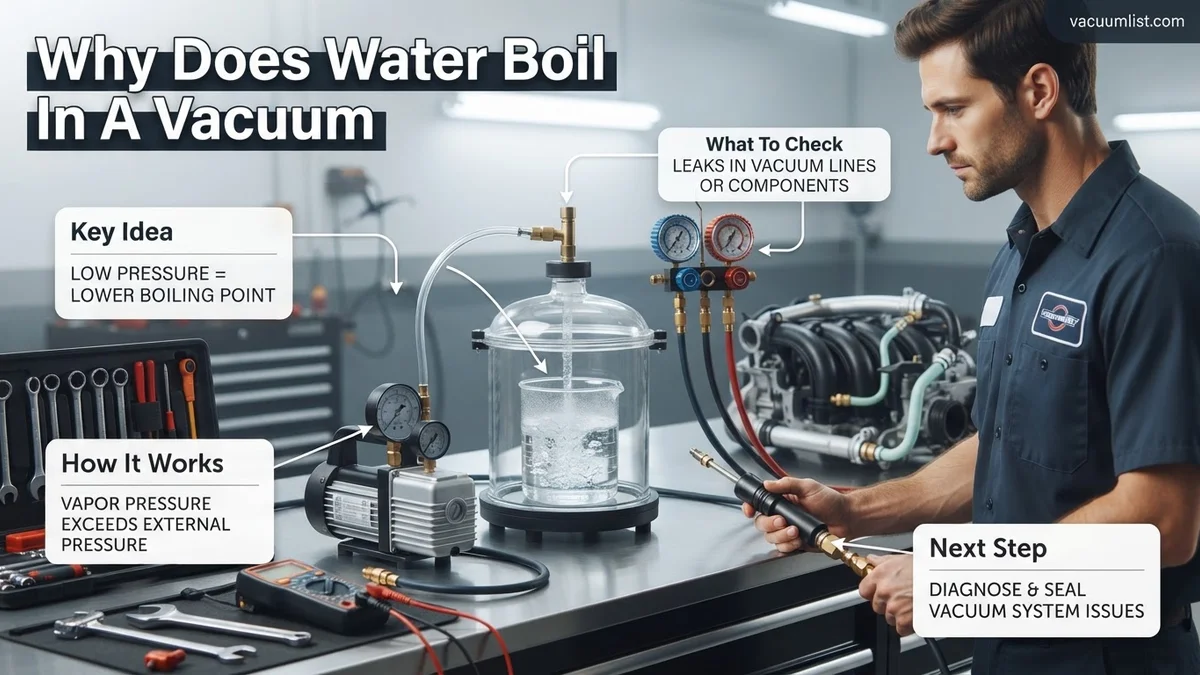
Water boils in a vacuum because atmospheric pressure is removed, allowing water molecules to escape into gas at much lower thermal energy levels. Without downward air pressure holding them back, molecules transition from liquid to vapor at room temperature.
Water boils in a vacuum because removing the surrounding air pressure eliminates the physical barrier holding liquid molecules together. At standard atmospheric pressure on Earth in 2026, you need to heat water to 212 degrees Fahrenheit (100 degrees Celsius) to give its molecules enough kinetic energy to break free into the air as steam.
When you drop that same pressure to near zero inside a vacuum chamber, water molecules no longer require thermal energy to escape. They immediately vaporize into gas at room temperature, creating a fascinating and counterintuitive phenomenon where cold water can violently bubble and boil right before your eyes.
Key Takeaways
- Atmospheric pressure acts as a heavy blanket keeping water molecules trapped in liquid form.
- A vacuum eliminates external pressure, lowering the required boiling point significantly.
- Vapor pressure must equal or exceed external pressure for boiling to occur.
- Boiling in a vacuum does not mean the water becomes hot; it remains at room temperature.
- Demonstrations like the syringe test prove this physics principle safely.
What Causes Water to Boil at Room Temperature in a Vacuum
You might picture boiling as a process driven entirely by intense heat. In reality, boiling is a mechanical battle between two competing forces: the internal push of water trying to turn into a gas and the external weight of the atmosphere pushing back down.
The Missing Weight of the Atmosphere
Standard air pressure pushes down on every square inch of liquid water with a force of about 14.7 pounds per square inch. This weight acts like an invisible heavy lid, forcing water molecules to stay tightly packed in their liquid state even as they vibrate faster from heat.
- Atmospheric pressure prevents ambient liquid water from escaping spontaneously.
- A vacuum chamber instantly removes this downward crushing weight.
- Without air pressing down, the invisible lid vanishes entirely.
- Water molecules can suddenly fly apart from one another with zero resistance.
Thermal Energy Versus Kinetic Escape
When you take away the atmospheric lid, the rules of thermal energy completely change for your liquid. Room-temperature water already contains plenty of internal kinetic energy, but normally that energy is not quite enough to overcome 14.7 psi of air pressure.
- Molecules at 70 degrees Fahrenheit are constantly moving and colliding.
- In normal conditions, they bounce off the surface air and fall back into the liquid.
- In a vacuum, those exact same bouncing movements let molecules fly straight out.
- The water boils without feeling hot to the touch because kinetic energy alone is enough.
Step-by-Step Guide to Understanding Vapor and External Pressure
To truly grasp this vacuum phenomenon, you need to look at how vapor pressure and external pressure interact on a microscopic scale. Boiling happens precisely when these two distinct measurements cross paths.
Defining Vapor Pressure
Every liquid has a hidden internal property called vapor pressure, which represents how desperately its molecules want to break free and turn into a gas. This internal pressure rises steadily as you heat the liquid up.
- Water molecules constantly try to evaporate from any liquid surface.
- As they bounce around, they create their own outward pressure bubble within the fluid.
- At 100 degrees Celsius, this internal vapor pressure finally matches normal sea-level air pressure.
- True boiling is simply the moment internal vapor pressure overpowers external air pressure.
The Balance of Competing Pressures
The mechanics of boiling come down to a simple numerical balance between what the water wants to do internally and what the environment forces it to do externally. You can shift this balance by changing either the temperature or the surrounding air pressure.
- External air pressure pushes inward, keeping liquid molecules trapped together.
- Internal vapor pressure pushes outward, trying to form gas pockets inside the liquid.
- If you heat the water, you raise its internal vapor pressure until it wins.
- If you pump out the air, you drop the external pressure until the room-temperature vapor pressure wins automatically.
How to Safely Test Low-Pressure Boiling with a Vacuum Chamber
Conducting a physical demonstration of low-pressure thermodynamics requires precise equipment to prevent structural failure or implosion. According to safety guidelines established by the National Science Teaching Association (NSTA) for 2026, operators must use rated acrylic or polycarbonate chambers capable of withstanding absolute zero atmospheres.
Step-by-Step Testing Procedure
- Inspect the Chamber: Examine the acrylic bell jar and rubber gasket for hairline cracks or debris that could compromise the airtight seal.
- Prepare the Water Sample: Fill a small borosilicate glass beaker halfway with room-temperature water around 20 degrees Celsius. Avoid using hot water to prevent premature thermal shock.
- Position the Beaker: Place the beaker securely on the center plate of the vacuum pump platform, ensuring the rim sits completely level.
- Initiate Evacuation: Turn on the motorized vacuum pump and monitor the analog or digital gauge as internal pressure drops below 2.33 kilopascals.
- Observe Phase Change: Watch closely as the water begins vigorous bubbling at ambient temperature without the application of external heat.
What If the Water Freezes Instead of Boiling During the Test
A common counterintuitive phenomenon occurs when low-pressure systems cause rapid evaporative cooling rather than sustained boiling. As pressure drops below the triple point of water at 0.01 degrees Celsius and 0.61 kilopascals, surface molecules absorb latent heat so quickly that the remaining liquid transitions directly into ice. Physics educators note that this occurs when the vacuum pump draws down too aggressively before equilibrium is reached.
Troubleshooting the Freeze Effect
- Regulate Evacuation Speed: Adjust the manual bleed valve slightly to slow down the rate of pressure drop, allowing ambient heat transfer to balance out evaporative cooling.
- Adjust Initial Water Temperature: Start the experiment with water pre-heated to approximately 35 degrees Celsius so the remaining thermal energy sustains the boiling action longer.
- Upgrade Equipment Specifications: If commercial consumer-grade pumps fail to maintain stable threshold pressures, upgrade to a dual-stage rotary vane pump rated for deep laboratory vacuums costing between $250 and $600 USD.
- Consult Professional Technicians: For industrial setups or persistent equipment calibration failures, seek assistance from certified vacuum instrumentation specialists. Professional diagnostic services typically range from $150 to $400 USD depending on the hardware complexity.
Conclusion
Water boils in a vacuum because lowering the ambient pressure reduces the energy required for vapor pressure to equal surrounding forces, forcing a phase change at room temperature. Managing this reaction safely requires strict adherence to equipment ratings and pressure thresholds. According to verified research and thermodynamic studies published by the National Institute of Standards and Technology (NIST), mastering this principle unlocks vital industrial applications ranging from freeze-drying pharmaceuticals to low-temperature chemical distillation. As an actionable next step, review standard laboratory safety protocols before operating any high-vacuum apparatus in 2026.
❓ Frequently Asked Questions
Why does atmospheric pressure prevent water from boiling easily?
Air molecules exert a constant downward force on the surface of the liquid. This external pressure forces water molecules to stay tightly packed together, requiring higher thermal energy (heat) to push past this barrier and turn into steam.
How does lowering the ambient pressure change the boiling point?
The boiling point of a liquid is defined as the temperature where its internal vapor pressure equals the external surrounding pressure. When you reduce the external pressure via a vacuum, that threshold drops, allowing lower temperatures to trigger boiling.
Why does water freeze after boiling in a vacuum?
When water rapidly boils under low pressure, it undergoes intense evaporative cooling. The molecules with the highest energy escape first, drastically dropping the remaining liquid’s temperature until it hits the freezing point.
Can you demonstrate this phenomenon safely at home?
Yes, placing a cup of warm water inside a sealed vacuum desiccator or using a large plastic syringe allows you to pull the air out and watch the water bubble vigorously without heating it.
Does this apply to liquids other than water?
Yes, every liquid has its own unique vapor pressure curve. Any liquid will boil at a lower temperature if the surrounding atmospheric pressure is sufficiently reduced.
What is the triple point of water?
The triple point is the specific temperature and pressure combination (0.01°C and 0.006 atm) where water’s solid, liquid, and gaseous phases can all coexist in thermodynamic equilibrium.