Do Vacuum Sealed Bags Reduce Weight The Real Truth for 2026
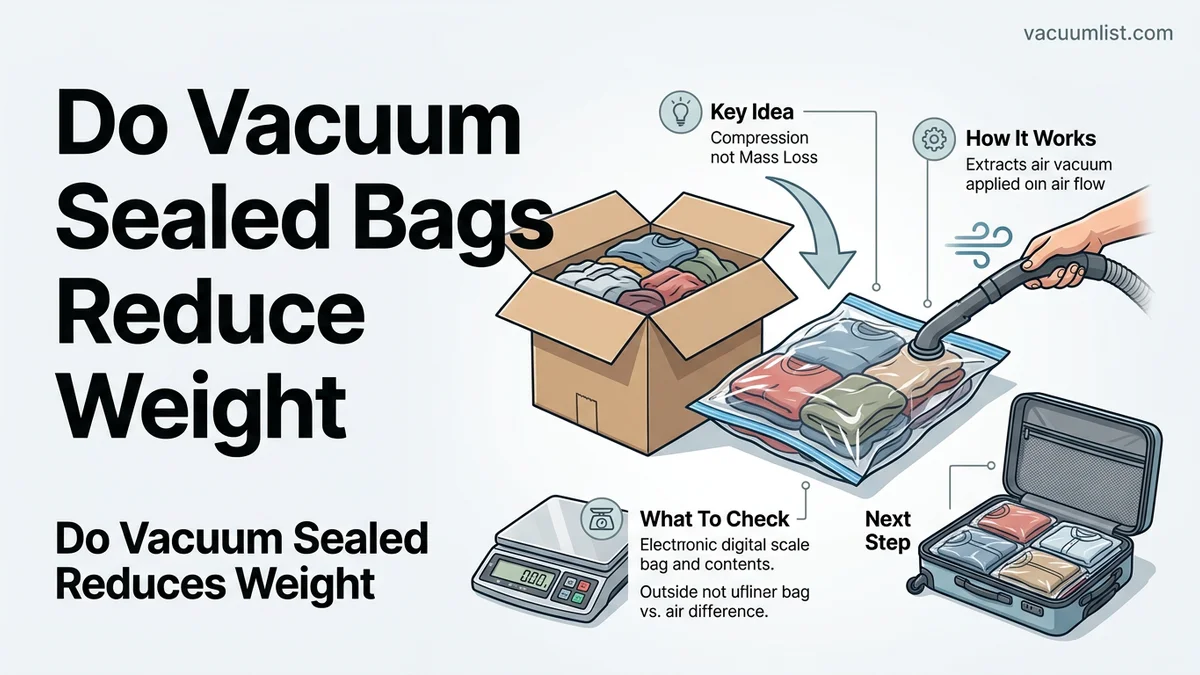
No, vacuum sealed bags do not reduce the physical weight of your items; they only reduce their volume. Removing the air compresses the contents, but the mass of the clothes or bedding remains exactly the same on a scale.
Vacuum-sealed bags do not reduce the actual physical weight or mass of the items you put inside them. When you pack bulky winter sweaters, down jackets, or dense bedding into a compression bag and suck the air out, you are drastically shrinking the volume and size, but you are not changing the mass.
As you prepare your luggage or storage bins for 2026, understanding this distinction prevents costly airline baggage fees and frustrating packing mistakes. While shrinking your items lets you fit a massive wardrobe into a tiny carry-on suitcase, gravity and airline scales still measure the exact gravitational pull on the matter inside your bag, meaning heavy items remain heavy regardless of how much air you remove.
Key Takeaways
- Vacuum sealed bags shrink volume and bulk, but mass remains entirely unchanged.
- Air has negligible weight, so removing it from a bag does not alter scale readings.
- Space-saving bags will not help you bypass strict airline baggage weight limits.
- Compression only affects fluffy items like sweaters, jackets, and winter bed linens.
- Packing heavy items means you still face excess baggage fees regardless of bag size.
What Causes the Confusion Around Do Vacuum Sealed Bags Reduce Weight
The Illusion of Weightlessness Through Compression
Human psychology and sensory perception play a massive role in why people believe vacuum sealing removes weight. When you lift a fluffy comforter that has been reduced to a dense, flat brick, it feels fundamentally different in your hands. Your brain associates compactness with lightness because heavy objects are typically small and dense, while light objects are often large and fluffy.
Furthermore, marketing campaigns for space-saving bags often emphasize terms like featherlight packing or weightless travel. These phrases describe the feeling of maneuvering a streamlined suitcase rather than an actual drop in mass on a scale. When you squeeze all the trapped oxygen and ambient air out of textile fibers, the package transforms from a bulky cloud into a compact slab. That dramatic change in shape tricks your muscles into anticipating a lighter load.
The Negligible Role of Air Mass in Textiles
Many travelers wonder if the actual air trapped inside a pile of clothes contributes measurable weight. The truth is that air does have mass, but the volume of air trapped within fabric is minuscule. A standard cubic foot of dry air weighs roughly 0.08 pounds at sea level. Even if your oversized winter jacket holds a few cubic feet of ambient air, extracting that air removes a fraction of an ounce.
- Air density is approximately 1.225 kg per cubic meter at standard temperature and pressure.
- The total air content inside a fully puffed-down jacket weighs less than a single metal zipper.
- Removing this air changes the total mass by an amount too small to register on standard household scales.
Because the mass of the air itself is practically zero compared to cotton, wool, or synthetic fleece, vacuum sealing achieves a volume reduction of up to eighty percent while leaving the total mass virtually identical.
How to Test and Measure Mass Versus Volume Accurately
Using Digital Scales for Pre- and Post-Seal Verification
You do not have to take anyone’s word for it; you can easily prove this physics principle at home using a digital luggage scale or a kitchen scale. By testing your items before and after compression, you will see the undeniable reality of mass preservation.
- Place a stack of heavy cotton towels or hoodies onto a digital scale and record the exact weight in pounds or grams.
- Transfer those same textiles into a plastic vacuum-seal bag and attach your hand pump or vacuum hose to extract all the air until the package is completely compressed.
- Place the flat, dense brick of textiles back onto the exact same scale and check the reading.
You will notice that the digital readout remains identical, save for a microscopic variance caused by the weight of the plastic bag itself. This simple test confirms that shrinking an object’s footprint does not alter its gravitational pull.
Understanding Dimensional Space Versus Gravitational Mass
Airlines and shipping companies care about two distinct metrics: dimensional space and gravitational mass. Vacuum sealing completely solves the first problem by shrinking your gear down so it fits into tighter physical dimensions. However, it completely ignores the second problem.
When baggage handlers or shipping couriers calculate surcharges, they evaluate both dimensions and weight. If you pack thirty pounds of dense denim jeans into a vacuum bag, the bag will easily fit into a small backpack. But the moment you step up to an airport check-in kiosk in 2026, the scale will still register thirty pounds, and you will face heavy bag fees.
- Volume reduction: Achieved successfully by removing interstitial air between fabric weaves.
- Mass reduction: Impossible via vacuum sealing because no physical matter is discarded from the garments.
Keep this limitation in mind when packing heavy materials. Vacuum bags are phenomenal tools for fighting bulky items, but they will never save you from exceeding strict weight limits on your travels.
Step-by-Step Guide to Packing Smart Within Airline Weight Limits
Mastering airline baggage restrictions in 2026 requires combining vacuum compression with strategic item selection. While compression reduces volume, physics dictates that heavy fabrics retain their mass. Follow this proven protocol to maximize your luggage efficiency before arriving at the departure gate.
1. Sort and Weigh Before You Pack
Gather all travel items and weigh them on a digital luggage scale before introducing any compression bags. Eliminate heavy, redundant garments that exceed strict airline thresholds, focusing instead on versatile, lightweight fabrics like merino wool or synthetic blends.
2. Distribute Dense Items Correctly
Place heavy items such as shoes, denim, and toiletries near the base and wheels of your suitcase to maintain balance. Reserve vacuum-sealed bags for compressible, voluminous items like winter coats, sweaters, and down jackets.
3. Execute the Compression Process
Load the vacuum bags carefully, ensuring zippers are fully sealed using the provided plastic slider. Extract air using either an electric travel pump or by rolling the bag manually from the top down to push air through the one-way valve.
4. Perform a Final Scale Check
Lift the fully packed suitcase with a portable hanging scale to verify total mass against current 2026 airline limits. Adjust contents immediately if the bag remains above the permitted threshold to avoid overweight baggage fees.
What If Your Luggage Is Still Too Heavy at the Airport Counter?
Encountering an overweight baggage warning at the airport check-in counter is stressful, but several rapid fallback strategies can prevent expensive fees. If your vacuum-sealed bag successfully reduced volume but the total mass still exceeds airline limits, execute these corrective steps immediately:
- Wear Your Heaviest Layers: Put on bulky jackets, heavy boots, or sweaters currently inside your luggage. Most international carriers do not count worn apparel toward your carry-on or checked baggage weight limits.
- Utilize Personal Items: Transfer dense, heavy items like electronics, chargers, and books from your primary suitcase into a purse, backpack, or laptop bag.
- Repack Into Smaller Bags: Distribute excess weight into a secondary reusable shopping bag or collapsible duffel if the airline permits an additional personal carry-on item.
- Pay Checked Bag Fees: If all physical reallocation fails, pay the airline’s standard overweight fee, which typically ranges from $50 to $200 depending on the route and carrier.
Conclusion
Vacuum-sealed bags are exceptional tools for shrinking bulky items and maximizing storage space, but they cannot alter the fundamental laws of physics regarding mass. To avoid surprise airline fees in 2026, travelers must pair volume compression with careful pre-trip weighing. According to verified research and luggage industry experts, combining targeted packing lists with digital scale checks remains the most reliable strategy for hassle-free travel. Your next actionable step is to weigh your empty suitcase and designated travel wardrobe today to establish a safe baseline before your departure date.
❓ Frequently Asked Questions
Do vacuum sealed bags reduce weight when packing for a flight?
Vacuum bags do not reduce weight at all. While they compress soft items to free up valuable space in your suitcase, the total mass stays the same, meaning airlines will still measure the same heavy weight on their scales.
Why does air removal not affect the total weight on a scale?
Air does have mass, but the volume of air inside a garment or pillow is extremely light. Removing that air changes the density and size of the package, but the actual weight difference is a fraction of an ounce and virtually undetectable.
Can I use space bags to beat airline weight restrictions?
No, airlines enforce strict weight limits rather than size limits alone. Because vacuum bags let you pack more items into a single suitcase, you are actually more likely to exceed the weight limit if you fill every available inch.
What is the primary purpose of using vacuum sealed bags?
The main goal is maximizing storage space in closets or suitcases by removing excess air trapped between fabrics. This allows you to store bulky winter gear or travel essentials in a fraction of the original space.
Do heavy fabrics like denim weigh less after being vacuum sealed?
Denim and other dense materials do not compress significantly, nor does their weight change. Vacuum sealing works best on trapped air pockets inside fluffy materials, leaving the actual material mass untouched.
How can I accurately check my luggage weight before heading to the airport?
Instead of relying on how light or heavy a vacuum-packed bag feels, always use a portable luggage scale or weigh yourself on a home scale while holding the bag to get an exact measurement.