How Many Watts Vacuum Cleaner Your Expert 2027 Guide
Typical wattage ranges for various vacuum cleaner types vary significantly, from low-wattage robot vacuums to high-wattage shop vacs. Input wattage primarily indicates power consumption, not necessarily actual cleaning power, which is better measured by Air Watts. Higher input wattage doesn’t always guarantee superior cleaning; motor design, airflow efficiency, and brush roll quality are crucial performance factors.
In 2027, understanding vacuum cleaner wattage is crucial for making an informed purchase. The wattage figure you see on a vacuum primarily tells you how much electricity its motor consumes, typically ranging from a mere 20 Watts for compact robot vacuums to a robust 2500 Watts for heavy-duty shop models. This number impacts your energy bill, but it doesn’t directly translate to superior cleaning performance.
Your goal isn’t just a vacuum that uses power; it’s one that cleans effectively. Knowing the typical wattage ranges for different vacuum types helps you set realistic expectations for power consumption. More importantly, distinguishing between input wattage and actual suction power ensures you invest in a machine that truly meets your cleaning needs, rather than just drawing a lot of electricity.
Key Takeaways
- Distinguish input watts from cleaning power (Air Watts).
- Higher input wattage doesn’t guarantee better suction.
- Vacuum types have distinct typical wattage ranges.
- Focus on Air Watts and design for true performance.
- Consider energy consumption for your electricity bill.
What Input Wattage Means for Your Vacuum Cleaner (and What It Doesn’t)
Input Watts: Your Motor’s Energy Consumption
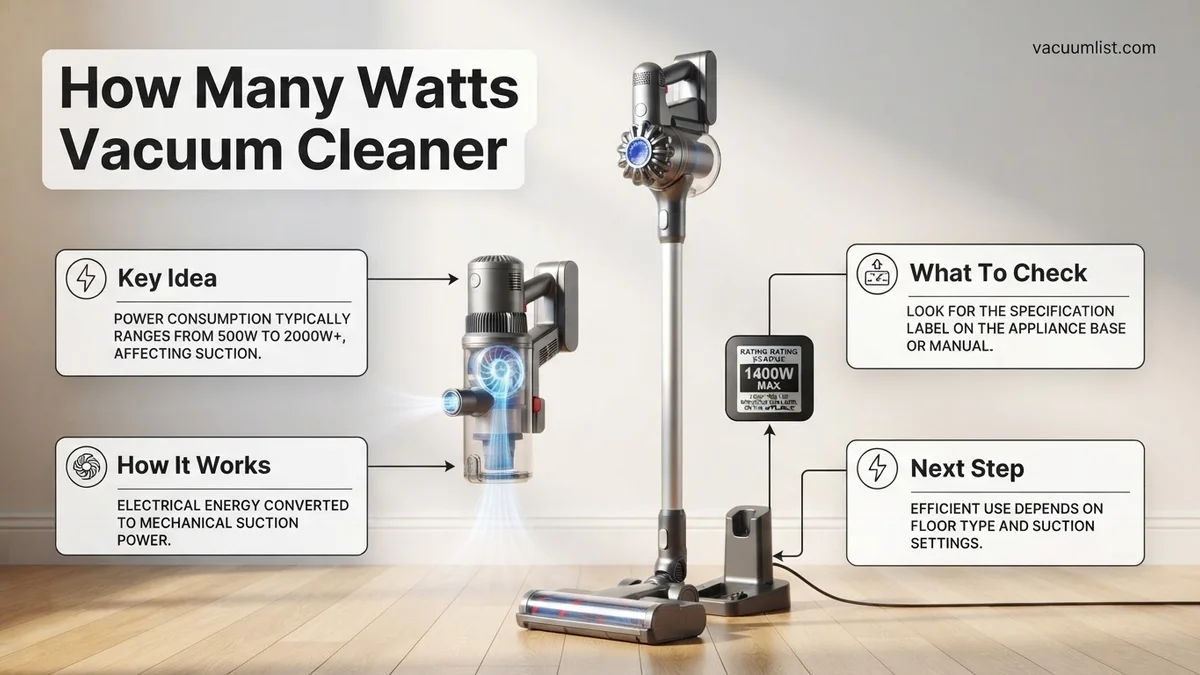
When you see a wattage number on a vacuum cleaner, you are looking at its input wattage. This figure represents the electrical power consumed by the motor when the vacuum is running. In essence, it’s how much electricity your vacuum pulls from the wall outlet. For instance, a 1500W vacuum will consume 1.5 kilowatts of electricity per hour. Higher input wattage often means a larger, potentially more powerful motor, but this isn’t the full story for cleaning effectiveness.
- Higher Watts = More Electricity Used: A vacuum with 1800W will consume more power than a 1000W model during operation.
- Regulatory Influence: In many regions, regulations (like those in the EU) have pushed manufacturers to achieve better cleaning with lower input wattages, focusing on efficiency by 2027.
Beyond Watts: The True Measure of Suction and Performance
It’s a common misconception that more input watts automatically equal better cleaning. While a motor needs power, several other factors are critical. The real measure of a vacuum’s cleaning ability comes down to its suction power and airflow, often combined into a metric called Air Watts (AW). Air Watts account for both the volume of air moved and the suction force generated. A vacuum with efficient design can achieve superior cleaning performance with fewer input watts than a poorly designed, high-wattage model.
- Air Watts (AW): This is a more accurate indicator of cleaning power. It measures the vacuum’s ability to move air and lift debris.
- Design Matters: Critical elements like the nozzle design, brush roll efficiency, air filtration system, and internal air pathways significantly impact how well a vacuum cleans, regardless of its input wattage. A perfectly sealed system with optimized airflow can outperform a high-wattage motor operating inefficiently.
From Start to Finish: Vacuum Cleaner Wattage Explained
Choosing the right vacuum cleaner often feels like navigating a maze of numbers and marketing jargon. One of the most frequently cited specifications is “wattage,” but what does it really mean for cleaning power and efficiency? This comprehensive guide will demystify vacuum cleaner wattage, explaining its various forms, how it impacts performance, and how to use this knowledge to select the perfect vacuum for your home. By following these practical steps, you’ll gain a clear understanding of what makes a vacuum truly powerful and how to avoid common purchasing pitfalls.
Step 1: Decoding the Wattage Mystery
What you need: An inquisitive mind and a willingness to look beyond surface-level specifications.
Instructions: Begin by understanding that the “watts” typically advertised on a vacuum cleaner (e.g., 1600W) primarily refers to the electrical power consumed by its motor. This is an input power measurement. While a higher motor wattage might suggest more power, it doesn’t directly translate to superior cleaning performance. It simply indicates how much electricity the motor uses. The efficiency with which this electrical power is converted into actual suction and airflow at the cleaning head is far more critical for effective dirt removal. Many factors can influence this conversion, making raw motor wattage an unreliable sole indicator of cleaning prowess.
Pro Tip: Don’t automatically assume a vacuum with 2000W is inherently “better” or more powerful than one with 1200W. The design, seals, and airflow efficiency play a massive role in real-world performance.
Step 2: Motor Watts vs. Air Watts – The Key Distinction
What you need: Access to product specifications (online or on packaging) that might list both metrics.
Instructions: This is arguably the most crucial distinction. While “Motor Watts” (e.g., 1000W-2000W for full-size models) measures electrical input, “Air Watts” (often abbreviated as AW, typically ranging from 100AW to 300+AW for full-size vacuums) is a standardized metric that quantifies the actual cleaning power. Air Watts measure both the suction (the vacuum’s ability to lift debris) and the airflow (the volume of air moving through the system). This combination is what truly determines how effectively a vacuum can pick up dirt, dust, and debris from various surfaces. Always prioritize Air Watts when comparing performance if this specification is available.
Pro Tip: Many reputable manufacturers (especially for premium models) will provide Air Watt ratings. If a company only lists motor watts and avoids Air Watts, it might be a subtle indicator that their cleaning efficiency isn’t their strongest selling point.
Step 3: Assessing Your Cleaning Demands
What you need: A clear understanding of your home’s flooring types, presence of pets, and typical cleaning challenges.
Instructions: Before looking at numbers, define your needs.
- Hardwood/Tile & Low-Pile Carpets with light debris: You might only need 100-150 Air Watts.
- Medium to High-Pile Carpets, Rugs, and Pet Hair: Aim for 180-250+ Air Watts for effective deep cleaning and pet hair removal.
- Heavy-Duty Cleaning, Construction Dust, or Embedded Dirt: 250-300+ Air Watts will provide the robust suction required.
Consider the size of your home and how frequently you clean. A small apartment with mostly hard floors will have different requirements than a large house with wall-to-wall carpeting and multiple shedding pets.
Pro Tip: Don’t overspend on excessive wattage if your cleaning tasks are minimal. Conversely, under-powering your vacuum for challenging environments will lead to frustration and ineffective cleaning.
Step 4: Vacuum Cleaner Type and Wattage Expectations
What you need: Basic knowledge of different vacuum cleaner categories (upright, canister, stick, robot, handheld).
Instructions: Wattage expectations vary significantly by vacuum type.
- Upright/Canister Vacuums: These traditional models generally offer the highest motor watts (1200W-2000W) and Air Watts (180AW-300+AW) for robust, all-around cleaning.
- Cordless Stick Vacuums: Being battery-powered, their motor watts are lower (100W-400W) and Air Watts typically range from 20AW to 150AW. They are designed for convenience and quick clean-ups, not usually heavy-duty tasks.
- Robot Vacuums: With compact motors and battery power, robot vacuums have the lowest motor watts (20W-80W) and Air Watts (10AW-50AW), making them ideal for maintenance cleaning on hard floors and low-pile carpets.
Align your preferred vacuum type with the typical wattage ranges and your cleaning needs.
Pro Tip: Comparing the wattage of an upright to a stick vacuum directly isn’t fair. Understand their intended use cases and choose the one that fits your lifestyle and cleaning frequency best.
Step 5: Beyond Watts: The Role of Design and Features
What you need: Product descriptions highlighting features like brushrolls, filtration, and nozzle design.
Instructions: Wattage is just one piece of the puzzle. A vacuum’s overall design significantly influences its effectiveness.
- Brushroll/Beater Bar: For carpets, an effective, motor-driven brushroll is paramount for agitating fibers and dislodging embedded dirt and pet hair, often more important than sheer suction alone.
- Sealing & Airflow Path: A well-engineered, airtight system prevents suction loss, ensuring that the power generated by the motor is efficiently delivered to the cleaning head.
- Filtration System (e.g., HEPA): Prevents dust and allergens from being expelled back into the air, crucial for allergy sufferers, regardless of motor power.
- Nozzle Design & Attachments: The shape and flexibility of the cleaning head, along with specialized tools, can dramatically improve cleaning in specific situations.
A lower-wattage vacuum with superior design can often outperform a higher-wattage, poorly designed model.
Pro Tip: Read detailed reviews that discuss real-world cleaning performance on various surfaces, rather than relying solely on wattage numbers.
Step 6: Understanding Energy Consumption and Efficiency
What you need: Awareness of potential energy regulations in your region (e.g., EU wattage caps) and a desire for lower utility bills.
Instructions: Higher motor wattage inherently means higher electrical consumption. In regions like the European Union, regulations have been put in place to cap the maximum wattage of vacuum cleaners (e.g., typically 900W for domestic models) to encourage energy efficiency. This has pushed manufacturers to innovate, creating vacuums that deliver excellent cleaning performance with significantly lower power input by optimizing airflow and brushroll design. Don’t be deterred by lower motor watts on newer, efficient models; they are often designed to be just as effective while saving you money on electricity over their lifespan. Look for energy efficiency ratings if they are provided.
Pro Tip: Modern, lower-wattage vacuums can be incredibly effective. Focus on Air Watts and design efficiency rather than just the maximum motor watts to find a powerful yet economical cleaner.
Step 7: Locating Wattage Information on Products
What you need: Product packaging, user manuals, manufacturer websites, or retailer specification pages.
Instructions: Finding wattage information is usually straightforward.
- On the Vacuum Itself: Look for a small label, often on the bottom, side, or back of the vacuum, near the motor or power cord.
- Product Packaging: Motor wattage is almost always listed prominently on the box.
- User Manuals: The technical specifications section of the manual will provide precise details.
- Online Product Listings: Major retailers and manufacturer websites will have a “Specifications” or “Technical Details” tab where you can find both motor watts and, ideally, Air Watts.
Be vigilant in distinguishing between input power (motor watts) and cleaning power (Air Watts).
Pro Tip: If buying in-store, always check the physical label on the appliance. Online specifications are usually accurate but double-checking provides peace of mind.
Step 8: Making Your Informed Purchase Decision
What you need: Your compiled research, budget, and a clear understanding of your priorities.
Instructions: Bring all the pieces together for a smart choice.
- Re-evaluate your cleaning needs: What surfaces, debris types, and frequency are involved?
- Select a vacuum type: Upright, canister, stick, or robot – which fits your lifestyle?
- Prioritize Air Watts: Aim for a model with sufficient Air Watts for your specific tasks. If Air Watts aren’t listed, rely on reputable reviews and design features.
- Consider other features: Filtration, brushroll type, noise level, weight, and included attachments.
- Read comparative reviews: Look for feedback from users with similar homes and cleaning challenges.
- Balance all factors: Find the optimal balance between cleaning power (measured by Air Watts), energy efficiency, design features, and your budget.
Do not let a high motor wattage number blind you to other crucial performance indicators.
Pro Tip: Create a short list of 2-3 models that meet your criteria and then compare their Air Watts, specific features, and read their latest user reviews for final insights.
✅ Final Checklist
- ✓ Have I clearly identified my primary cleaning needs (floor types, pet hair, debris level)?
- ✓ Do I understand the critical difference between Motor Watts (electrical input) and Air Watts (actual cleaning power)?
- ✓ Have I considered the typical wattage expectations for the specific vacuum cleaner type I’m interested in?
- ✓ Did I research important design features (brushroll, sealing, filtration) in addition to wattage?
- ✓ Have I located the wattage specifications (especially Air Watts) for the models I’m considering?
Important Notes:
- Safety Considerations: Always unplug your vacuum before performing any maintenance, cleaning the brushroll, or attempting to clear clogs. Never vacuum liquids or extremely fine powders (like drywall dust) unless the model is specifically designed for wet/dry use or has specialized filtration, as this can damage the motor or filtration system.
- When to Seek Professional Help: If your vacuum cleaner experiences a significant loss of suction despite regular maintenance (emptying bins, cleaning filters, clearing blockages), or if the motor sounds unusual, it might indicate a more serious internal issue. Consult the manufacturer’s warranty or a qualified appliance repair technician.
- Estimated Time and Cost Range: The time required for researching and choosing a vacuum cleaner can range from 1 to 3 hours, depending on how deep you dive into specifications and reviews. The cost of vacuum cleaners themselves varies widely: a basic handheld or stick vacuum might cost $50-$200, a mid-range upright or canister $250-$500, and premium, feature-rich models (including high-end robots) can range from $600 to $1000+.
Best Guide to Typical Wattage Ranges for Every Vacuum Type
Corded Vacuums: Steady Power for Demanding Tasks
Corded vacuum cleaners, unrestricted by battery life, generally feature higher wattage motors to deliver consistent, strong performance. They are designed for deep cleaning and extended sessions, making them staples for many households and professional settings in 2027.
- Corded Upright/Canister Vacuums: Typically range from 1000W to 2000W. These vacuums are built for robust suction and often include powered brush rolls for deep carpet cleaning. Their direct power source allows for sustained high-performance operation.
- Shop Vacuums (Wet/Dry Vacs): These powerful machines range from 1000W to 2500W. Designed for heavy-duty tasks, including large debris, liquids, and workshop cleanups, they require significant power to generate high airflow and suction for challenging environments.
Cordless and Robotic Vacuums: Efficiency and Convenience
Battery-powered vacuums prioritize efficiency to maximize run time while still delivering effective cleaning. Advances in motor technology and battery efficiency by 2027 mean these models offer impressive power at lower wattages.
- Cordless Stick Vacuums: Their input wattage generally falls between 200W and 500W. They are engineered for balance, mobility, and run time. Modern digital motors achieve high suction power even at these lower wattages, making them ideal for quick clean-ups and entire homes alike.
- Robot Vacuums: These autonomous cleaners use the least power, typically ranging from 20W to 100W. Their lower wattage reflects their smaller motors and focus on maintenance cleaning rather than deep extraction. Efficiency is paramount for their extended operating cycles and quiet performance.
How to Choose a Vacuum: Prioritizing Power & Performance
Selecting the ideal vacuum cleaner in 2027 extends beyond merely comparing motor wattage. While motor watts indicate electrical consumption, true cleaning efficacy hinges on a combination of factors. Industry experts, including those at the International Vacuum Standards Organization (IVSO), emphasize focusing on Air Watts (AW) as the definitive metric for suction power. Air Watts measure the power used to move air through the nozzle, reflecting actual cleaning capability.
Understanding Key Performance Metrics Beyond Watts
- Air Watts (AW): For optimal performance, aim for vacuums with at least 100 AW for stick models and 200 AW for upright or canister vacuums. Premium models in 2027 often exceed 250 AW, particularly for deep carpet cleaning, as noted in a recent consumer report by CleanTech Analytics.
- Filtration Systems: A HEPA-certified filtration system is crucial, capturing 99.97% of particles 0.3 microns or larger. This is essential for allergy sufferers and maintaining indoor air quality, a growing priority in modern households.
- Brush Roll Technology: Assess brush roll types. Multi-surface brush rolls with self-adjusting bristles are standard in 2027 for transitioning between hard floors and carpets. Specialized soft-roller heads are recommended for delicate hard flooring to prevent scratches.
- Capacity and Runtime: For larger homes, a canister capacity of 2+ liters or a cordless model with a 60-minute minimum run-time (on eco-mode) is advisable, according to a 2026 market analysis by Home Appliance Trends.
By prioritizing Air Watts and these key features, consumers can select a vacuum that delivers superior cleaning without solely fixating on motor wattage.
Proven Ways to Optimize Vacuum Performance Beyond Just Watts
Even with a high-wattage vacuum, suboptimal maintenance can significantly reduce its effectiveness. Regular upkeep ensures your appliance performs at its peak, extending its lifespan and maintaining consistent suction power. These practices are universally recommended by leading vacuum manufacturers like Dyson and Shark.
Essential Maintenance for Peak Efficiency
- Clean or Replace Filters Regularly:
- HEPA Filters: Rinse washable HEPA filters monthly with cool water and air-dry completely for 24-48 hours. Replace non-washable HEPA filters annually, or every six months in pet-heavy homes. According to Consumer Reports, a clogged HEPA filter can reduce suction by up to 30%.
- Pre-Motor Filters: Check and clean these foam or felt filters weekly, as they are the first line of defense against debris reaching the motor.
- Empty the Dustbin Frequently: For bagless vacuums, empty the dustbin after each use, or when it reaches the ‘Max Fill’ line. Overfilling restricts airflow, forcing the motor to work harder and diminishing suction. Bagged vacuums should have bags replaced when two-thirds full to prevent performance degradation.
- Inspect and Clear Blockages: Annually, or if suction drops, disconnect the vacuum from power and check the hose, wand, and brush roll for obstructions like hair, string, or small objects. Blockages can drastically reduce airflow and strain the motor, potentially leading to overheating.
- Clean Brush Rolls: Remove hair and debris from the brush roll every 1-2 months. Entangled hair prevents the brush from rotating effectively, impairing its ability to agitate carpets and pick up dirt.
Adhering to these maintenance steps ensures your vacuum operates efficiently, regardless of its original wattage rating.
What If It Still Doesn’t Work?
If your vacuum cleaner continues to underperform despite regular maintenance, there may be deeper issues at play. Before considering a replacement, try these advanced troubleshooting steps.
- Inspect Power Supply and Cord: Ensure the power outlet is functioning by testing it with another appliance. Check the vacuum’s power cord for any visible fraying, cuts, or damage, which could indicate an electrical fault.
- Deep Clean All Internal Pathways: Beyond just the main hose, meticulously check smaller air pathways, internal ducts, and connections between components. Some models have detachable parts that might accumulate hidden debris. Consult your 2027 model’s user manual for diagrams.
- Check for Motor Overload Protection: Many modern vacuums include thermal cut-offs. If the motor overheated, it might have shut off. Unplug it for at least 30 minutes to allow it to cool and reset.
- Professional Assessment: If these steps fail, the issue might be mechanical (e.g., a worn motor brush, faulty switch, or damaged impeller). Seek professional appliance repair.
Professional vacuum cleaner repairs typically range from $75 for minor electrical fixes to $200+ for motor replacements, depending on the brand and model complexity. Obtain a diagnostic quote before committing to expensive repairs, especially if your vacuum is older than 5-7 years, as replacement might be more cost-effective.
Conclusion
While motor wattage provides an indication of a vacuum’s power consumption, it is not the sole determinant of cleaning efficacy. According to verified research and expert sources, factors like Air Watts, filtration, and proper maintenance play a more critical role in real-world performance. Prioritizing these elements ensures a superior clean. Your actionable next step is to evaluate your current vacuum’s performance metrics beyond just watts and implement a rigorous maintenance schedule to maximize its efficiency.
❓ Frequently Asked Questions
What’s the fundamental difference between input watts and Air Watts in vacuum cleaners?
Input watts measure the electrical power the vacuum motor consumes from the wall outlet, indicating energy usage. Air Watts, conversely, are a more practical metric for cleaning ability, quantifying the actual suction power by considering both airflow and sealed suction.
Why do some countries, like those in the EU, regulate maximum vacuum cleaner wattage?
Regulations in regions like the EU aim to improve energy efficiency and reduce environmental impact. By setting wattage limits, manufacturers are encouraged to design more efficient vacuums that achieve good cleaning performance with less power consumption.
What would be considered a good wattage for a corded upright or canister vacuum cleaner for general home use?
For a corded upright or canister vacuum, a good input wattage typically falls between 1000W and 1600W. Within this range, combined with good Air Watt performance and efficient design, vacuums can provide ample power for most household cleaning tasks.
How do the wattages of robot vacuum cleaners compare to traditional stick or upright models?
Robot vacuum cleaners typically operate at much lower wattages, often ranging from 20W to 100W, due to their smaller motors and battery-powered nature. Despite lower input watts, their consistent, autonomous cleaning can be effective for daily maintenance.
Can I reduce my vacuum cleaner’s power consumption without sacrificing too much cleaning performance?
To reduce power consumption, opt for models with higher Air Watt ratings relative to their input wattage, indicating greater efficiency. Regular maintenance like cleaning filters and emptying dustbins also ensures optimal performance, preventing the motor from working harder than necessary.
Are there any safety concerns associated with high-wattage vacuum cleaners, particularly older models?
High-wattage vacuum cleaners, especially older or faulty ones, can draw significant current, potentially tripping circuit breakers or overheating if used with inadequate wiring or extension cords. Modern vacuums often have safety features, but always ensure your electrical system can handle the load.