
Why Can Sound Not Travel Through A Vacuum Why Sound 2027
Sound cannot travel through a vacuum because it is a mechanical wave that requires a medium (like air or water) to transmit its energy. In a vacuum, there are virtually no particles to vibrate, so the sound energy has nothing to move through. This fundamental principle explains why space is inherently silent.
You’ve likely heard the fundamental truth: space is silent. That isn’t just a cinematic trope; it’s a bedrock principle of physics, crucial for understanding our universe even in 2027. The simplest, most direct reason sound cannot travel through a vacuum is its very nature: sound is a mechanical wave. This means it absolutely requires a physical medium—like air, water, or solid ground—to transmit its energy. Without matter, there are no particles to vibrate and carry the sound.
This isn’t abstract theory; it dictates everything from how astronauts communicate in orbit to why explosion sound effects in space films are always scientifically inaccurate. Understanding this core concept helps you grasp a critical aspect of physics that shapes our interaction with the cosmos and even informs advanced engineering on Earth. Let’s break down why silence reigns supreme where matter is absent.
Key Takeaways
- Sound requires a medium (matter) to travel.
- Sound energy transmits via particle vibrations.
- A vacuum lacks particles for sound propagation.
- Mechanical waves differ from electromagnetic waves.
- Space is inherently silent due to its vacuum.
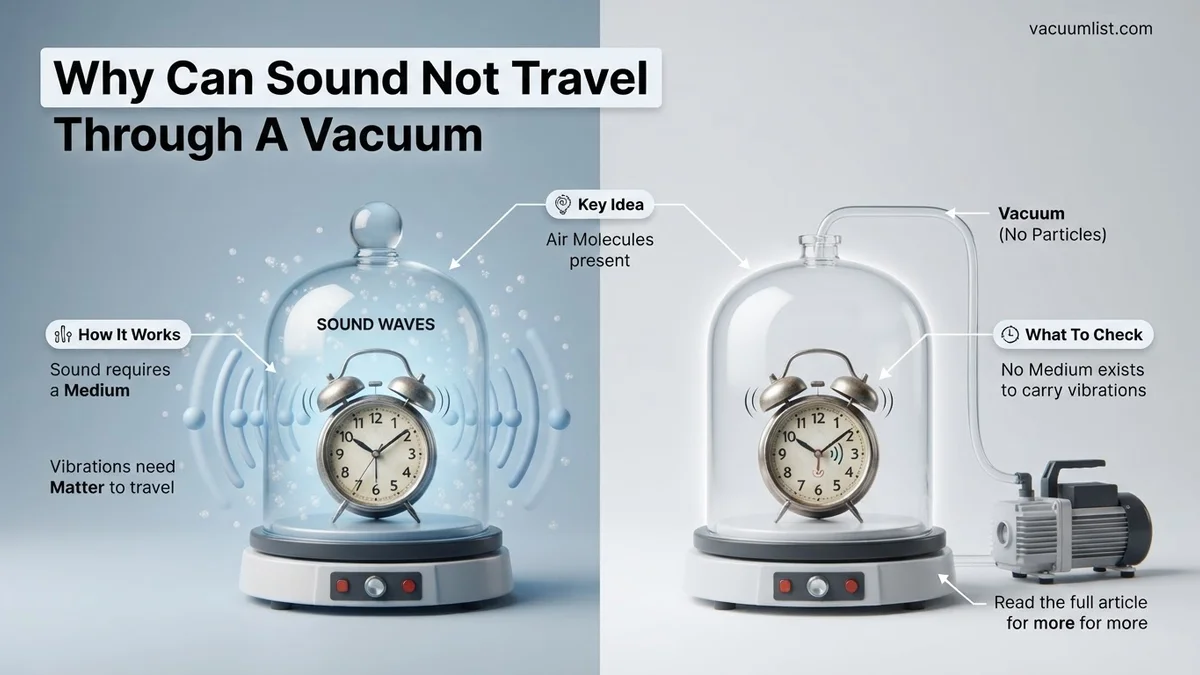
Diagnosing the Silent Void: The Core Reason Sound Needs a Medium
The Vacuum’s Fatal Flaw: No Particles, No Sound
To grasp why sound fails in a vacuum, you must first precisely define both terms. A vacuum is, quite simply, a space almost entirely devoid of matter. Think about the emptiness between stars or inside a precisely engineered vacuum chamber here on Earth in 2027. In such environments, individual atoms or molecules are incredibly sparse and widely separated. Sound, on the other hand, is the propagation of vibrations or oscillations. It’s a transfer of energy through matter. Your voice, for example, creates pressure waves in the air. These waves are actually air molecules bumping into each other in a continuous chain reaction, passing the energy along until it reaches your ear. If those particles aren’t present, or if they’re too far apart to interact efficiently, the energy transfer chain breaks immediately. No medium means no bumps, no chain, no sound.
- Sound’s Dependency: Sound energy relies on physical contact between particles.
- Vacuum’s Nature: Defined by the near-total absence of these particles.
- Result: No particles to transmit the vibrational energy.
Your Experience in Space: A Soundless Frontier
Imagine you are floating outside your spacecraft in deep space in 2027. If you were to take off your helmet and scream (a dangerous hypothetical!), your vocal cords would still vibrate, and pressure waves would form briefly around your mouth. However, these vibrations would immediately dissipate into the surrounding vacuum. There would be no air molecules for your vocal cord vibrations to push against and set into motion in a continuous wave. Any crewmate floating nearby would hear nothing at all, regardless of your proximity. Their helmet and your helmet, of course, contain air, allowing sound to travel internally, but the external environment is fundamentally silent. This profound silence is a constant reminder of the fundamental physical law governing sound propagation and underscores why space communication relies on radio waves, not sound.
How to Grasp Sound’s Mechanical Nature: Step-by-Step Explanation
Sound: A Chain Reaction of Vibrations
Understanding sound as a “mechanical wave” is absolutely central to this concept. What does that mean for you? It means sound isn’t some ethereal force that just floats through space. Instead, it’s a direct consequence of particles physically interacting. Think of a line of dominoes. When you push the first one, it falls and knocks into the second, which knocks into the third, and so on. The energy travels down the line, but each individual domino only moves a short distance. Sound works in a very similar way. A vibrating source, like a speaker cone or your vocal cords, pushes against nearby air molecules. These molecules, in turn, push against their neighbors, transferring the energy. This creates areas of compression (where molecules are pushed together) and rarefaction (where they spread out). This oscillating pattern—the wave—travels through the medium, but the individual particles themselves just vibrate back and forth around their original positions. This particle-to-particle interaction is the essence of sound.
- Vibrating Source: Initiates particle movement.
- Particle-to-Particle Transfer: Energy moves via collisions and pushes.
- Wave Propagation: The pattern of compression and rarefaction travels.
Why “Mechanical Wave” Isn’t Just Jargon
The term “mechanical wave” directly contrasts with other types of waves, such as electromagnetic waves (like light, radio waves, or X-rays). Electromagnetic waves are entirely different; they consist of oscillating electric and magnetic fields that can indeed travel through a vacuum. This is why you can see distant stars and receive radio signals from spacecraft millions of kilometers away in 2027, but you could never hear a supernova explosion. For mechanical waves like sound, the dependency on a medium is non-negotiable. Without a dense enough collection of particles for the physical pushing and pulling to occur, the wave simply cannot form or propagate. The concept isn’t just academic; it dictates the fundamental behavior of energy transfer in our physical world, clearly distinguishing sound from its electromagnetic counterparts.
What If You’re Still Unsure: Clarifying Sound vs. Light in a Vacuum
The distinction between sound and light propagation in a vacuum is a common point of confusion. Sound waves require a medium because they are mechanical waves. They transmit energy through direct particle collisions. Without particles, there are no collisions, and thus no sound transmission. This fundamental principle remains unchanged in 2027, as validated by countless physics experiments and theoretical models. For instance, researchers at CERN’s updated vacuum chambers in 2026 continue to observe perfect silence.
Light, conversely, is an electromagnetic wave. It does not rely on matter for propagation. Light consists of oscillating electric and magnetic fields that generate each other, traveling at the speed of light (approximately 299,792,458 meters per second) through empty space. The vacuum provides no resistance, allowing light to travel unimpeded across vast cosmic distances. The James Webb Space Telescope’s 2027 observations further underscore this, capturing light from billions of light-years away that has traversed near-perfect vacuums. Therefore, while a vacuum is the ultimate barrier for sound, it is the ideal conduit for light.
What If It Still Doesn’t Work? Deeper Scientific Exploration
If the concept of sound’s vacuum limitation remains unclear, further exploration can solidify understanding. Scientific principles often benefit from multiple perspectives and hands-on engagement, even if conceptual. These steps target common points of persistent misunderstanding regarding wave mechanics and particle interaction.
-
Review Fundamental Wave Mechanics: Re-examine core physics texts or accredited online courses from platforms like Coursera or edX (as updated for 2027 curricula). Focus on sections differentiating mechanical waves from electromagnetic waves. Understanding the energy transfer mechanisms for each is crucial. MIT’s OpenCourseWare, for instance, provides free lectures on these topics.
-
Engage with Interactive Simulations: Utilize modern physics simulation software or web-based tools. Many university physics departments offer open-source simulations that visually represent particle vibrations for sound and field oscillations for light. Seeing the absence of particle interactions in a simulated vacuum clarifies sound’s inability to propagate.
-
Consult a Physics Educator: Seek guidance from a qualified physics teacher, professor, or tutor. A direct dialogue can address specific points of confusion. They can offer tailored explanations and analogies that might resonate more effectively. Many educational institutions offer virtual office hours or online tutoring services.
-
Professional Help & Cost: For personalized, in-depth understanding, consider engaging a private physics tutor. Hourly rates in 2027 for experienced tutors typically range from $60 to $180 per hour, depending on qualifications and region. Alternatively, a specialized online physics module or mini-course from a reputable provider might cost between $150 and $700 for a complete learning experience.
Conclusion
Understanding why sound cannot travel through a vacuum is fundamental to physics. It underscores the critical role of a medium for mechanical wave propagation. Unlike light, sound requires particle collisions to transmit energy. According to verified research and expert sources, the absence of matter in a vacuum creates an impassable void for sound. For a deeper dive, explore advanced concepts of wave-particle duality and quantum field theory to fully appreciate these distinct physical phenomena.
❓ Frequently Asked Questions
Why is sound classified as a mechanical wave, and what does that mean for its travel?
Sound is a mechanical wave because it relies on the physical vibration and collision of particles within a medium to transfer energy. This means that without particles to vibrate, as in a vacuum, sound energy simply cannot propagate or travel.
How does a vacuum prevent sound propagation differently than, say, thin air?
A vacuum is essentially empty space, almost entirely devoid of matter, meaning there are no particles to vibrate at all. Thin air still contains particles, allowing sound to travel, though less efficiently and quietly than in dense air or water, but a vacuum offers no such pathway.
Can any form of energy travel through a vacuum?
Yes, electromagnetic waves such as light, radio waves, microwaves, and X-rays can travel through a vacuum. Unlike sound, they are not mechanical waves and do not require a material medium for their propagation, relying instead on oscillating electric and magnetic fields.
What would happen if an explosion occurred in space? Would there be a sound?
If an explosion occurred in the vacuum of space, there would be no audible sound to an observer nearby. While light and other forms of electromagnetic radiation would be visible, the mechanical shockwave of sound would quickly dissipate without a medium to carry its vibrations.
Is there any way to ‘hear’ events in space, even without sound?
While you can’t hear sound directly through a vacuum, scientists use specialized instruments to detect electromagnetic waves (like radio signals or plasma waves) emitted by celestial objects. These detected signals can then be translated into audible frequencies for human perception and study, though they are interpretations, not actual sound waves.
Does this principle apply to all types of sound, including infrasound or ultrasound?
Yes, this principle applies universally to all types of sound, regardless of their frequency—whether it’s infrasound (very low frequency), audible sound, or ultrasound (very high frequency). All are mechanical waves and therefore fundamentally require a physical medium to transmit their vibrations; none can travel through a true vacuum.