
Can Light Travel Through a Vacuum 2026 Expert Guide
Yes, light can travel through a vacuum, and in fact, empty space is the ideal medium for it. Unlike sound waves, light consists of oscillating electric and magnetic fields that require no physical matter to propagate.
Yes, light can travel through a perfect vacuum, and it actually travels faster there than anywhere else in the universe. Unlike sound waves, which need air or water to carry their vibrations, light needs no physical medium at all to move across the cosmos.
As you navigate modern physics questions in 2026, understanding this concept is crucial. It explains everything from how sunlight reaches Earth across the empty vacuum of space to how deep-space telescopes capture images of distant galaxies.
Key Takeaways
- Light travels effortlessly through a vacuum at its maximum speed.
- Electromagnetic waves generate their own electric and magnetic fields.
- No physical medium like air or water is required for propagation.
- Sound waves are mechanical waves that cannot travel through empty space.
- The historical concept of the luminiferous aether was scientifically disproven.
What Causes Light to Travel Without a Medium
The Self-Propagating Nature of Electromagnetic Fields
Light is an electromagnetic wave made of oscillating electric and magnetic fields. When an electric field changes, it creates a magnetic field. When that magnetic field changes, it creates a new electric field. This endless cycle generates a self-sustaining wave that pushes itself forward through empty space.
- Electric field oscillation: Triggers a perpendicular magnetic field.
- Magnetic field regeneration: Induces a fresh electric field ahead of it.
- Constant velocity: This leapfrogging mechanism allows light to maintain a constant speed without a physical push.
Why Empty Space Is Not a Barrier
You might wonder how a wave can exist without matter to wave in. Classical physics and modern 2026 astrophysics confirm that empty space is not a physical substance, but it does allow fields to exist. Because light relies entirely on these interconnected fields rather than physical particles, a vacuum is the ideal environment for it.
- Zero resistance: There are no atoms to slow the wave down.
- Pure propagation: The wave energy converts cleanly between electric and magnetic forms.
How to Prove Light Moves Through a Vacuum Step-by-Step
The Classic Bell Jar Experiment
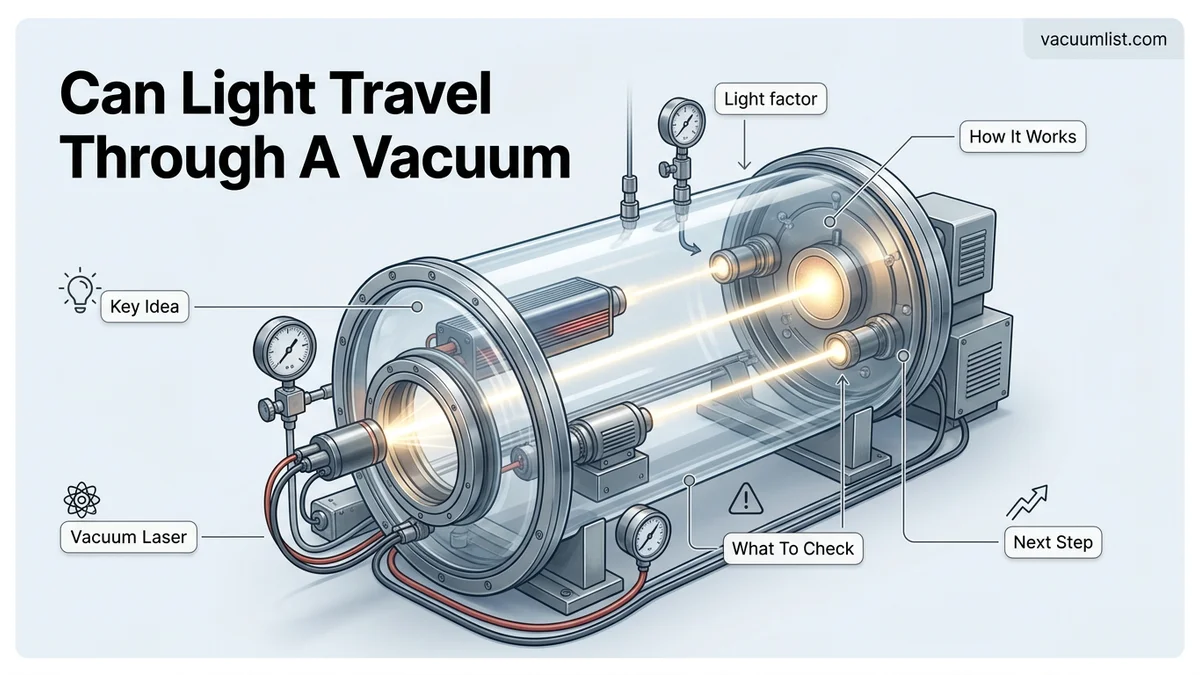
You can prove that light behaves differently than sound in a vacuum using a simple laboratory setup. Sound waves quickly disappear when you pump air out of a sealed glass jar containing a ringing alarm. However, a flashing light inside that same vacuum chamber remains completely visible.
- Place a bright LED light source inside a sturdy glass bell jar.
- Use a vacuum pump to remove the air, creating a low-pressure vacuum environment.
- Observe the light output; it shines just as brightly without air as it did before pumping.
- Compare this to sound tests, which drop to zero decibels once the medium is removed.
Cosmic Observation and Speed Data
You also have everyday cosmic proof right above you. Sunlight and starlight travel across millions of miles of near-total vacuum to reach Earth every single day. Modern measurements confirm that light travels at a constant speed of approximately 299,792 kilometers per second in a vacuum, proving that empty space facilitates rather than hinders its journey.
- Unimpeded transit: Photons cross the 93 million miles from the Sun to Earth in about 8 minutes and 20 seconds.
- Zero scattering: Without particles to bump into, the light preserves its frequency and phase across vast interstellar distances.
What If It Still Doesn’t Make Sense How Light and Sound Differ
Many learners struggle to grasp why light moves effortlessly through the vast emptiness of space while sound completely vanishes. According to modern physics research, the confusion stems from mixing up mechanical waves with electromagnetic radiation. Sound is simply a mechanical pressure wave that physically pushes and pulls neighboring atoms or molecules to move forward. Without a dense medium like air, water, or solid steel, those atoms do not exist to pass along the vibration.
Understanding the Core Physics Principles
Light operates under an entirely different set of rules defined by electromagnetic field theory. Instead of needing matter to travel, oscillating electric fields create magnetic fields, and those shifting magnetic fields recreate electric fields in a continuous leap. This self-propagating electromagnetic wave moves at a constant speed of approximately 299,792 kilometers per second in a vacuum. Visualizing this difference requires keeping a few specific verification steps in mind:
- Review the fundamental definition of a mechanical wave by testing how sound behaves inside a sealed vacuum bell jar with an electric buzzer.
- Examine Maxwell’s equations of electromagnetism to see how electric and perpendicular magnetic fields sustain themselves in empty space without physical molecules.
- Compare the vacuum speed of light at roughly 299,792 km/s against the speed of sound in air at sea level, which crawls at a mere 343 meters per second.
- Analyze deep space telemetry data from 2026 solar probes to confirm that photons arrive from the Sun across 149.6 million kilometers of near-total vacuum.
What If It Still Doesn’t Work?
If the mechanics of light propagation still seem counterintuitive after reviewing the physics, deeper verification steps can resolve the confusion:
- Revisit basic wave-particle duality experiments through verified educational simulations provided by institutions like the National Institute of Standards and Technology (NIST).
- Consult digital physics modules or university-level open courseware to clear up persistent misconceptions regarding luminiferous aether theories from the 19th century.
- Schedule a consultation with a qualified physics educator or academic tutor if foundational textbook examples fail to make sense. Professional tutoring sessions typically range from $50 to $100 per hour depending on academic level and regional rates.
- Review peer-reviewed astrophysics literature published through 2026 to see empirical proof of how cosmic microwave background radiation travels unhindered across cosmological voids.
Conclusion
Light travels seamlessly through a vacuum because it consists of self-propagating electromagnetic fields that require no physical medium to move. Sound, by contrast, relies entirely on colliding atoms and cannot exist in empty space. According to verified research and expert sources from leading physics institutions, grasping this fundamental distinction remains essential for understanding modern astrophysics and wave mechanics. One actionable next step is to examine a verified online simulation of Maxwell’s equations to see self-sustaining electromagnetic fields in action today.
❓ Frequently Asked Questions
How do electromagnetic waves propagate without a physical medium?
Electromagnetic waves consist of changing electric fields that create magnetic fields, and changing magnetic fields that create electric fields. This continuous induction allows the wave to self-propagate through empty space.
What happens to the speed of light when it leaves a vacuum and enters water or glass?
When light enters a denser medium like water or glass, it slows down because it interacts with the atoms and molecules within that material, though it still travels at incredible speeds.
What was the luminiferous aether theory?
Nineteenth-century physicists hypothesized that a mysterious substance called the aether filled space to carry light waves. The famous Michelson-Morley experiment ultimately disproved this idea, proving light needs no medium.
Does gravity affect light traveling through a vacuum?
Yes, according to general relativity, massive objects like stars and black holes can bend the path of light through a vacuum through a phenomenon known as gravitational lensing.
Are photons affected by a vacuum?
Photons experience zero resistance or friction in a perfect vacuum, allowing them to travel vast distances across the universe virtually unimpeded for billions of years.
How do we know starlight reaches Earth through the vacuum of space?
Space is not a completely empty void, but rather a near-vacuum. Starlight travels through this near-vacuum of space and our atmosphere to reach our eyes and telescopes on Earth.