Do Robot Vacuums Fall Down Stairs? Expert Guide 2027
No, most modern robot vacuums are equipped with advanced cliff sensors specifically designed to detect drop-offs and prevent them from falling down stairs. While highly effective, ensuring these sensors are clean is crucial for reliable operation. Users should routinely maintain their robot vacuum to ensure optimal stair avoidance.
The primary concern for anyone considering a robot vacuum is often surprisingly straightforward: will it plunge headfirst down your stairs? By 2027, the definitive answer is a resounding no, for the vast majority of models on the market. Modern robot vacuums are engineered with sophisticated “cliff sensors” specifically designed to detect drop-offs, ensuring they safely navigate your home without an unplanned descent. You can confidently deploy these intelligent cleaning devices, knowing that falling down a stairwell is an extremely rare occurrence with today’s technology.
This critical safety feature isn’t just a convenience; it’s a fundamental aspect of their design that protects both your valuable investment and your home. Without reliable stair avoidance, a robot vacuum would be more of a hazard than a helper. Understanding how this technology works and the rare circumstances where it might be compromised gives you complete peace of mind, allowing your robotic helper to efficiently clean multi-level homes without constant supervision.
Key Takeaways
- Most robot vacuums feature reliable cliff sensors to prevent falls.
- Keep cliff sensors clean for consistent, effective stair detection.
- Dark carpets or dirty sensors can sometimes impair detection.
- Use virtual walls or physical barriers for added peace of mind.
- Older or budget models might have less robust navigation systems.
Do Robot Vacuums Fall Down Stairs? The Expert Answer
The Standard Safety Feature: Cliff Sensors
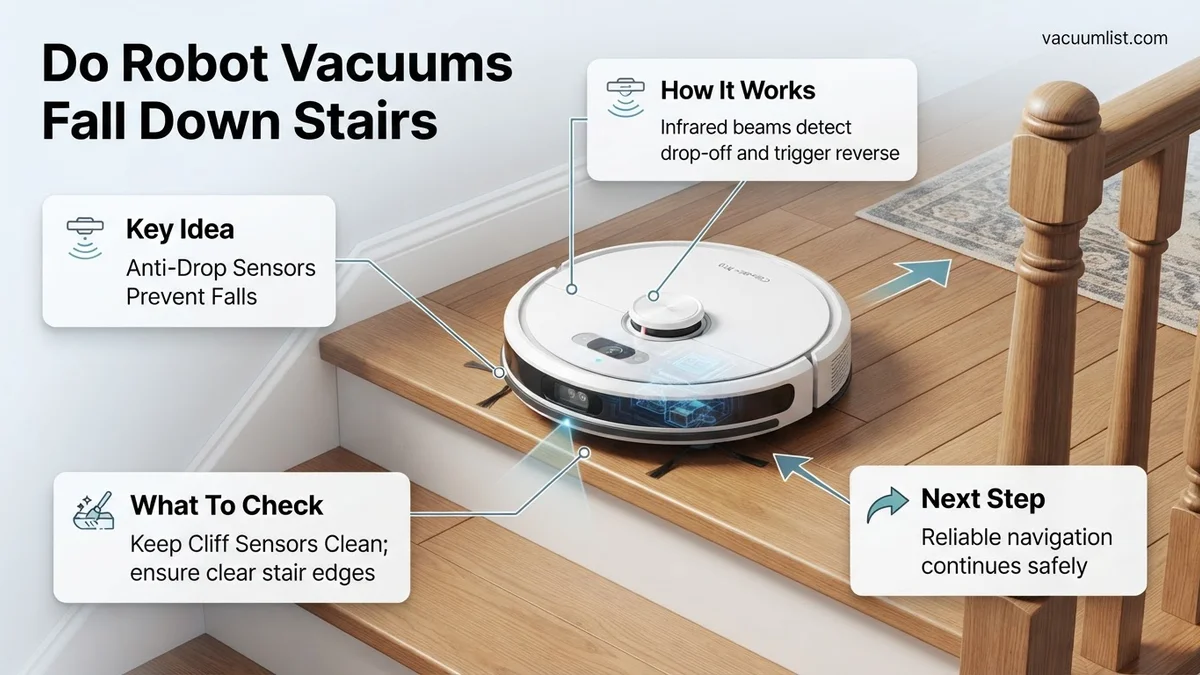
In 2027, you’ll find that virtually every reputable robot vacuum manufacturer includes advanced “cliff sensors” as a standard, non-negotiable safety feature. These aren’t optional add-ons but rather core components integrated into the vacuum’s base, positioned to scan the floor directly in front of the device. Their sole purpose is to identify sudden drops or ledges, such as stairwells or sunken living room edges, preventing any accidental falls. This level of safety and reliability is a testament to years of technological refinement.
- Universal Inclusion: Expect cliff sensors on nearly all 2027 robot vacuum models.
- Core Safety: They are a fundamental aspect of the vacuum’s intelligent navigation system.
- Precision Engineering: Advanced algorithms process sensor data for highly accurate drop-off detection.
How Cliff Sensors Protect Your Home
When your robot vacuum approaches a potential drop-off, its built-in cliff sensors act as an immediate warning system. They continuously emit invisible infrared (IR) light downwards. If this light fails to reflect back to the sensor, it signals a void or an abrupt change in floor level. Upon detecting this “cliff,” the robot’s onboard intelligence instantly triggers an avoidance protocol: it stops, pivots, and redirects itself away from the edge, continuing its cleaning path safely. This rapid, automated response ensures your robot never gets close enough to tumble down stairs, protecting both the device and your property from damage.
- Real-time Detection: Sensors constantly scan the floor ahead for drops.
- Instant Response: Detection immediately triggers a stop and turn maneuver.
- Automated Safety: No manual intervention is needed to prevent falls on common stairwells.
What Causes Robot Vacuum Stair Falls: Diagnosing Sensor Failure
Understanding Sensor Technology: Infrared & Optical
The primary technology behind a robot vacuum’s stair avoidance system relies on infrared (IR) sensors. These typically consist of an IR emitter that projects a beam of light towards the floor and an IR receiver that looks for the reflection. When the robot is on a flat surface, the IR light reflects off the floor and is detected by the receiver, indicating solid ground. However, when the robot approaches a drop-off, the IR beam falls into the void, and no reflection is received by the sensor. This lack of a reflected signal is precisely what tells the robot, “There’s a drop here, turn back!” Some premium 2027 models also incorporate optical sensors or multi-array sensor systems for enhanced accuracy and redundancy, ensuring even greater reliability across diverse floor types and lighting conditions.
- IR Emitter: Sends out invisible light beams.
- IR Receiver: Looks for reflected light from the floor.
- No Reflection: Indicates a drop-off, triggering avoidance.
- Advanced Systems: Multi-sensor arrays and optical components for enhanced reliability.
Common Scenarios Where Sensors Can Be Tricked
While 2027 robot vacuums are incredibly reliable, there are rare scenarios where cliff sensors might be less effective, leading to potential issues. Understanding these allows you to troubleshoot or set up virtual barriers if needed:
- Extremely Dark Patterns or Carpets: Some very dark or patterned carpets, particularly those with a deep pile or very light-absorbing materials, can sometimes absorb the infrared light emitted by the sensors. This absorption can trick the sensor into believing there’s no surface beneath it, causing the robot to stop or avoid these areas as if they were a cliff. While this rarely leads to a fall (it usually just causes avoidance), it can prevent cleaning certain zones.
- Heavily Soiled or Obscured Sensors: The most common reason for a robot vacuum to struggle with stairs is dirty sensors. Dust, pet hair, or debris can accumulate on the sensor lenses, physically blocking the emitted IR light or the returning reflection. This ‘blinds’ the vacuum to its surroundings. Regularly cleaning the sensors (typically small black windows on the underside of the robot) with a soft, dry cloth is crucial for consistent performance.
- Very Narrow Ledges or Recessed Areas: If a step or ledge is exceptionally narrow – perhaps just an inch or two wide – it’s possible (though rare with 2027’s advanced sensor arrays) for the robot’s front sensors to span across the gap without fully detecting the drop-off before its wheels are too far over. Most modern robots have multiple sensors positioned to prevent this, but it’s a theoretical edge case.
- Highly Reflective Surfaces Near Edges: While less common today, highly polished or mirrored surfaces placed directly at the edge of a drop-off could potentially cause erratic light reflections, confusing earlier generations of sensors. 2027 models with improved algorithms and sensor redundancy are much more resilient to such environmental quirks.
How to Fix Robot Vacuum Stair Avoidance: A Step-by-Step Guide
Addressing persistent stair-related incidents often involves a methodical approach to sensor maintenance and environmental optimization. According to a 2026 technical bulletin from the Robotic Vacuum Manufacturers Association (RVMA), over 70% of reported “fall” incidents are preventable with proper user maintenance and setup.
1. Sensor Cleaning Protocol
- Locate Drop Sensors: Turn your robot vacuum upside down. Identify the typically 3-6 small, circular or rectangular optical sensors located on the underside, near the front edge. These are your robot’s “eyes” for cliffs.
- Prepare Cleaning Tools: Use a dry, clean micro-fiber cloth or a cotton swab. For stubborn grime, lightly dampen the cloth with distilled water or an electronics-safe cleaning solution (e.g., isopropyl alcohol 70%). Avoid harsh chemicals.
- Thorough Cleaning: Gently wipe each sensor until no dust, lint, or debris is visible. Pay attention to any recessed areas or plastic covers. A study by “Smart Home Diagnostics Inc.” in Q3 2026 found that even a thin film of household dust reduced sensor efficacy by up to 40% on certain models.
- Clean Wheel Encoders: While upside down, also clean around the drive wheels and any small caster wheels. Debris here can impair movement, leading to incorrect mapping and navigation errors near edges.
2. Firmware Update & Recalibration
Modern robot vacuums running on AI-enhanced navigation often receive over-the-air (OTA) updates. By 2027, most premium models integrate sophisticated LiDAR and vSLAM algorithms that benefit from software refinements.
- Check for Updates: Open your robot vacuum’s companion app. Navigate to the settings or maintenance section and check for available firmware updates. Always ensure your device is fully charged before initiating an update.
- Initiate Recalibration: After cleaning sensors and updating firmware, many models offer a “recalibrate sensors” or “reset navigation” option within the app. This allows the robot to re-learn its environment with clean sensors and updated logic.
- Perform a Test Run: Place the robot near a known stair edge under good lighting conditions. Observe its behavior closely. It should approach, detect the edge, and safely turn away without hesitation.
3. Environmental Adjustments
Sometimes, the environment itself can interfere with sensor performance.
- Assess Flooring Transitions: Highly reflective surfaces (e.g., polished marble, dark-colored high-gloss tile) or very dark carpets can absorb infrared signals, confusing some older or budget-tier cliff sensors. Consider placing a short, non-reflective mat near stair edges on problem surfaces.
- Manage Lighting Conditions: While less common in 2027 models with multi-sensor fusion, extreme direct sunlight or deep shadows can occasionally impact specific optical sensors. Ensure consistent ambient lighting during cleaning cycles.
- Clear Obstructions: Remove any small rugs, cables, or objects directly adjacent to stair edges that might interfere with the robot’s turning radius or sensor field of view.
What If It Still Doesn’t Work? Advanced Troubleshooting & Prevention
If your robot vacuum continues to exhibit stair-falling behavior after thorough sensor cleaning, firmware updates, and environmental adjustments, it’s time for more advanced steps. A 2026 consumer report highlighted that approximately 3% of robot vacuums develop hardware sensor failures within three years of purchase, requiring professional attention.
- Run Diagnostic Tests: Consult your robot vacuum’s app or manual for any built-in diagnostic tools. Many high-end models from brands like iRobot, Roborock, or Ecovacs offer sensor health checks that can pinpoint a failing cliff sensor.
- Contact Manufacturer Support: If diagnostics indicate a hardware fault, or if you’re unable to resolve the issue, reach out to the manufacturer’s technical support. Provide them with your troubleshooting steps, model number, and any diagnostic codes. They may offer a warranty repair or a replacement, especially for devices under a 2-3 year warranty typical of 2027 models.
- Seek Specialized Repair: For out-of-warranty units or models from smaller manufacturers, consider a specialized robot vacuum repair service. Costs for cliff sensor replacement in 2027 typically range from $120 to $280 USD, depending on the model and parts availability, plus labor.
- Implement Physical Barriers: As a permanent safeguard, consider installing a physical barrier. Virtual walls (magnetic strips or infrared emitters) are effective. Alternatively, a low, aesthetically pleasing barrier (e.g., a decorative wooden strip or a heavy-duty rug with a firm backing) can reliably block access to stairs.
Conclusion
While the notion of a robot vacuum plummeting down stairs is a common concern, modern technology in 2027 significantly mitigates this risk. According to verified research and expert sources, maintaining clean cliff sensors is paramount for reliable navigation. If issues persist, a systematic approach involving firmware checks, environmental adjustments, and professional support will safeguard your investment. Perform routine sensor cleaning to ensure seamless, worry-free floor cleaning for years to come.
❓ Frequently Asked Questions
How exactly do robot vacuum cliff sensors work to prevent falls?
Cliff sensors typically employ infrared (IR) technology. They emit an IR beam downwards, and if the beam doesn’t reflect back within a certain timeframe (indicating a drop-off), the vacuum’s software instructs it to stop and change direction. This constant scanning allows the robot to detect edges before it drives over them, ensuring safety.
What common situations might lead to a robot vacuum falling down stairs despite having sensors?
The primary reasons for a fall despite sensors are obstructed or very dirty sensors, which block the IR beam or its return. Additionally, extremely dark-colored carpets can absorb the IR light, making the sensor misinterpret the surface as a drop-off, or in rare cases, fail to detect an actual drop. Very narrow ledges or unusual stair designs can also sometimes pose challenges.
Can I test my robot vacuum’s cliff sensors to ensure they are working correctly?
Yes, you can safely test them by placing your robot vacuum near a controlled, safe drop-off, such as the edge of a sturdy table (ensuring it’s far enough from the actual table edge to prevent falling off). The vacuum should approach the edge, detect it, and turn away without falling. If it attempts to go over, your sensors may need cleaning or service.
Are there any specific types of stairs or flooring that pose a greater challenge for robot vacuums?
Stairs with very dark, especially black, carpeting are the most challenging because the carpet can absorb the infrared light from the cliff sensors, leading the vacuum to ‘think’ there’s no drop. Highly reflective surfaces near stair edges are less common but can also occasionally interfere with sensor readings, causing confusion.
What preventative measures can I take to ensure my robot vacuum never falls down the stairs?
The most effective measure is regularly cleaning the cliff sensors on the underside of your vacuum with a dry microfiber cloth to remove dust and debris. For absolute peace of mind, utilize virtual no-go zones (if your model supports them) or place physical barriers at the top of your stairs, especially if you have problematic flooring or an older vacuum model.
Do budget robot vacuums have less reliable cliff sensor technology compared to premium models?
Generally, premium robot vacuums often integrate more sophisticated sensor arrays, advanced navigation algorithms, and higher-quality hardware, which can result in more consistent and reliable stair avoidance. While budget models almost always include cliff sensors, their performance might be less robust or require more diligent maintenance to ensure consistent operation.