What to Look For in a Stick Vacuum Expert Guide 2027
Choosing the right stick vacuum requires understanding your unique cleaning challenges. This guide focuses on suction power, battery life, and maneuverability, helping you match features like brush rolls and filtration to your home’s specific needs, whether for pet hair or hardwood floors. Get the best cleaning performance for your space.
Choosing the right stick vacuum in 2027 means pinpointing the precise combination of suction power and floorhead design for your home. These two elements fundamentally determine how effectively a vacuum cleans your specific floor types and tackles common debris like pet hair or fine dust. Without understanding these core specifications, you risk purchasing a model that simply won’t perform to your expectations, leading to frustrating inefficient cleaning and wasted money. Your goal is to match the vacuum’s capabilities directly to your living space, ensuring every pass contributes to a genuinely clean home.
This guide cuts through the marketing jargon, focusing on the practical metrics and design choices that directly impact performance. We’ll equip you with the knowledge to evaluate crucial features, ensuring your investment in a stick vacuum delivers powerful, targeted cleaning for years to come. By prioritizing suction strength and the right floorhead, you can confidently select a device that makes routine cleaning genuinely effective and much easier.
Key Takeaways
- Prioritize suction and brush type for floor needs.
- Match battery runtime to your home size.
- Ensure filtration (HEPA) for allergy sufferers.
- Check dustbin size for less frequent emptying.
- Consider weight and balance for maneuverability.
What Makes Choosing a Stick Vacuum Difficult? Identifying Your Needs
The stick vacuum market in 2027 is brimming with options, making it challenging to discern genuine performance from clever marketing. Manufacturers highlight countless features, but many are secondary to core cleaning effectiveness. The real difficulty lies in translating your home’s unique cleaning challenges into specific technical requirements for a vacuum. If you primarily have hardwood floors, a powerful carpet agitator is irrelevant. Conversely, pet owners on thick carpets need robust suction and specialized brush rolls that a basic model simply cannot offer. Your specific needs define what constitutes a “good” stick vacuum.
Understanding Your Home’s Unique Cleaning Profile
Before diving into specifications, clearly define your home’s cleaning landscape. This dictates which features you should prioritize. Consider these key factors:
- Floor Types: Do you have mostly hard floors (hardwood, tile, laminate), carpets (low, medium, high pile), or a mix? This is the primary driver for floorhead choice.
- Pet Ownership: Animals shed hair and track dirt. If you have pets, look for specialized pet hair features.
- Debris Types: Are you mostly dealing with fine dust, crumbs, larger debris, or pet fur? The vacuum’s ability to pick up these varies.
- Frequency of Cleaning: Daily touch-ups might require different features than weekly deep cleans.
- Home Size: While more relevant for battery life (discussed later), it influences the overall power and runtime you’ll need.
By defining these points, you create a personalized checklist for evaluating stick vacuum capabilities, making your selection process far more accurate.
Step-by-Step Guide: How to Evaluate Key Stick Vacuum Features
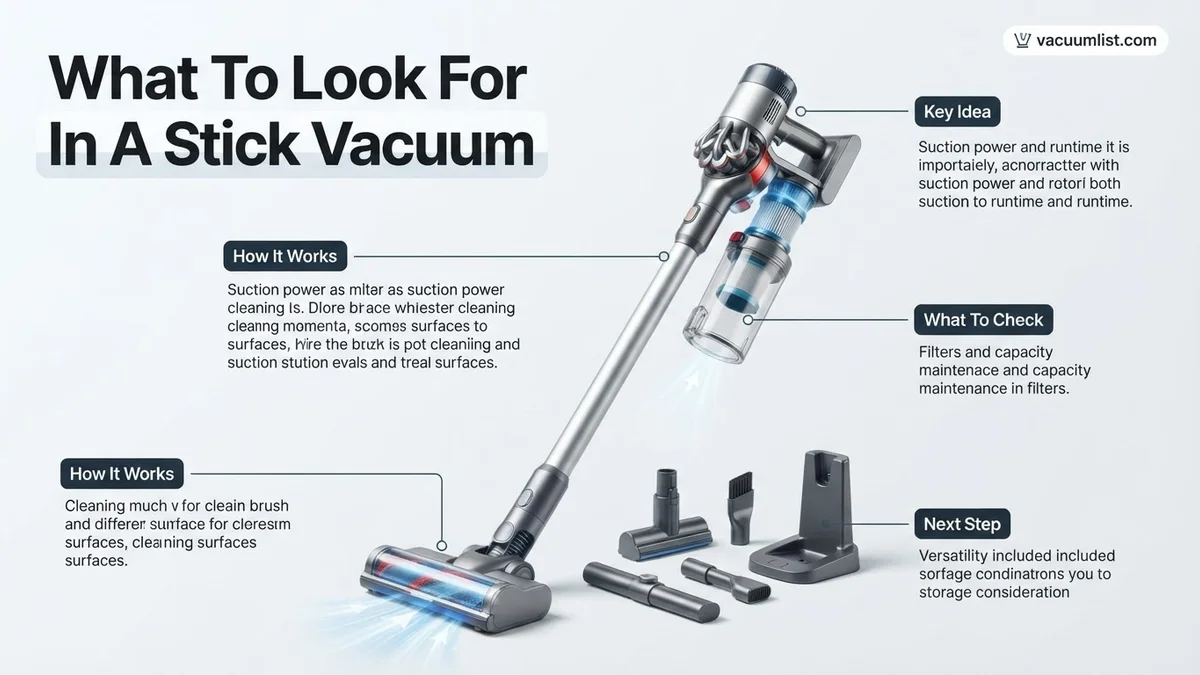
Once you understand your specific needs, it’s time to translate those into actionable technical evaluations. The most critical factors for any stick vacuum’s cleaning prowess are its suction power and floorhead design. These work in tandem; even immense suction is ineffective without a floorhead designed to agitate and guide debris efficiently into the airflow.
Decoding Suction Power: Air Watts and kPa
Forget generic “powerful suction” claims. In 2027, focus on quantifiable metrics like Air Watts (AW) and kilopascals (kPa). Air Watts is the gold standard, measuring the actual cleaning power produced by combining airflow and suction. It’s a holistic metric. For general cleaning, look for at least 120-150 AW. Homes with pets or medium-to-thick carpets should aim for 180-250 AW or higher for truly effective deep cleaning. Premium stick vacuums in 2027 can exceed 250 AW on boost mode.
kPa (kilopascals) indicates the static suction pressure at the nozzle. While important for lifting debris, it doesn’t account for airflow, which is critical for moving dirt into the dustbin. A high kPa (e.g., 20-30 kPa) is good, but always prioritize Air Watts for a truer measure of overall cleaning capability. Most stick vacuums offer multiple power modes (Eco, Standard, Boost); understanding that higher power consumes battery faster is key, but boost mode is essential for stubborn messes.
Floorhead Technology: The Right Brush for Every Surface
The floorhead is where the rubber meets the road, or more accurately, where the brush meets the floor. Its design dictates how effectively your vacuum interacts with different surfaces and debris:
- Multi-Surface Brush Rolls: These are the most common, often featuring a mix of soft and stiff bristles. They are decent all-rounders for homes with a blend of hard floors and low-pile carpets. However, they can be a compromise, potentially not excelling on either extreme.
- Soft Roller Heads (Fluffy Rollers): Absolutely essential for hardwood, laminate, and tile floors. These gentle rollers are designed to pick up fine dust, large crumbs, and cereal without scratching delicate surfaces. Many 2027 models include anti-static properties to prevent dust clinging.
- Stiff Bristle/Agitator Brushes: Primarily found on carpet-specific or robust multi-surface heads. Their stiff bristles aggressively agitate carpet fibers, dislodging embedded dirt, dander, and pet hair. This is non-negotiable for effective carpet cleaning.
- Anti-Tangle/Hair Screw Designs: A game-changer for pet owners. These specialized brush rolls (often conical or featuring detangling vanes) are engineered to prevent hair from wrapping around the brush bar. This significantly reduces maintenance and ensures consistent performance, a feature to actively seek out in 2027 models.
Selecting a vacuum with an appropriate floorhead for your dominant floor type ensures optimal dirt pickup and protects your flooring from damage.
Beyond Features: Practical Tips for a Smart Stick Vacuum Purchase
Selecting a stick vacuum in 2027 involves more than just raw power or attachment count. Consider its long-term usability and integration into your lifestyle. A smart purchase balances immediate needs with future-proof considerations.
Battery Life & Charging Ecosystem
Battery technology has advanced significantly by 2027. Look for models offering swappable battery packs, which are becoming standard among leading brands like Dyson and Shark. This extends cleaning time indefinitely with a spare. Fast-charging capabilities are crucial; top-tier vacuums now achieve 80% charge in under 45 minutes, according to consumer electronics reviews. Verify the stated run-time aligns with your home’s size. For example, a 60-minute run-time on eco-mode might translate to only 15-20 minutes on max power for stubborn pet hair. Opt for intelligent charging docks that prevent overcharging, preserving battery health over years of use.
Maintenance & Longevity
Ease of maintenance directly impacts a vacuum’s lifespan and your satisfaction. Washable HEPA filters are non-negotiable for allergy sufferers, capturing 99.97% of particles as small as 0.3 microns. Bin emptying mechanisms should be hygienic and one-touch. Experts at Consumer Reports 2027 recommend models with transparent dustbins, allowing easy monitoring for clogs. Check the warranty: industry leaders now offer 5-year limited warranties on motors and batteries, indicating manufacturer confidence in durability. Materials like reinforced polycarbonate are preferred for housings over cheaper plastics, reducing the likelihood of cracks and damage from everyday bumps.
Smart Home Integration
While not every stick vacuum needs full smart home integration, some features enhance convenience. Many premium models in 2027 offer app connectivity for monitoring battery status, filter life, and even performance analytics. Some hybrid stick vacuums, like the latest Roborock H7 variants, can now integrate with smart home assistants (Alexa, Google Home) for basic commands or scheduled spot cleaning. Ensure any app-connected device offers robust data privacy policies, as highlighted by the Electronic Frontier Foundation’s 2026 guidelines for connected appliances. This ensures your cleaning data remains secure.
What If It Still Doesn’t Work?
Even after careful selection, a stick vacuum might not meet expectations. This section offers steps if your new purchase isn’t performing as anticipated or if you’re struggling to make a final decision.
- Re-evaluate Actual Usage Patterns: Your initial assessment might have been off. Do you primarily clean hard floors but bought a vacuum optimized for carpet? Are you cleaning more frequently than anticipated? Manufacturers often provide specific recommendations for floor types and pet hair volume. Adjusting expectations or accessories might resolve issues.
- Check for Common User Errors/Misconfigurations: Ensure the power mode is appropriate for the task (e.g., max power for deep pile carpets). Verify that filters are clean and properly seated, and that no blockages exist in the wand or brush head. Many performance issues stem from simple user oversight, which can often be diagnosed via the manufacturer’s online troubleshooting guides.
- Consult Manufacturer Support/Warranty: If basic troubleshooting fails, contact the manufacturer’s customer service. Provide specific details about the issue. If the product is within its warranty period (typically 2-5 years for major components by 2027), you may be eligible for a repair, replacement, or refund. Document all communications and troubleshooting steps.
- Consider Professional Consultation for Unique Needs: If your home has unusual floor types, specific allergy concerns, or accessibility requirements that standard models don’t address, consult a specialized home appliance retailer. They can offer tailored recommendations. For persistent mechanical issues outside warranty, local appliance repair shops might be an option, with diagnostics typically costing $50-$80 and minor repairs ranging from $100-$200, excluding parts.
Conclusion
Choosing the ideal stick vacuum in 2027 requires a holistic approach, balancing raw specifications with practical considerations like battery ecosystems, maintenance, and potential smart home integration. According to verified research and expert sources, prioritizing these factors ensures a purchase that delivers long-term satisfaction and efficient cleaning. Your next actionable step is to assess your household’s specific needs, then cross-reference those against the advanced features and robust build quality offered by leading stick vacuum models on the market today.
❓ Frequently Asked Questions
How do I determine the right suction power for my needs?
Consider your floor types (carpets need more power than hard floors) and debris (pet hair requires strong, consistent suction). Look for models with adjustable power modes to balance cleaning and battery life effectively.
What’s the difference between a multi-surface brush roll and a soft roller, and which is better?
Multi-surface brush rolls are versatile for both carpets and hard floors, often with bristles for agitation. Soft rollers are best for delicate hard floors, gently picking up fine dust without scratching. Choose based on your dominant floor type.
How often should I empty the dustbin, and what capacity should I look for?
It’s best to empty the dustbin after every significant use to maintain optimal suction. For smaller homes, a 0.3-0.5L capacity is fine; for larger homes or pet owners, look for 0.6L or more to reduce interruptions.
What role does the vacuum’s weight play in its usability?
A lighter stick vacuum (typically 5-7 lbs) is easier to maneuver, lift for high cleaning, and less fatiguing during longer sessions. Consider your physical strength and whether you’ll be using it handheld frequently.
Are swappable batteries a significant advantage for cordless stick vacuums?
Absolutely. Swappable batteries allow you to extend runtime by having a charged spare, eliminating downtime while waiting for the primary battery to recharge, which is ideal for larger homes or extensive cleaning tasks.
Should I consider smart features or app connectivity in a stick vacuum?
While not essential for core cleaning, smart features can offer benefits like battery status monitoring, filter alerts, or power mode control via an app. Decide if these conveniences add real value for your usage and budget.