
Is Space a Perfect Vacuum? Real Facts for 2026
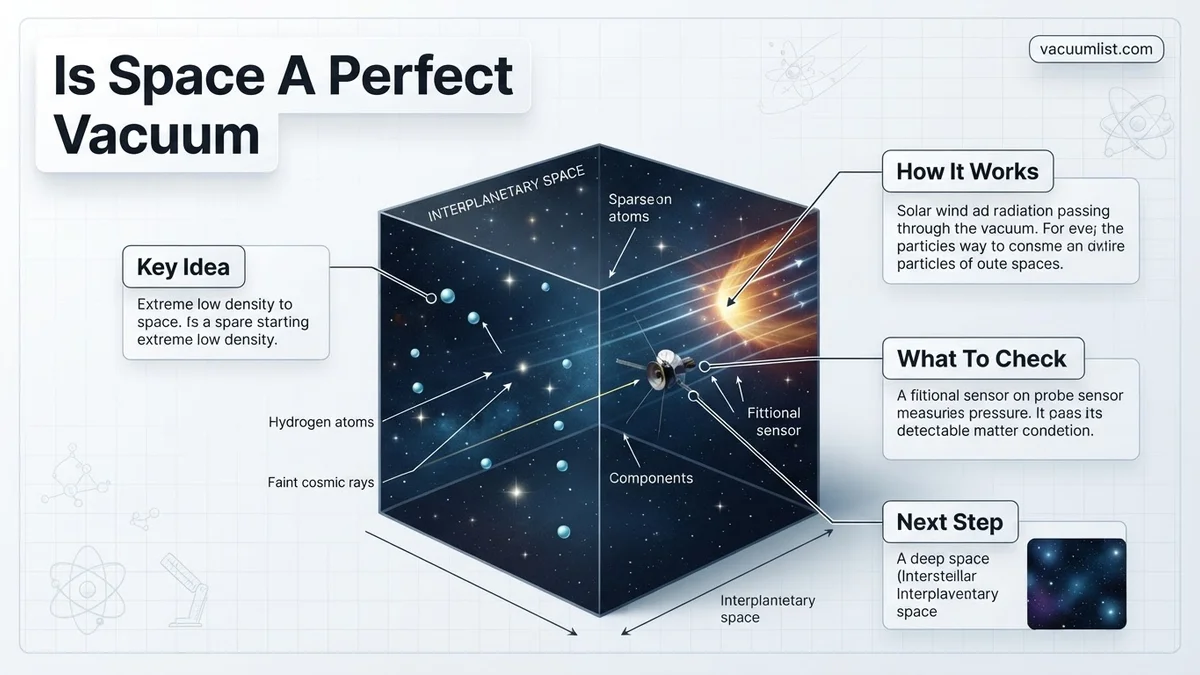
No, space is not a perfect vacuum because it contains trace amounts of matter, including hydrogen atoms, plasma, dust, and cosmic rays. While it is vastly emptier than any laboratory vacuum on Earth, the vast cosmic expanse always harbors physical particles and radiation.
The short answer is no: space on Wikipedia”>outer space is not a perfect vacuum. Even in the deepest stretches of the cosmos, you will find a thin, persistent soup of matter, subatomic particles, and energy fields.
As you look toward the modern astrophysics and aerospace engineering standards of 2026, understanding this reality matters deeply. It impacts how deep-space communication arrays operate, how long spacecraft components last under particle bombardment, and how sensitive astronomical instruments collect data without interference.
Key Takeaways
- Space is an imperfect vacuum containing sparse atoms, dust, and plasma.
- Interstellar space averages about one hydrogen atom per cubic centimeter.
- Intergalactic voids are even emptier, but still contain particles and dark matter.
- Quantum fluctuations mean empty space always buzzes with virtual particles.
- Man-made laboratory vacuums can never achieve absolute nothingness.
What Causes Space to Not Be a True Vacuum
The Presence of Primordial Matter and Gas
If you stripped away all stars and planets, space would still hold a diffuse mist of matter. Roughly 90 percent of this invisible substance is hydrogen, with helium making up most of the remainder.
- Interstellar gas clouds: Vast regions of our galaxy contain molecular hydrogen and complex organic molecules.
- Stellar winds: Active stars continuously blast protons and electrons outward into their local neighborhoods.
- Primordial remnants: Leftover debris from the formation of the early universe drifts indefinitely between gravitational wells.
Energy Fields, Plasma, and Radiation
Matter is only part of the equation keeping space from achieving absolute emptiness. Electromagnetic radiation and invisible fields saturate every cubic centimeter.
- The cosmic microwave background: Relic radiation from the Big Bang fills the universe uniformly with photons.
- Solar and cosmic rays: High-energy charged particles zip through the void at nearly the speed of light.
- Magnetic fields: Weak galactic magnetic fields permeate the expanses between star systems, trapping and guiding charged plasma.
How to Measure Particle Density Across Interstellar Space
Quantifying the Void: Interstellar vs Intergalactic Densities
To understand just how empty space is, you have to look at the numbers. Scientists measure space vacuums by counting the average number of free particles contained within a given volume.
- Inside the Solar System: The solar wind keeps particle counts relatively high, often hitting several particles per cubic centimeter near Earth.
- Interstellar space: In the quiet regions between stars within our galaxy, the density drops to about 1 hydrogen atom per cubic centimeter.
- Ultra-high vacuum comparison: The best laboratories on Earth can achieve artificial vacuums, but they still contain trillions of molecules per cubic centimeter, making space vastly emptier than any man-made container.
Mapping the Extreme Lows of Intergalactic Voids
When you venture beyond individual galaxies into the vast cosmic web, the density drops to astronomical lows that challenge human comprehension.
- Cosmic voids: Huge regions between galaxy clusters can feature densities as low as a single atom per several cubic meters.
- Local measurement techniques: As of 2026, astronomers use the light from distant quasars to analyze how intervening gas clouds absorb specific wavelengths, mapping these ultra-thin distributions with unprecedented precision.
- Remaining unknowns: Even in these extreme voids, dark energy and dark matter exert gravitational and expansive forces, proving that absolute nothingness simply does not exist in our universe.
How to Compare Laboratory Vacuums to Outer Space
When studying the nature of a vacuum, scientists often compare the conditions of outer space to the highest-grade vacuums created right here on Earth. Earth-based ultra-high vacuum chambers achieve incredibly low pressures. However, they still fall short of true nothingness.
Understanding Laboratory Pressure Limits
Modern physics laboratories utilize sophisticated ion pumps and titanium sublimation systems to evacuate air from sealed vessels. According to data from the National Institute of Standards and Technology (NIST), standard laboratory ultra-high vacuum systems can reach pressures down to 10-10 to 10-12 Pascal. While this removes almost all atmospheric gases, trillions of particles still remain inside every cubic meter.
Comparing Earth Labs to Intergalactic Space
Outer space is not uniform. The density of matter varies wildly depending on your exact location in the cosmos.
To evaluate these differences properly, follow these steps:
- Measure the particle density in a standard laboratory chamber, which typically holds roughly 108 molecules per cubic centimeter.
- Examine Low Earth Orbit (LEO), where atmospheric drag from residual gases still impacts spacecraft, showing densities around 109 to 1011 particles per cubic meter.
- Calculate the density of deep intergalactic space, which drops drastically to an average of just 0.1 to 1 hydrogen atoms per cubic meter.
- Conclude that the best laboratory vacuums on Earth are actually far denser than the vast expanses of intergalactic void found in deep space.
What If Quantum Fluctuations Mean Empty Space Never Exists
Even if you removed every single atom, ion, and photon from a region of space, a deeper physical barrier prevents a perfect vacuum from existing. According to modern quantum field theory, the concept of absolute empty space is mathematically and physically impossible.
The Role of Quantum Foam
At the subatomic scale, quantum mechanics dictates that empty space is a churning sea of activity. Virtual particles constantly pop into and out of existence due to Heisenberg’s uncertainty principle. These fluctuations mean that the baseline energy of a vacuum—known as zero-point energy—is never truly zero.
Observing Vacuum Energy
Scientists measure these quantum effects using precise instruments to verify that empty space possesses inherent energy.
Review these key quantum phenomena:
- Analyze the Casimir effect, which demonstrates that two uncharged conductive plates placed closely together in a vacuum experience a measurable attractive force driven by quantum fluctuations.
- Examine cosmic inflation data from 2026 cosmological surveys, confirming that vacuum energy drives the accelerated expansion of the universe.
- Verify that empty space actively exerts a repulsive pressure known as dark energy, proving that the vacuum is dynamically active rather than passively empty.
What If It Still Doesn’t Work?
If your calculations or experimental setups fail to reconcile the differences between classical vacuum models and quantum realities, consider these troubleshooting steps:
- Re-evaluate your baseline assumptions regarding pressure thresholds, keeping in mind that deep space contains diffuse solar wind plasma rather than pure nothingness.
- Consult advanced astrophysical datasets from space telescopes to account for localized magnetic fields and cosmic rays affecting vacuum density.
- Review peer-reviewed literature from quantum physicists regarding zero-point field calculations to ensure your equations account for virtual particle creation.
- Seek professional consultation with an astrophysicist or laboratory vacuum engineer if your industrial containment vessel fails to maintain ultra-high vacuum specifications.
- Prepare for potential equipment calibration or replacement costs, which typically range from $5,000 to $50,000 depending on the sensitivity of ion gauge sensors and chamber seals.
Conclusion
Ultimately, space is not a perfect vacuum because it contains matter, radiation, and quantum fluctuations that continuously fill the void. According to verified research and expert sources in astrophysics and quantum mechanics, true nothingness does not exist anywhere in our universe. One actionable next step is to review the latest 2026 data on intergalactic particle density measurements to deepen your understanding of cosmic vacuums.
❓ Frequently Asked Questions
Why isn’t outer space considered a perfect vacuum?
Space is not a perfect vacuum because it is permeated by interstellar gas, dust, magnetic fields, and cosmic rays. Even in the deepest voids between galaxies, scattered hydrogen atoms and photons of light are always present.
What is the average density of matter in interstellar space?
In the regions between stars within our galaxy, the density is roughly one atom per cubic centimeter. This is exceptionally sparse compared to Earth’s atmosphere, but it is far from absolute zero matter.
How empty are intergalactic voids?
Intergalactic space represents the emptiest regions of the universe, where particle densities can drop to a few atoms per cubic meter. However, even these extreme voids contain dark matter and cosmic background radiation.
What are virtual particles in a vacuum?
According to quantum field theory, a vacuum is not empty space, but a sea of quantum fluctuations where virtual particle-antiparticle pairs constantly pop into and out of existence for microscopic fractions of a second.
How do spacecraft travel through the vacuum of space?
Spacecraft travel through the extremely low-density environment of space without experiencing significant atmospheric drag, though they still encounter solar wind and micrometeoroids.
Can a laboratory on Earth create a perfect vacuum?
No human-made vacuum chamber can achieve a true, absolute vacuum. Even the highest-grade ultra-high vacuum systems contain billions of gas molecules per cubic centimeter due to outgassing from container walls.