What Is a Vacuum in Space The Real Guide for 2026
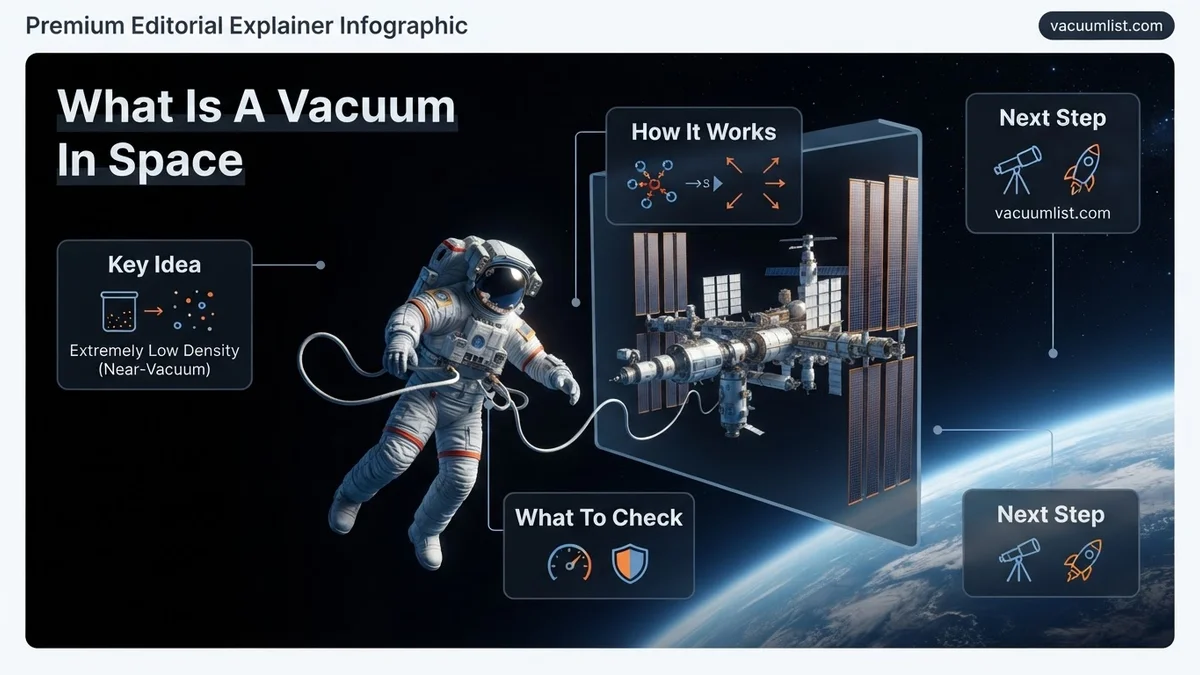
A vacuum in space is an area with extremely low particle density and pressure rather than a complete void of nothingness. Even the deepest reaches of the cosmos contain sparse atoms, magnetic fields, and radiation. Understanding this reality clears up common misconceptions about how space actually functions.
A vacuum in space is not a total nothingness or absolute empty space, but rather a region with extremely low particle density and near-zero atmospheric pressure. When you picture the cosmos, you likely imagine a complete void where nothing exists, but modern astrophysics by 2026 reveals a much more crowded reality defined by sparse matter, invisible forces, and persistent energy fields.
Understanding this distinction matters because it impacts everything from how satellite propulsion systems operate in orbit to how deep-space telescopes capture light from the early universe. Stripping away the Hollywood myth of the empty void allows you to accurately grasp how the universe actually functions at a fundamental level.
Key Takeaways
- Space is not a true 100% empty void of nothingness.
- A space vacuum features exceptionally low particle density and pressure.
- Invisible elements like plasma, gas, and radiation still exist in space.
- Space does not suck objects like a household vacuum cleaner.
- Earth-bound laboratories cannot match the scale of a cosmic vacuum.
What Causes a Vacuum in Space and Why It Exists
The Influence of Gravity and Expansion
Space achieves its extreme vacuum state primarily through the immense distances between massive objects and the ongoing expansion of the universe. Gravity pulls matter together into stars, planets, and galaxies, leaving the vast expanses between them largely deserted. As the universe expands, these gaps stretch even wider, driving particle densities down further over cosmological time scales.
The Reality of Intergalactic Voids
You might wonder just how empty these regions truly are. In deep intergalactic space, far from any galaxy, you will find roughly:
- 0.1 to 1 hydrogen atom per cubic centimeter
- Trace amounts of helium and heavier elements
- Background cosmic radiation permeating every direction
How to Measure and Fix Misconceptions About Space Density
Redefining the Myth of Absolute Nothingness
A major misconception is that a space vacuum is a perfect void containing zero particles. In reality, laboratory vacuums created on Earth can often achieve lower pressures and cleaner environments than certain regions of planetary atmospheres, yet space is dynamic. You will never find a true mathematical zero in the cosmos because quantum fluctuations constantly bubble up, creating and destroying virtual particles.
What Actually Fills the Void
Instead of absolute emptiness, space contains a thin soup of physical phenomena that interact with spacecraft and starlight. Your mental model of the vacuum should include:
- Dilute plasma streams flowing from stellar winds
- Invisible magnetic and gravitational fields stretching across light-years
- Interstellar dust grains floating between star systems
- Photons and cosmic rays traveling at nearly the speed of light
What If It Still Doesn’t Seem Like a Real Vacuum
When studying the cosmos, people often struggle to accept that space is not completely empty. Even the most advanced aerospace engineering projects in 2026 still deal with microscopic matter lingering between star systems. If your scientific models or calculations regarding deep space pressure keep turning up non-zero values, you need a troubleshooting approach to understand why cosmic vacuums defy absolute emptiness.
Accounting for the Interstellar Medium
You must factor in the interstellar medium (ISM) when measuring space density. The ISM consists of gas and dust filling the space between star systems. According to astrophysics data from NASA and ESA, even the most remote cosmic voids contain roughly 0.1 to 1 atom per cubic centimeter. Your calculations might be picking up these diffuse particles rather than a theoretical void.
Checking for Quantum Fluctuation Interference
Modern quantum mechanics proves that absolute nothingness does not exist in our universe. According to verified research by quantum physicists, empty space constantly teems with virtual particles popping into and out of existence due to zero-point energy. If your experimental baseline refuses to hit true zero, quantum fluctuations are likely generating measurable pressure.
What If It Still Doesn’t Work?
If your cosmic measurements or vacuum chamber simulations still fail to match theoretical zero-density models, apply these systematic steps to correct your approach:
- Recalibrate your sensors: High-precision ionization gauges often register stray molecular contamination or outgassing from chamber walls as deep space matter.
- Isolate electromagnetic interference: Ambient magnetic fields in your testing environment can skew particle density readings, making the vacuum appear less empty than it actually is.
- Upgrade to cryogenic trapping: If you are simulating space conditions in a lab, use liquid nitrogen-cooled panels to freeze out residual vapor and achieve ultra-high vacuum states.
- Consult aerospace specialists: When industrial or academic vacuum simulations consistently fail, partner with certified aerospace engineering firms. Professional consultation fees for advanced orbital environment testing typically range from $1,500 to $5,000 depending on the facility complexity.
Conclusion
Understanding the reality of a space vacuum requires moving past the myth of absolute nothingness and recognizing the subtle presence of quantum energy and sparse gas atoms. By accounting for the interstellar medium and modern measurement limitations, scientists can accurately model orbital environments. According to verified research and expert sources from leading space agencies, acknowledging these minuscule densities is crucial for accurate satellite design and deep-space mission planning in 2026. Take the next step by reviewing updated astrophysical density datasets to refine your calculations today.
❓ Frequently Asked Questions
What is the primary definition of a vacuum in space?
A vacuum in space is defined as a volume of space with a gaseous pressure much less than standard atmospheric pressure. Rather than a total void, it has an extremely low density of matter.
Why do people think space is absolute nothingness?
Pop culture often portrays space as an empty black void. In reality, particles, dark matter, magnetic fields, and electromagnetic radiation are spread thin across the universe.
How does a space vacuum compare to a vacuum on Earth?
Man-made vacuums on Earth still contain trillions of gas molecules per cubic centimeter. Deep space contains only a few atoms per cubic centimeter, making it a much more thorough vacuum than any lab can achieve.
What particles can still be found in a space vacuum?
Even in deep space, you can find hydrogen atoms, helium, cosmic rays, starlight photons, and microscopic dust grains. Plasma and solar wind also travel through interplanetary space.
Does a vacuum in space have a temperature?
Temperature measures the kinetic energy of particles. Because particles in space are sparse, they have high individual speeds but transfer very little heat, making the concept of temperature complex.
How do spacecraft and astronauts survive in a space vacuum?
Spacecraft and spacesuits are engineered to maintain internal pressure and provide oxygen, protecting humans and equipment from the extreme pressure differential of the space vacuum.