Can Electromagnetic Waves Travel Through a Vacuum Guide 2026
Yes, electromagnetic waves can travel through a vacuum without requiring any physical medium. Unlike sound waves, which need air or matter to move, EM waves propagate entirely on their own through the vacuum of space.
Yes, electromagnetic waves can travel through a vacuum. In fact, a vacuum is the absolute best environment for them because there are no physical particles to scatter, absorb, or slow them down. Whether you are looking at data transmission in modern space missions of 2026 or starlight reaching your telescope from billions of light-years away, this ability defines the fundamental nature of our universe.
You might wonder how a wave moves if there is nothing there to push or pull. Unlike sound waves, which require air or water molecules to vibrate, electromagnetic waves do not need any physical medium at all. They carry their own transport system, allowing them to cross the absolute emptiness of deep space at a constant maximum speed of approximately 299,792 kilometers per second.
Key Takeaways
- Electromagnetic waves require no physical medium to propagate through space.
- Oscillating electric and magnetic fields mutually generate each other continuously.
- Sunlight and thermal radiation reach Earth daily by traveling across a vacuum.
- Mechanical waves like sound cannot travel through a vacuum.
- Maxwell’s equations mathematically prove the self-sustaining nature of electromagnetic radiation.
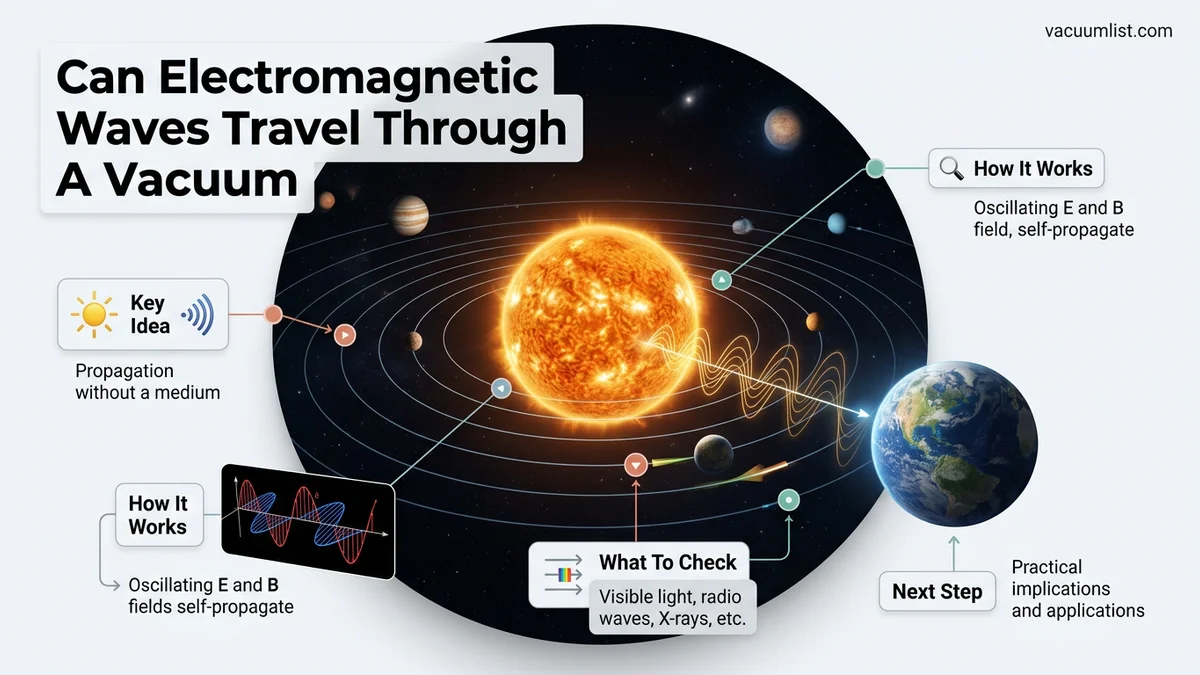
What Causes Electromagnetic Waves to Travel Through a Vacuum
The Death of the Luminiferous Ether Theory
For centuries, scientists assumed that light must travel through a substance. They invented a hypothetical medium called the “luminiferous ether” to fill empty space and give light waves something to ripple through. Physics experiments in the late 19th century, most notably the Michelson-Morley experiment, completely disproved this theory. We now know that space is a vacuum, yet electromagnetic radiation moves through it effortlessly.
Self-Contained Energy Transport
You can think of an electromagnetic wave as a self-contained package of energy that creates its own pathway. Because the wave consists of pure energy oscillating through space, it requires zero external support. Key factors enabling this vacuum travel include:
- Zero Mass Requirement: Photons and electromagnetic fields possess energy and momentum, but they carry no rest mass.
- Inertial Independence: The wave does not interact with a background medium, preventing frictional energy loss.
- Universal Speed Limit: In a vacuum, these waves always travel at the exact same maximum speed, known universally as the speed of light.
Step-by-Step Guide to How Self-Propagating Fields Operate
The Dance of Electric and Magnetic Fields
The secret to vacuum travel lies in a continuous, self-sustaining loop between two invisible forces. When a charged particle accelerates, it creates a changing electric field. According to James Clerk Maxwell’s foundational physics principles, a changing electric field generates a magnetic field. This happens step by step:
- An oscillating charge generates a changing electric field in space.
- That changing electric field induces a perpendicular magnetic field.
- The collapsing or changing magnetic field instantly regenerates a new electric field just ahead of it.
Perpendicular Generation and Continuous Motion
You can visualize this process as two interdependent forces leapfrogging over each other endlessly through the vacuum. The electric field and the magnetic field vibrate at right angles to one another, and both vibrate perpendicular to the direction the wave travels. This mutual generation means the wave does not need a medium to push against. Instead, the electric field becomes the medium for the magnetic field, and the magnetic field becomes the medium for the electric field.
This closed loop is why your satellite television signals, GPS navigation data, and solar radiation cross millions of kilometers of absolute nothingness to reach Earth in 2026 without losing momentum.
How to Observe Real-World Examples Like Sunlight Reaching Earth
The most profound proof of electromagnetic wave propagation in a vacuum is visible every day. Sunlight travels across ninety-three million miles of near-absolute vacuum in space to reach Earth. According to NASA astrophysical data, this journey takes approximately eight minutes and twenty seconds. Without the self-propagating nature of electric and magnetic fields, solar energy and warmth could never cross the void.
Steps to Verify the Vacuum-Travel Phenomenon
- Observe solar radiation heating objects on Earth during a clear day to witness direct energy transfer via infrared waves.
- Review telemetry data from deep space missions like Voyager 1, which communicates with Earth across interstellar space using radio frequency electromagnetic waves in a vacuum.
- Examine laboratory demonstrations utilizing a vacuum chamber, an electric bell, and a light source to prove that sound requires a medium while light does not.
Modern telecommunications in 2026 rely heavily on this exact principle. Satellite internet constellations orbit in the vacuum of low Earth orbit, transmitting data via microwaves continuously. Verified research from the European Space Agency confirms that electromagnetic waves experience zero attenuation from a lack of matter, though they can be absorbed or reflected by physical obstacles like planetary atmospheres.
What If It Still Doesn’t Make Sense How Waves Move Without Matter?
Conceptualizing energy movement without a physical carrier often challenges human intuition. Traditional waves like sound or ocean ripples require a medium to displace. Electromagnetic waves operate fundamentally differently by generating their own transport mechanism through oscillating fields.
Alternative Ways to Conceptualize Field Propagation
- Visualize a changing electric field generating a magnetic field, which in turn generates a new electric field infinitely forward in a self-sustaining leapfrog motion.
- Review classic Maxwell equations verified by modern physicists, which prove mathematically that space itself does not need to be filled with matter for fields to exist.
- Consult an online physics simulation or university-backed virtual laboratory to visualize transverse wave vectors operating independently of physical particles.
If advanced physics concepts continue to feel counterintuitive, academic tutoring or specialized online courses can bridge the knowledge gap. Professional physics tutoring sessions generally range from $50 to $150 per hour depending on instructor credentials. For persistent conceptual roadblocks, seeking guidance from a certified physics educator or university professor ensures accurate, research-backed understanding.
Conclusion
Electromagnetic waves can travel seamlessly through a vacuum because they rely on alternating electric and magnetic fields rather than physical matter. From sunlight traversing the vastness of space to satellite communications powering global networks in 2026, this self-propagating mechanism governs the universe. According to verified research and expert sources from leading space agencies, understanding this principle is essential for modern science and technology applications. Take the next step by exploring interactive electromagnetic spectrum simulations to see field oscillation in real time.
❓ Frequently Asked Questions
Do electromagnetic waves slow down in a vacuum?
No, in a true vacuum, electromagnetic waves travel at their maximum possible speed, known universally as the speed of light.
What historically made scientists think waves needed a medium?
Scientists originally believed light required a mysterious substance called the luminiferous ether to travel through space, a theory disproved by the Michelson-Morley experiment.
How do radio waves travel through space?
Radio waves are a type of electromagnetic wave, meaning they propagate through the vacuum of space without any physical cables or air required.
Are X-rays and gamma rays able to cross a vacuum?
Yes, all parts of the electromagnetic spectrum, from radio waves to high-energy gamma rays, can travel through a vacuum.
Why can astronauts not hear sound in space?
Sound is a mechanical wave that requires a medium like air to vibrate, whereas space is a vacuum devoid of sufficient matter to carry sound.
What equations prove electromagnetic waves need no medium?
Maxwell’s equations mathematically demonstrate that electric and magnetic fields can regenerate one another in empty space, forming self-propagating waves.