How to Vacuum Shag Carpet Step-by-Step Guide for 2026
Learning how to vacuum shag carpet correctly prevents long fibers from tangling and protects your vacuum cleaner from damage. Turning off the beater bar and using suction-only mode is essential for maintaining high-pile rugs.
Vacuuming a shag carpet successfully in 2026 comes down to one golden rule: you must disable the spinning brush roll and use suction-only mode. Traditional rotating bristles grab the long, loose fibers of high-pile rugs, pulling, twisting, and eventually shredding them into a matted mess. Modern shag carpets add luxurious texture to your home, but their deep, plush construction easily traps dirt, pet hair, and debris far beneath the surface.
Protecting your investment requires understanding how your cleaning tools interact with delicate yarn. By turning off the agitator and mastering slow, deliberate passes, you prevent costly damage to both your flooring and your vacuum motor. Let us dive into the mechanics of why standard cleaning methods fail on high-pile carpets and how to adjust your approach immediately.
Key Takeaways
- Always disable the beater bar or rotating brush roll to prevent tearing long shag fibers.
- Use suction-only mode to glide smoothly across the thick pile without getting stuck.
- Move the vacuum slowly to allow airflow to lift embedded dirt from the base.
- Vacuum in multiple directions to thoroughly loosen and extract trapped dust and debris.
- Shake out smaller shag rugs outside before vacuuming to remove heavy, loose particles.
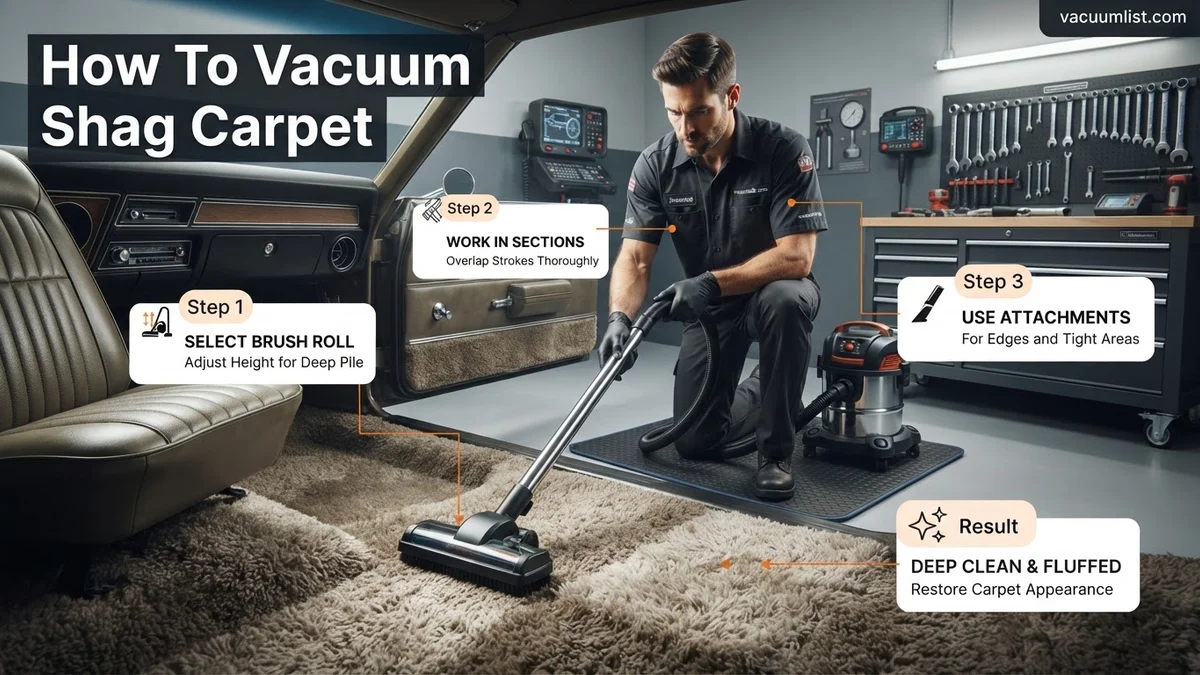
Why Traditional Vacuuming Damages Shag Carpet
Standard upright vacuums rely on aggressive beater bars designed for low-pile or commercial carpets. When these rotating brushes encounter 1-to-2-inch shag fibers, disaster strikes quickly.
The Dangers of Rotating Brush Rolls
- Fiber pulling: Stiff bristles snag individual yarn strands, pulling them out of the primary carpet backing.
- Fraying and twisting: High-speed friction unravels the tightly twisted tips of the shag, creating a fuzzy, worn-out appearance.
- Premature wear: Continuous mechanical stress thins out high-traffic zones years ahead of schedule.
The Risk of Pulled Yarns and Snags
Once a single shag loop catches on a spinning bristle, the entire strand can unspool. This creates unsightly runs and bald spots that standard trimming cannot fix. Even worst-case scenarios involve the vacuum cleanly slicing through delicate synthetic or wool fibers, permanently ruining the rug’s plush density.
Master Shag Carpet Vacuuming in 8 Simple Steps
Shag carpets offer a luxurious, retro-chic aesthetic and unmatched underfoot comfort, but their deep, thick pile requires a specialized cleaning approach. Standard vacuuming often fails because traditional beater bars get hopelessly tangled in the long fibers, while weak suction merely skims the surface of the dense carpet bed. This comprehensive guide will walk you through the exact methods, tools, and techniques required to safely and effectively deep-clean your shag carpet, removing trapped dirt, dust mites, and pet dander without damaging the delicate fibers.
Step 1: Disable the Rotating Beater Brush
What you need: Your vacuum cleaner and its user manual if you are unsure of the settings.
Instructions: Before your vacuum touches the rug, you must deactivate the rotating brush roll or beater bar. Shag fibers are exceptionally long and loose; a spinning bristle brush will grab these threads, pull them tight, and violently rip or fray them. Locate the height adjustment or brush-roll switch on your vacuum and turn the beater bar completely off. If your vacuum does not have a manual off switch for the brush, you will need to switch to a dedicated straight-suction floor nozzle attachment for this task.
Pro Tip: If your vacuum lacks a brush shut-off feature, never force it across shag carpet. Renting or purchasing a canister vacuum with a straight-suction floor tool is a safer alternative to avoid ruining your rug.
Step 2: Maximize Vacuum Suction Height
What you need: Your upright or canister vacuum cleaner.
Instructions: Adjust your vacuum’s height setting to the highest possible level. Shag carpets are densely packed, and if the vacuum head presses too flatly against the surface, it creates an airtight seal that cuts off airflow entirely. Raising the nozzle allows the vacuum to pull air up through the thick under-layers of the carpet. If your vacuum has manual suction control vents on the handle or hose, open them slightly to prevent the machine from gripping the rug too aggressively, which makes pushing and pulling nearly impossible.
Pro Tip: Test the glide resistance by pushing the vacuum gently. If it feels like you are pushing a heavy sled through sand, the height setting is still too low.
Step 3: Remove Loose Debris and Toys First
What you need: A laundry basket or trash bag, and your own hands.
Instructions: Get down on your hands and knees to thoroughly inspect the shag carpet before turning on the machine. Shag acts like a giant net, swallowing small items such as coins, Lego bricks, hair clips, and pet toys. Vacuuming over these items can puncture your vacuum bag, crack the internal fan blades, or cause a severe clog in the hose. Run your fingers through the fibers in a sweeping motion to pull hidden objects to the surface, and clear the area completely.
Pro Tip: Do a quick flashlight scan across the carpet at a low angle. The shadows cast by the light will instantly reveal hidden debris nestled deep within the fibers.
Step 4: Vacuum Using a Slow, Overlapping Grid Pattern
What you need: Your properly adjusted vacuum cleaner.
Instructions: Vacuuming shag requires patience because air needs time to travel through the deep pile to extract embedded dirt. Push your vacuum forward at half your normal speed, then pull it back slowly over the exact same path. Once you have completed a pass across the length of the room, rotate your direction 90 degrees and vacuum the entire space again to form a cross-hatch grid pattern. This multi-directional approach ensures you lift dirt that gets trapped from different angles within the twisted fibers.
Pro Tip: Never use a rapid back-and-forth scrubbing motion. Slow, deliberate strokes give the airflow enough dwell time to pull heavy sand and grit up from the carpet backing.
Step 5: Utilize the Upholstery Attachment for Edges and Corners
What you need: Vacuum hose and the wide upholstery or furniture brush attachment.
Instructions: The main vacuum head often cannot reach tightly into room corners or right up against baseboards where dust bunnies and pet hair accumulate. Attach your vacuum’s flexible hose and fit it with an upholstery tool. Press the tool gently into the perimeter edges of the shag carpet, using a lifting motion rather than a dragging motion. Pay special attention to areas underneath heavy furniture legs where the shag is compressed and tends to trap localized dust.
Pro Tip: If your upholstery tool has a lint strip, use it to pull up embedded pet hair that the suction alone fails to draw out from the tight perimeter zones.
Step 6: Hand-Rake the Fibers to Restore Fluffiness
What you need: A specialized carpet rake, a wide-tine wooden rake, or a clean metal pet slicker brush.
Instructions: Even after thorough vacuuming, shag carpet fibers can remain matted down from foot traffic. Take your carpet rake or pet brush and gently pull it through the carpet in long, sweeping strokes. This action lifts the crushed pile, untangles twisted yarn fibers, and restores that trademark plush, bouncy appearance. It also brings any remaining subsurface dust particles to the surface so your vacuum can catch them on a final light pass.
Pro Tip: Always rake in one consistent direction rather than scrubbing back and forth. This creates a uniform grain that makes the entire room look professionally cleaned.
Step 7: Address Trapped Odors with Baking Soda
What you need: 1 to 2 cups of plain baking soda and a fine-mesh sifter.
Instructions: Shag carpets readily absorb household odors due to their high surface area and deep backing. If your rug smells stale, fill your sifter with baking soda and dust a light, even layer across the entire surface of the dry carpet. Allow the baking soda to sit undisturbed for 30 to 45 minutes so it can absorb trapped oils and odor molecules. Finally, take your vacuum—with the beater bar still turned off—and slowly vacuum up all the baking soda residue.
Pro Tip: Avoid using commercial scented carpet powders, as their oils can coat the synthetic shag fibers, leaving a sticky residue that actually attracts more dirt over time.
Step 8: Empty the Bag or Dust Cup Immediately
What you need: Your vacuum cleaner and an outdoor trash bin.
Instructions: Shag carpets hold an astonishing amount of fine dust and particulate matter. By the time you finish vacuuming, your vacuum’s bag or cyclonic dust cup will likely be packed tight, which drastically reduces future suction power. Take the collection bin or bag outside immediately to empty it into a trash receptacle, tapping gently to release fine silt. If your vacuum uses a washable HEPA filter, rinse it out every month to maintain optimal airflow.
Pro Tip: Emptying the container outdoors prevents the cloud of fine dust you just worked hard to extract from escaping back into your indoor living space.
✅ Final Checklist
- Brush roll / beater bar was completely deactivated before starting
- Vacuum height was raised to prevent suction seal lockups
- Entire floor was vacuumed twice in a cross-hatch grid pattern
- Edges and corners were detailed using the upholstery attachment
- Carpet fibers were hand-raked to restore volume and fluffiness
Important Notes:
- Never use steam cleaners or heavy water extraction on vintage or natural-fiber shag rugs without professional supervision, as improper drying can cause mold and rotting backing.
- For delicate wool or silk shag rugs, consider hiring a certified professional carpet cleaner every 12 to 18 months.
- Estimated time: 30 to 45 minutes for a standard 10×12 room. Cost: $0 if you own the tools, or approximately $15–$25 if renting a specialty straight-suction vacuum.
What Causes Vacuums to Get Stuck on High-Pile Rugs
If you have ever tried pushing a standard vacuum across a thick shag rug, you know the frustration of the machine locking up tight. Several physical factors cause this frustrating suction trap.
The Suction Seal Problem
- Airflow restriction: Dense pile forms an airtight seal against the bottom plate of heavy vacuum heads.
- Lack of clearance: Low-riding vacuum nozzles lack the height needed to skim over plush fibers without compression.
- Overheating risks: Blocked airflow forces the vacuum motor to strain, leading to thermal overload and potential burnout.
Understanding Motor Strain and Belt Failure
When a shag carpet swallows your vacuum head, the motor works overtime to pull air through dense layers of yarn. This resistance generates excess heat. If your machine features a mechanical drive belt connected to a jammed brush roll, that belt will snap or melt within seconds. Upgrading your routine to a straight-suction technique eliminates this resistance entirely, keeping your equipment safe through 2026 and beyond.
Step-by-Step Guide on How to Vacuum Shag Carpet Safely
Cleaning high-pile textiles requires a methodical process to protect delicate yarn bindings. According to the Carpet and Rug Institute (CRI), following the correct mechanical settings prevents fiber distortion and premature wear.
Step 1: Adjust Your Vacuum Settings
Turn off the beater bar and roller brush entirely. If your upright model lacks a brush roll shutoff switch, use a dedicated straight-suction floor nozzle attachment.
Step 2: Execute Slow, Overlapping Passes
Move your vacuum nozzle forward and backward at half your normal speed. Slower passes allow adequate airflow to lift deep-seated particulate matter from the base of the thick backing.
Step 3: Vacuum from Multiple Angles
Divide your rug into quadrants and vacuum each section horizontally, then vertically. Changing directions dislodges tangled debris that settles between densely packed, twisted yarn strands.
- Set the vacuum head to its highest height adjustment to maximize airflow clearance over the thick pile.
- Disconnect motorized brush rolls to eliminate friction that causes fiber fraying and static matting.
- Gratefully glide the suction tool north-to-south across the entire surface area.
- Repeat the motion east-to-west to capture embedded grit trapped deeper down in the foundation.
What If Dirt Is Still Trapped After Vacuuming
Sometimes standard suction fails to remove stubborn grit, sticky residues, or embedded pet hair from heavy shag construction. If routine passes leave your fibers looking dull or feeling gritty, implement these advanced remediation steps:
- Perform Manual Raking: Use a specialized carpet rake or a clean, wide-toth plastic rake to gently loosen matted dirt and lift crushed pile fibers before a secondary vacuum pass.
- Apply Dry-Foam Extraction: Distribute an approved low-moisture absorbent powder formulated for high-pile rugs, let it bond to oils for 30 minutes, and vacuum it out thoroughly.
- Hire Professional Hot-Water Extraction: When DIY methods fail, schedule professional truck-mounted steam cleaning. Industry standards recommend professional deep cleaning every 12 to 18 months.
- Evaluate Professional Service Costs: Certified deep-cleaning services for oversized synthetic or wool shag rugs typically range from $150 to $350 depending on total square footage and fiber sensitivity.
Conclusion
Mastering how to vacuum shag carpet safeguards your investment against abrasive dirt buildup and fiber damage. By disabling rotating brush rolls and utilizing slow, multidirectional suction passes, you maintain the plush texture of your home flooring. According to verified research and expert sources from the Carpet and Rug Institute, regular maintenance combined with annual deep cleaning extends high-pile lifespan by up to 40 percent. Take your next actionable step today by inspecting your current vacuum settings and scheduling a systematic cleaning routine.
❓ Frequently Asked Questions
How do I prevent my vacuum from sucking up shag carpet threads?
Always disengage the beater bar and switch to a high-height setting or suction-only mode. If your vacuum lacks this feature, use a handheld upholstery attachment instead.
Is it safe to use a carpet rake on shag carpet?
A carpet rake is actually ideal for shag carpets. It fluffs flattened fibers, redistributes pile, and brings embedded dirt to the surface before you vacuum.
What is the best vacuum height adjustment for high-pile rugs?
Set your vacuum to the highest possible pile setting. This creates a gap between the vacuum head and the carpet surface, reducing suction lock and allowing easier movement.
How do I clean deep stains out of a shag carpet without ruining it?
Blot spills immediately with a clean, white cloth and a mild carpet cleaner mixture. Avoid aggressive scrubbing, which mats and ruins the surrounding long fibers.
Why does my vacuum smell burning when I clean my shag carpet?
A burning smell usually indicates that the brush roll is caught on the carpet threads and the belt is friction-stalling. Turn off the vacuum immediately and check the roller.
Should I shake out my shag rug instead of vacuuming?
Shaking smaller rugs outdoors is a great way to remove heavy grit that vacuums struggle to lift, but you should still vacuum periodically for routine dust removal.