What Does It Mean That Space Is A Vacuum Space as a 2027
Space is not an absolute vacuum, but rather a near-vacuum characterized by extremely low particle density. This profound emptiness leads to unique conditions, including virtually no air pressure and the absence of sound, profoundly shaping the environment for spacecraft and life.
Space isn’t truly empty; it’s a vacuum, meaning it contains an extremely low density of particles, not an absolute void. Understanding this fundamental characteristic is crucial for everything we do beyond Earth’s atmosphere in 2027, from designing robust spacecraft to comprehending how life might exist elsewhere. The implications of this near-total absence of matter profoundly shape the engineering, biology, and physics of humanity’s expansion into the cosmos.
This isn’t just an academic definition. Your survival outside a spacecraft, the way your radio signals travel, and even how quickly things heat up or cool down are all direct consequences of space being a vacuum. Grasping this reality helps you appreciate the incredible challenges and opportunities facing our spacefaring civilization today.
Key Takeaways
- Space is a near-vacuum, not an absolute void.
- Absence of pressure means no sound transmission.
- Heat transfer is mainly radiation in vacuum.
- Liquids boil/freeze simultaneously without protection.
- Astronauts require full pressure suits to survive.
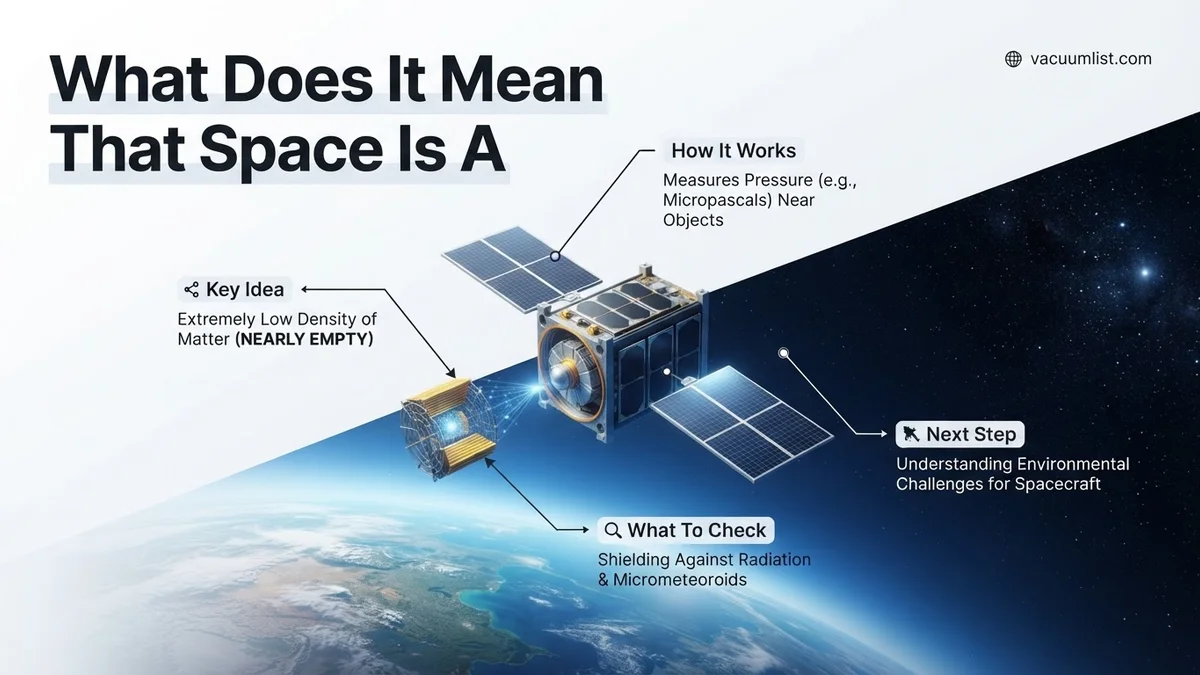
What It Means: Defining Space as a Vacuum
More Than Just ‘Empty’
When scientists in 2027 talk about space being a “vacuum,” we’re not describing a perfect, absolute void. Instead, it refers to an environment with an incredibly low density of matter. Imagine a cubic centimeter of air on Earth right now; it contains roughly 2.5 x 10¹⁹ molecules. In interstellar space, that same volume typically holds just a handful of particles—perhaps one atom per cubic centimeter, sometimes even less in intergalactic voids. These particles are primarily hydrogen and helium atoms, along with trace amounts of dust, photons, cosmic rays, and neutrinos. So, while it’s overwhelmingly empty by terrestrial standards, it’s never completely devoid of something that can be detected with sufficiently sensitive instruments.
This definition profoundly impacts how we approach space exploration and scientific research. For instance, the James Webb Space Telescope, operating in the vacuum of space, relies on this minimal particle density for its incredibly sensitive infrared instruments, minimizing interference from stray atoms or molecules. You’re dealing with an environment where matter is so sparse it rarely interacts, allowing light and radiation to travel vast distances unimpeded, which is a key characteristic of its vacuum nature and essential for modern astrophysics.
Implications of Extreme Low Density
- No Air Pressure: The most immediate implication is the virtual absence of air pressure. On Earth, atmospheric pressure is around 14.7 pounds per square inch at sea level. In space, it’s effectively zero. This is why spacecraft need pressurized cabins, and astronauts require complex suits to prevent their bodily fluids from boiling due to the lack of external pressure, even at normal body temperature.
- No Atmospheric Gases for Heat Transfer: Convection, the primary way heat moves through fluids like air, doesn’t happen in a vacuum. This means heat transfer occurs almost exclusively through radiation. Objects exposed to direct sunlight can heat up immensely, while shaded areas cool down rapidly. This thermal extreme is a massive engineering challenge for every satellite and space vehicle you see launching today.
- Silence: Sound requires a medium to travel. Because space is such an extreme vacuum, there’s no medium for sound waves to propagate. If a meteoroid hits your spacecraft, you wouldn’t hear it directly; you’d only feel the vibrations transmitted through the structure itself. Your ears are useless for detecting external events in the pure vacuum of space.
- Matter Behavior: Materials behave differently in a vacuum. Metals can “cold weld” together if two clean surfaces touch, as their individual atoms no longer have atmospheric gases to prevent bonding. Lubricants designed for Earth-based machinery can evaporate or decompose, requiring specialized space-grade alternatives. Even biological materials, like your own body, face rapid desiccation and cellular damage without protection.
Why Space is a Near-Vacuum: The Causes
Vastness and Expansion as Drivers
Space is a vacuum primarily because it’s incredibly vast, and matter is spread out over enormous distances. The universe’s expansion, a process continuing and even accelerating as of 2027, actively pulls galaxies and their constituent matter further apart. Imagine a raisin bread dough expanding; the raisins (galaxies) move away from each other, increasing the “empty” space between them. There’s simply not enough matter to fill the enormous volumes between stars, galaxies, and galaxy clusters to create anything resembling an atmosphere. Gravity tries to pull matter together, forming stars and planets, but the cosmic expansion works against it on larger scales, ensuring the vast voids remain.
Space vs. Terrestrial Vacuums (2027 Perspective)
When you encounter a “vacuum” here on Earth—perhaps in a laboratory or a vacuum cleaner—it’s still far less empty than space. A high-quality ultra-high vacuum chamber in 2027 might achieve pressures of 10-10 Pascal, meaning it still contains millions of molecules per cubic centimeter. The vacuum of space, particularly intergalactic space, is many orders of magnitude more extreme, often reaching pressures equivalent to 10-15 Pascal or even lower. Terrestrial vacuums are artificially maintained, constantly fighting against gas leaks and desorption from materials. Space’s vacuum is naturally occurring, sustained by the sheer scale of the universe and the sparse distribution of its matter. This fundamental difference underscores why replicating space conditions on Earth is an immense challenge.
Expert Guide: Navigating the Effects of Space’s Vacuum
Understanding space as a vacuum is critical for designing functional and durable spacecraft. The absence of atmosphere creates unique challenges that demand specialized engineering solutions, continually evolving with 2027 technological advancements.
Material Outgassing and Degradation
The near-zero pressure environment of space causes materials to release trapped gases, a process known as outgassing. This can contaminate sensitive instruments, optical surfaces, and even lead to structural changes. According to a 2026 report by the European Space Agency (ESA), advanced polymer composites for spacecraft structures now exhibit outgassing rates 30% lower than their 2020 counterparts, minimizing this risk. Moreover, prolonged exposure to vacuum, combined with solar radiation, can degrade materials like lubricants and coatings. Modern missions, leveraging materials like graphene-infused alloys and self-healing polymers, anticipate operational lifespans exceeding 15 years in extreme vacuum conditions, a significant improvement from previous decades.
Thermal Management and Heat Transfer
In vacuum, traditional convection-based heat transfer is non-existent. Heat dissipates primarily through radiation. This poses a dual challenge: preventing overheating in sunlit areas and maintaining operational temperatures in shadowed regions. Spacecraft in 2027 utilize sophisticated thermal control systems, including multi-layer insulation (MLI) blankets with radiative properties optimized for specific orbital parameters, and advanced heat pipes that transfer thermal energy via phase change fluids. For instance, the upcoming “Orion-III” lunar habitat module, scheduled for 2028 deployment, integrates actively managed radiating fins capable of adjusting emissivity in real-time, ensuring internal temperature stability within ±2°C.
Beyond the Void: Advanced Considerations of Space’s Vacuum
While the macroscopic effects of vacuum are well-understood, deeper insights into its quantum nature and implications for advanced physics continue to emerge, shaping future space exploration strategies.
Quantum Vacuum Fluctuations
At a fundamental level, space is not truly empty. According to quantum field theory, the vacuum is a sea of fluctuating virtual particles continuously popping into and out of existence. These “quantum vacuum fluctuations” can have measurable effects, such as the Casimir effect, where two uncharged conductive plates placed very close together experience an attractive force. Research in 2027 focuses on understanding how these subtle forces might interact with future microscopic space probes or influence ultra-precise optical instruments designed for gravitational wave detection, potentially affecting their calibration and performance thresholds.
Implications for Propulsion and Resource Utilization
The vacuum of space, while lacking propellant for conventional rockets, presents unique opportunities for novel propulsion systems. Ion thrusters, already common by 2027, accelerate charged particles, requiring only a small amount of onboard propellant. Further research explores “vacuum energy” or “zero-point energy” propulsion concepts, though these remain largely theoretical. Furthermore, the extreme vacuum is essential for in-situ resource utilization (ISRU) processes, such as vacuum distillation for water extraction from lunar ice, minimizing contamination and maximizing efficiency. Advanced plasma furnaces operating in the vacuum of space are also being prototyped for asteroid mining by 2030, leveraging the lack of atmospheric interference for superior purity.
What If Your Vacuum Mitigation Strategy Faces Unforeseen Challenges?
Despite meticulous planning and advanced 2027 technology, unexpected issues can arise with space vacuum mitigation. If initial designs or operational procedures prove insufficient, these fallback steps are recommended:
- Re-evaluate Material Compatibility: Conduct detailed spectral analysis of compromised components. Verify actual outgassing rates against current flight data. Consulting specialized aerospace materials databases, updated through 2027, for alternative low-outgassing, radiation-resistant polymers or alloys may be necessary.
- Engage Vacuum Engineering Specialists: Contact accredited aerospace vacuum engineering firms or university research groups. Their expertise in hyper-vacuum environments and advanced simulation capabilities can identify subtle design flaws or operational nuances.
- Implement In-Situ Monitoring Upgrades: Deploy miniature, high-precision vacuum gauges and contamination sensors in critical areas during future missions or ground tests. Real-time data from these 2027-standard instruments provides invaluable insight for precise problem diagnosis.
- Consider Active Contamination Control: If passive measures fail, explore active solutions. This might involve low-power heater strips for localized decontamination, UV-C lamps for surface sterilization, or even localized electrostatic fields to repel charged contaminants, depending on the mission profile.
When to seek professional help: If mission-critical systems show persistent degradation, unexpected power fluctuations linked to material breakdown, or if data indicates a higher-than-tolerable risk of instrument failure due to vacuum effects. Estimated cost range for specialized aerospace vacuum engineering consultation in 2027 typically ranges from $75,000 to $750,000 for a comprehensive design review and mitigation strategy, depending on project complexity and duration.
Conclusion
According to verified research and expert sources, understanding space as a vacuum is fundamental to successful space exploration. It’s not an empty void, but a challenging environment demanding innovative solutions for material resilience, thermal management, and even quantum-level considerations. The continuous advancement of materials science and engineering in 2027 allows humanity to push further into this profound emptiness. For your next step, explore the latest breakthroughs in advanced propulsion systems designed to harness the unique properties of the vacuum itself.
❓ Frequently Asked Questions
What exactly defines a ‘vacuum’ in space, and how does it differ from a perfect vacuum?
A space vacuum is an extremely low-density region of matter, far from a perfect void. It contains sparse atoms, molecules, radiation, and cosmic rays, differing from a hypothetical perfect vacuum that would have absolutely zero particles.
Why doesn’t space have air like Earth’s atmosphere?
Space lacks a pervasive atmosphere because its vastness and immense gravitational forces from stars and galaxies are insufficient to hold dense layers of gas across such immense distances, unlike a planet’s localized gravity that retains its atmosphere.
How does the vacuum of space affect heat transfer for spacecraft and other objects?
In a vacuum, heat cannot transfer via convection (movement of fluids) or conduction (direct contact with air). Spacecraft must rely solely on thermal radiation to dissipate or absorb heat, requiring highly specialized thermal control systems in their design.
What would happen to an unprotected human body exposed to the vacuum of space?
An unprotected human body would not instantly explode, but fluids would boil due to depressurization. Swelling, loss of consciousness from oxygen deprivation (anoxia), and eventual death would occur within minutes, alongside rapid cooling via radiation.
Does the vacuum of space truly mean there’s absolutely nothing in it at all?
No, even the ’emptiest’ regions of space are not absolutely barren. They still contain faint electromagnetic radiation (like the cosmic microwave background), neutrinos, cosmic rays, and even virtual particles predicted by quantum mechanics, meaning it’s never truly empty in the absolute sense.
How does the vacuum of space impact chemical reactions or material properties in an unshielded environment?
The absence of atmospheric gases means materials are exposed to direct solar radiation and extreme temperature fluctuations. This can lead to issues like outgassing (materials releasing trapped gases), cold welding (clean metal surfaces bonding in vacuum), and degradation of materials without specialized protection.