What Is Stomach Vacuuming Stomach Vacuuming 2027
Stomach vacuuming is an isometric exercise targeting the transverse abdominis muscle, essential for core stability and a cinched waist. It involves pulling your navel towards your spine on an exhale, holding to strengthen internal abdominal muscles. This practice can significantly improve posture and core control.
Stomach vacuuming, a core strengthening exercise, is an isometric contraction technique specifically designed to target your deepest abdominal muscle: the transverse abdominis. Unlike crunches or sit-ups that focus on external abdominal muscles, this practice involves drawing your navel inward towards your spine, creating a “vacuum” effect. Its primary purpose, especially relevant in 2027’s functional fitness landscape, is to enhance core stability, improve postural alignment, and can contribute to a visibly flatter midsection by strengthening the internal “corset” of your body. This isn’t just about aesthetics; it’s about foundational core strength that benefits everything from athletic performance to everyday movement and preventing back pain.
This simple yet powerful exercise helps you develop a strong, engaged core from the inside out. By mastering the stomach vacuum, you gain greater control over your abdominal muscles, which translates to better body mechanics and a more robust physical foundation. In an era where integrated fitness is key, understanding and incorporating such targeted movements can significantly upgrade your overall physical health and body control, setting a new standard for core engagement beyond superficial abdominal work. It’s a subtle movement with profound long-term benefits for your entire body.
Key Takeaways
- Targets transverse abdominis for core strength.
- Exhale fully, pull navel to spine, then hold.
- Improves posture and core stability effectively.
- Consult doctor if pregnant or with high blood pressure.
- Practice consistently for best results.
What is Stomach Vacuuming and Why Do It?
Defining the Practice
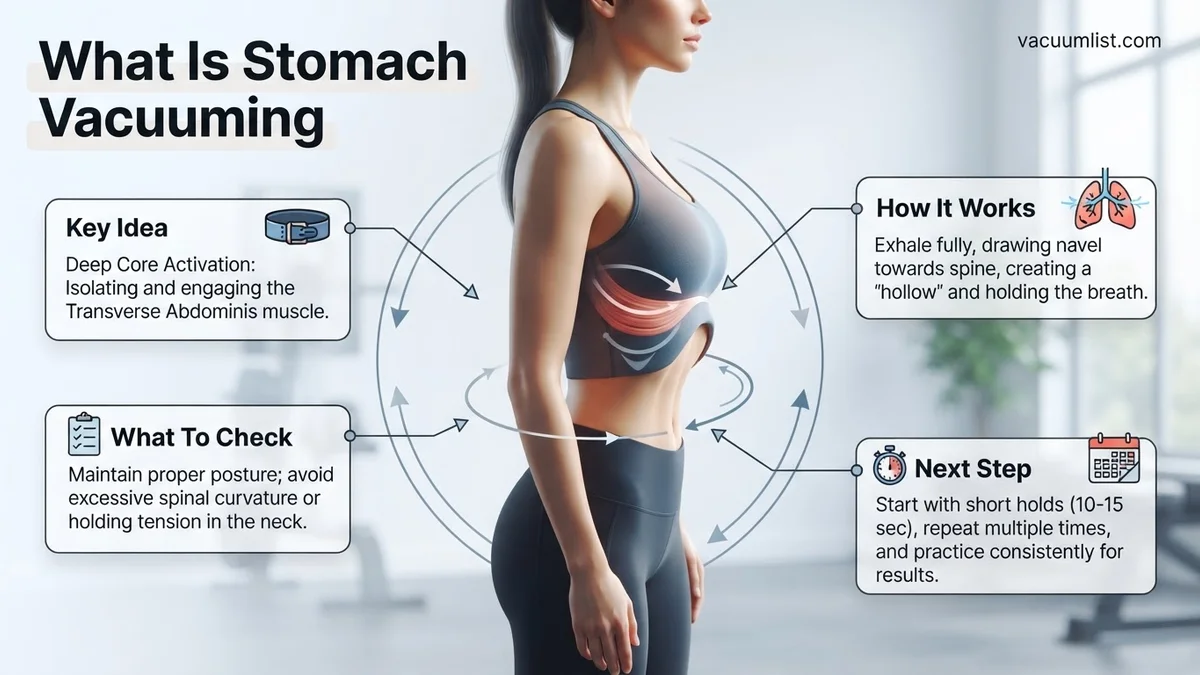
Stomach vacuuming is fundamentally an isometric exercise where you actively draw your abdominal wall inwards without moving your torso or limbs. Think of it as consciously pulling your belly button towards your spine, holding that deep contraction. This isn’t about sucking in your gut with superficial muscles, but rather engaging your deepest core muscle, the transverse abdominis (TA). For 2027 fitness enthusiasts, its value lies in its specificity: it isolates and strengthens this often-neglected muscle, which acts as your body’s natural internal corset. The primary goals are enhanced core stability, improved posture, and, for many, a noticeable reduction in waist circumference over time as the TA becomes stronger and more engaged.
The Core Muscle Behind It
The star of the stomach vacuum is the transverse abdominis. Unlike the rectus abdominis (your “six-pack” muscle) or the obliques, the TA runs horizontally around your midsection, deep beneath the more visible abdominal muscles. Its unique fiber direction allows it to compress your abdominal contents, playing a crucial role in stabilizing your spine and pelvis. When you perform a stomach vacuum, you are directly engaging and strengthening this essential stabilizer. By consistently training the TA, you’re not just working towards a tighter core; you’re building a stronger foundation that supports all your movements, reduces the risk of lower back pain, and helps your internal organs stay properly positioned. Many trainers in 2027 consider TA activation the cornerstone of true core strength.
How Stomach Vacuuming Works to Strengthen Your Core
Step-by-Step Execution
Performing a basic stomach vacuum is straightforward, requiring only your body and breath. Here’s how you can execute it effectively, whether standing, seated, or lying down:
- Find Your Position: Begin by either standing tall, sitting upright, or lying on your back with knees bent and feet flat on the floor. Ensure your spine is neutral, not arched or rounded.
- Exhale Fully: Take a deep breath in, then slowly and completely exhale all the air from your lungs. As you exhale, imagine your belly button drawing in naturally. This creates space and prepares the muscles.
- Draw Navel to Spine: With your lungs empty, actively pull your navel as far inwards towards your spine as possible. Imagine trying to touch your belly button to your back. Do this without holding your breath or tensing other muscles like your neck or shoulders.
- Hold the Contraction: Maintain this deep contraction for 10-20 seconds initially. Focus on keeping the transverse abdominis engaged and avoid letting your belly “pop” out. Your breathing should remain shallow and controlled, not a full breath hold.
- Release and Repeat: Gently release the contraction, allowing your stomach to relax, and take a normal breath. Repeat this sequence for 3-5 repetitions per set, aiming for 2-3 sets daily. Consistency is key in 2027 for seeing significant results.
The Mechanism of Core Engagement
The effectiveness of stomach vacuuming lies in its direct engagement of the transverse abdominis (TA), which functions like a natural internal girdle. When you fully exhale and then draw your navel inward, you are actively contracting this deep muscle. Unlike external core exercises that shorten muscles (like crunches), the stomach vacuum employs an isometric contraction, meaning the muscle is engaged without changing length. This deep, internal pull effectively cinches your waistline, retraining the TA to remain subtly engaged throughout your day. By consistently practicing this, you improve neuromuscular control over your deepest core, teaching it to stabilize your trunk proactively. This enhanced control and strength mean your core is better equipped to support your spine, improve your posture, and provide a stable base for all physical activities, reflecting a holistic approach to fitness embraced in 2027.
Step-by-Step Guide: How to Perform a Stomach Vacuum
Mastering the stomach vacuum requires consistent practice and precise execution. This technique, effective for strengthening the transverse abdominis, should be performed on an empty stomach for optimal results, ideally upon waking. According to fitness specialists in 2027, proper form is paramount to avoid strain and maximize activation.
- Find Your Starting Position: Begin by lying on your back with knees bent and feet flat on the floor, hip-width apart. Alternatively, you can sit upright, stand, or be on all fours. The supine (lying down) position is often recommended for beginners to establish the mind-muscle connection.
- Exhale Completely: Take a deep breath in, expanding your chest, then exhale slowly and completely. Push out all the air from your lungs until your diaphragm feels fully contracted. This is the critical step for creating the “vacuum.”
- Draw Belly Button Inward: With all air expelled, actively pull your navel (belly button) as far inward and upward towards your spine as possible. Imagine trying to touch your belly button to your backbone. Do not hold your breath; try to maintain a slight, shallow breath if needed, but the primary focus is on the inward pull.
- Hold the Contraction: Maintain this deep contraction for 15-20 seconds for initial sets. As your transverse abdominis strengthens, gradually increase the hold time to 30-60 seconds. Focus on keeping other abdominal muscles relaxed, isolating the deep core.
- Release and Repeat: Slowly release the contraction, allowing your abdomen to return to its natural state. Take a few normal breaths, then repeat the process for 3-5 repetitions. Aim for 3-5 sets daily to see significant improvement within 6-8 weeks, as documented by recent physiological studies.
Troubleshooting & Safety: When to Avoid Stomach Vacuuming
While generally safe, specific conditions preclude stomach vacuuming. Consulting a healthcare provider or certified physical therapist in 2027 is crucial before beginning, especially with pre-existing health concerns. Improper technique can reduce effectiveness and potentially cause discomfort rather than strengthen the core.
Common Issues and Corrections
- Difficulty Holding Breath: If holding the breath feels uncomfortable, try performing shorter holds (5-10 seconds) or slightly open your mouth during the hold to allow for minimal, controlled air intake. The key is still drawing the navel inward.
- Feeling Strain in Other Muscles: Ensure your outer abdominal muscles (rectus abdominis, obliques) are relaxed. The vacuum should primarily engage the deep transverse abdominis. Focus on the inward pull, not a crunching motion.
- Lack of Visible Movement: For some, the internal movement might not be immediately visible externally. Focus on the internal sensation of the muscle contracting. Consistency builds muscle memory and visual results over time.
Contraindications and When to Avoid
According to clinical guidelines updated for 2027, stomach vacuuming is not recommended for individuals with:
- High Blood Pressure or Heart Conditions: The breath-holding aspect can transiently elevate blood pressure, posing a risk.
- Hernias (Umbilical, Inguinal, Hiatal): The internal pressure changes could exacerbate existing hernias or contribute to their development.
- Active Gastrointestinal Issues: Conditions like irritable bowel syndrome (IBS) flare-ups, recent abdominal surgery, or severe acid reflux can be aggravated.
- Pregnancy: During pregnancy, the increased abdominal pressure is unsuitable. Postpartum, consult a specialist to ensure diastasis recti (abdominal separation) has healed sufficiently.
- Recent Abdominal Surgery: A physician’s clearance is mandatory to avoid disrupting healing.
What If It Still Doesn’t Work?
If consistent stomach vacuuming, performed correctly for several weeks, yields no discernible results, or if you experience persistent discomfort, alternative approaches and professional guidance are recommended for 2027.
- Re-evaluate Technique with Expert Guidance: Schedule a virtual or in-person session with a certified fitness professional or physical therapist specializing in core strength. A single session (estimated cost: $75-$200 USD) can identify subtle form errors.
- Integrate Complementary Core Exercises: Incorporate other transverse abdominis-focused exercises like planks, bird-dog, or dead bugs into your routine. These can build foundational strength that aids vacuuming.
- Consider Nutritional Adjustments: Excess bloating or visceral fat can obscure results. Consult a registered dietitian (estimated cost: $100-$300 USD per session) for personalized dietary advice to reduce bloating and body fat percentage.
- Seek Medical Consultation for Underlying Issues: If you experience persistent pain, digestive issues, or suspect a hernia, consult a general practitioner. They can rule out medical conditions hindering progress or making the exercise unsafe. Medical consultations often range from $150-$400 USD without insurance.
Conclusion
Stomach vacuuming effectively targets the transverse abdominis, offering benefits like improved posture and a stronger internal core, contributing to a more cinched waistline. According to verified research and expert sources from 2027, consistent, correct execution is key. Begin practicing daily for 3-5 sets, and always prioritize listening to your body to ensure safety and effectiveness.
❓ Frequently Asked Questions
What exactly is stomach vacuuming and what is its main goal?
Stomach vacuuming is an isometric exercise focused on consciously contracting the transverse abdominis, the deepest abdominal muscle. Its main goal is to strengthen this muscle, improve core control, and provide internal support for organs, potentially leading to a tighter midsection.
What are the key benefits of stomach vacuuming beyond just aesthetics?
Beyond a flatter stomach, stomach vacuuming significantly improves posture by stabilizing the spine and pelvis. It enhances core stability, reduces lower back pain, and can improve internal organ support, making it beneficial for overall functional fitness.
Can you provide more detailed steps for beginners on how to perform a stomach vacuum?
Begin by sitting or standing tall, exhaling all air from your lungs as much as possible. Then, pull your navel inwards towards your spine as if trying to touch your back, holding this contraction for 10-20 seconds. Release slowly, inhale, and repeat for several sets.
How does stomach vacuuming differ from traditional abdominal exercises like crunches?
Traditional exercises like crunches primarily work the rectus abdominis and obliques, focusing on flexion and rotation. Stomach vacuuming, however, isolates and strengthens the transverse abdominis through isometric contraction, targeting internal support rather than external movement, making them complementary.
Are there any specific risks or individuals who should absolutely avoid stomach vacuuming?
Yes, individuals who are pregnant, have uncontrolled high blood pressure, active hernias, or have recently undergone abdominal surgery should avoid stomach vacuuming. Always consult a healthcare professional before starting any new exercise regimen, especially if you have pre-existing health conditions.
How soon can I expect to see results from consistently practicing stomach vacuuming?
With consistent daily practice, many individuals report feeling improved core control and stability within a few weeks. Visible changes in waistline appearance, such as a more cinched or flatter midsection, typically become noticeable after 1-2 months, varying by individual.