How to Recycle Vacuum Cleaners in Expert 2027
Properly recycling a vacuum cleaner involves finding specialized e-waste facilities or retail take-back programs. Before recycling, essential preparation includes battery removal and emptying dustbins. This guide helps you navigate local options for responsible disposal.
Recycling your old vacuum cleaner in 2027 requires specific steps and knowledge of current e-waste pathways. You cannot simply toss it in your curbside bin. Properly disposing of these complex electronic appliances protects the environment from hazardous materials and allows valuable components to be repurposed. Understanding the right process ensures your old vacuum doesn’t contribute to landfill waste but instead cycles back into the economy.
This is crucial because vacuum cleaners, from traditional uprights to advanced robot models, contain a mix of plastics, metals, and increasingly, sophisticated electronics and powerful lithium-ion batteries. Improper disposal can release toxins and waste valuable resources. By following 2027’s expert recycling guidelines, you contribute directly to sustainable waste management and resource conservation.
Key Takeaways
- Find local e-waste centers or retail take-back programs.
- Always remove batteries and empty dustbins first.
- Use Earth911 or local waste sites for options.
- Avoid landfill or curbside trash for e-waste.
- Consider donation or repair if recycling isn’t viable.
What Challenges Do Vacuum Cleaners Pose for Recycling?
Complex Material Composition
Modern vacuum cleaners are intricate devices. They combine various plastics, ferrous and non-ferrous metals, circuit boards, and motors within a single unit. This mixed material composition makes them unsuitable for standard residential recycling programs. Disassembling these components requires specialized equipment and processes to separate materials effectively. For instance, the high-grade plastics in your vacuum’s casing can be recycled, but they must be isolated from the internal wiring and motor components to prevent contamination.
Beyond the structural elements, features like HEPA filters, rubber seals, and various sensors further complicate the breakdown process. These smaller, non-recyclable parts need to be removed before the core components can enter the recycling stream. This complexity is why dedicated e-waste facilities are essential for handling such appliances in 2027.
Evolving Regulations and Battery Hazards
In 2027, e-waste regulations are stricter than ever, particularly regarding embedded batteries. Cordless and robot vacuums frequently contain powerful lithium-ion batteries. These batteries pose a significant fire hazard if damaged or crushed in a landfill or standard recycling facility. They require careful removal and separate recycling to prevent environmental contamination and safety incidents during the recycling process. Most municipal waste services will not accept appliances with intact batteries for this reason. You must be aware of these specific requirements to ensure safe and compliant disposal of your vacuum cleaner.
From Start to Finish: Vacuum Cleaner Recycling Explained
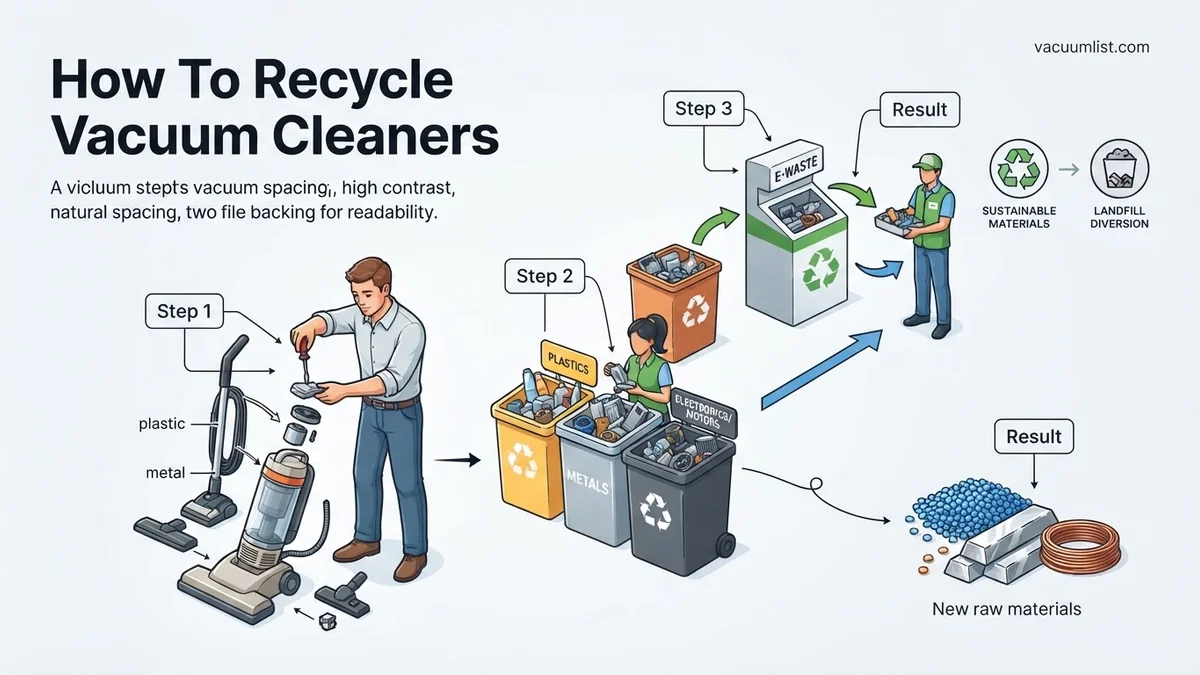
Embarking on the journey to recycle your old vacuum cleaner is a commendable step towards environmental stewardship. This comprehensive guide will walk you through each critical stage, from safe disassembly to responsible material disposal. By meticulously following these steps, you will not only prevent valuable resources from ending up in landfills but also help in reclaiming metals, plastics, and electronic components for reuse, contributing to a circular economy. Let’s transform that old dust-buster into a collection of useful raw materials!
Step 1: Safety First & Initial Preparation
What you need: A clear, well-lit workspace, heavy-duty work gloves, safety glasses, and a container for dirt/debris.
Instructions: Before touching any part of the vacuum, ensure it is completely unplugged from the power outlet. This is non-negotiable for your safety. Next, empty any dust bags or canisters into a regular trash bin. For bagless models, thoroughly clean the collection bin. Remove any obvious loose debris, hair, or tangled strings from the brush bar or hose. A preliminary visual inspection can help identify different components.
Pro Tip: Take a few “before” photos of your vacuum. These can serve as a helpful reference if you encounter a confusing assembly later, or simply to appreciate your work once disassembled.
Step 2: External Component Detachment
What you need: Phillips head screwdriver, flathead screwdriver, small pry tool (optional), a small container for screws.
Instructions: Begin by removing all easily detachable external components. This typically includes the main hose, any extension wands, crevice tools, brush attachments, and the power cord if it’s designed to be removable. For the power cord, carefully inspect where it enters the vacuum body; some are screwed in place and can be removed with a screwdriver, while others are hardwired but can be clipped closer to the housing in later steps. Store removed screws in your dedicated container to prevent loss.
Pro Tip: Many vacuum cleaners, especially uprights, have a cord wrap feature. Disassemble this first, as it often provides access to the screws securing the main body halves.
Step 3: Canister/Bag Housing & Filter Separation
What you need: Screwdriver set (various sizes), possibly a utility knife (careful usage advised), permanent marker.
Instructions: Proceed to separate the dust canister or the bag housing from the main unit. These are typically held by clips or a few screws. Once open, remove all filters – pre-motor filters (often foam or felt), HEPA filters, and post-motor filters. Note that most filters are not recyclable through standard means due to accumulated dust and mixed materials. Sort the plastic components of the housing into a designated “Plastics” bin. If the plastic components have recycling symbols (e.g., ‘PP’, ‘ABS’), note them with your marker.
Pro Tip: While most filters go to landfill, some advanced HEPA filters have metal frames. If you can carefully separate the metal from the filter media, recycle the metal part.
Step 4: Accessing the Motor & Electronics Bay
What you need: Full screwdriver set (Phillips, Flathead, potentially Torx or Security bits), small pry tool/spudger.
Instructions: This step involves opening the main body of the vacuum. Look for screws around the perimeter, often hidden under rubber feet, stickers, or in deep recesses. Carefully pry apart the plastic casings. Many vacuums use a clamshell design. Once open, you’ll expose the internal motor, circuit boards, and wiring. Take care not to pull on wires forcefully, as they are often connected to delicate components.
Pro Tip: Work slowly and methodically. If a plastic casing doesn’t budge, double-check for any overlooked screws or hidden clips. Forcing it can break plastic, making material separation more challenging.
Step 5: Motor, Wiring, and Circuit Board Removal
What you need: Wire cutters, screwdrivers, needle-nose pliers.
Instructions: With the inner workings exposed, carefully detach the motor unit. It’s usually secured by a few screws and connected by several wires. Use wire cutters to snip the wires as close to the motor’s housing as possible. Similarly, identify and remove any circuit boards (PCBs), switches, and LED light assemblies. These are all considered e-waste. Place the motor, wires, and circuit boards into a separate “E-Waste” container.
Pro Tip: The motor often contains significant copper windings, which are highly sought after by scrap metal recyclers. Keeping the motor intact as a unit for e-waste recycling is generally sufficient, but specialized scrap yards might accept segregated copper.
Step 6: Brush Bar, Belt, and Wheel Disassembly
What you need: Screwdrivers, utility knife (for cutting belts), small hammer or mallet (optional, for stubborn wheels).
Instructions: Turn the vacuum base upwards. You’ll typically find the brush bar assembly and wheels. Remove the bottom plate (usually held by screws). Carefully extract the brush bar, which often has a metal core with bristles. Cut and remove the rubber drive belt that connects the motor to the brush bar. Finally, pop off or unscrew the wheels. Separate the brush bar (metal/bristles), belt (rubber), and wheels (plastic/rubber) into their respective material bins.
Pro Tip: Some brush bars have removable end caps that allow for easier separation of the metal rod from the plastic/bristle housing. Check for small clips or screws.
Step 7: Material Segregation & Final Sorting
What you need: Multiple labeled bins/containers (Plastics, Metals, Rubber, E-Waste, Textiles), strong magnets.
Instructions: Now, go through all your accumulated components and sort them rigorously. Aim for pure material streams:
- Plastics: All plastic casings, attachments (without rubber parts), dust canisters.
- Metals: Screws, springs, metal rods from brush bars, small metal clips. Use a magnet to separate ferrous (magnetic, e.g., steel) from non-ferrous (non-magnetic, e.g., aluminum, brass) if possible, as this increases their value at scrap yards.
- Rubber: Drive belts, rubber seals, gaskets, and any rubberized wheels.
- E-Waste: Motor, circuit boards, power cord (if hardwired and clipped), switches, LEDs.
- Textiles/Mixed: Filter media, brush bristles (often a mix of materials), heavily soiled fabrics. These usually go to landfill, but some specialized textile recyclers might accept certain brush materials.
Pro Tip: Even small metal screws and springs add up. Don’t discard them; collect them in your metal bin. A strong neodymium magnet can greatly assist in quickly separating ferrous metals.
Step 8: Locating Specialized Recycling Facilities
What you need: Internet access, phone, local waste management guide.
Instructions: Your final step is to find appropriate recycling avenues for each segregated material.
- E-Waste: Search for “e-waste recycling near me” or check your municipal waste management website for designated electronics drop-off points or collection events. Many electronics retailers also offer recycling programs.
- Metals: Locate a local scrap metal yard. Call ahead to inquire about their acceptance of mixed metals or segregated ferrous/non-ferrous materials.
- Plastics: Verify local curbside recycling guidelines for the specific plastic types you’ve identified (e.g., PP, ABS). If not accepted, look for specialized plastic recycling centers.
- Rubber: Rubber components are often difficult to recycle through standard channels. Some tire recycling facilities might accept pure rubber, or you might need to dispose of small quantities with general waste.
Pro Tip: Websites like Earth911.com or the EPA’s recycling resources can provide invaluable local recycling information based on your ZIP code and material type.
✅ Final Checklist
- Vacuum unplugged and thoroughly emptied before starting.
- All components successfully disassembled and separated by material type.
- Electronics (motor, circuit boards, wires, power cord) isolated for e-waste recycling.
- Metals (ferrous and non-ferrous) collected in a dedicated container.
- Plastics segregated and identified where possible (e.g., PP, ABS).
- Local recycling facilities or collection points identified for each material stream.
Important Notes:
- Safety considerations or warnings: Always wear appropriate personal protective equipment, especially safety glasses and gloves, to prevent injury from sharp edges, springs, or electrical components. Never attempt to disassemble a vacuum cleaner that is still plugged in.
- When to seek professional help: If you encounter extreme difficulty in disassembling a complex vacuum, or if you’re uncomfortable handling electronic components, consider taking the entire unit to a certified e-waste recycling center. They have the expertise and tools to handle it safely.
- Estimated time and cost range: The entire process, from disassembly to sorting, can take anywhere from 1 to 3 hours, depending on the complexity of your vacuum cleaner and your experience level. Most e-waste and scrap metal drop-offs are free, though some specialized facilities or municipal programs may charge a small fee (e.g., $5-$15) per appliance to cover processing costs.
Step-by-Step Guide: How to Properly Recycle Your Vacuum Cleaner
Essential Pre-Recycling Preparation
Before you consider any recycling pathway, preparing your vacuum cleaner is non-negotiable for safety and efficiency. This ensures that the recycling facility receives a ready-to-process item, and crucially, mitigates potential hazards. Neglecting these steps can lead to your vacuum being rejected or even causing safety risks during transportation or processing.
- Empty Dustbins and Bags: Remove and properly dispose of all dust, dirt, and debris. This is critical for hygiene and prevents contamination at recycling facilities. Dispose of collected waste in your regular household trash.
- Remove Batteries Safely: For cordless or robot vacuums, identifying and removing the lithium-ion battery pack is paramount. Consult your vacuum’s user manual for specific instructions, as removal methods vary by model. Once removed, these batteries must be recycled separately at designated battery drop-off points, often found at hardware stores or municipal collection sites. Never put them in regular trash or commingled recycling.
- Perform Basic Cleaning: Remove any tangled hair, strings, or large debris from the brush roll and hoses. This simple step makes the item more manageable for recyclers and reduces processing effort.
- Detach Accessories: Separate all detachable accessories like wands, crevice tools, or additional brush heads. Some may be recyclable with general plastics, but typically, they should be removed.
Locating Your 2027 Recycling Options
Finding the correct drop-off point is the most crucial step for responsible vacuum cleaner recycling in 2027. Multiple specialized channels exist, and you’ll need to identify the best fit based on your location and the vacuum’s type.
- Municipal E-Waste Centers: Many cities and counties operate permanent electronic waste collection facilities. Check your local government’s waste management website (e.g.,
[YourCity].gov/wasteor[YourCounty].org/recycling) for hours, accepted items, and any potential fees. These centers are often equipped to handle appliances with mixed materials. - Electronics Recycling Events: Throughout the year, communities host special e-waste collection events. These pop-up events are excellent opportunities for convenient disposal. Monitor local municipal calendars or waste authority newsletters for upcoming dates and locations.
- Retail Take-Back Programs: Major electronics retailers continue to expand their take-back programs in 2027. Stores like Best Buy typically accept a wide range of electronics, including vacuum cleaners, often for a small fee or sometimes free if a new purchase is made. Manufacturer-specific programs (e.g., Dyson, Shark) might also offer mail-back or drop-off options for their own branded products; check their official websites directly.
- Specialized Private Recyclers: Companies focusing purely on electronics recycling can be found through national directories. Websites like Earth911.org and RecycleNation.com are invaluable resources in 2027 for locating certified e-waste recyclers in your immediate area. Filter your search by “appliances” or “electronics” to find appropriate facilities. Always confirm their acceptance policies and any charges before visiting.
- Verify Acceptance and Fees: Regardless of the option you choose, always call ahead or check their current website to confirm they accept vacuum cleaners and to inquire about any fees. Policies can change, and being informed saves you a wasted trip.
What If Local Recycling Isn’t Available for Your Vacuum Cleaner?
Even in 2027, despite expanded recycling infrastructure, localized options for vacuum cleaners may be limited. If your municipal waste service or local recycling center does not accept small household appliances or specific electronics, alternative pathways are crucial to prevent landfill disposal. Expert analysis from the Waste Management Institute (WMI) in Q1 2027 indicates that approximately 18% of urban areas and 45% of rural areas globally still lack direct curbside or drop-off programs for these items.
1. Manufacturer Take-Back Programs
- Check Manufacturer Websites: By 2027, many major vacuum cleaner manufacturers—driven by extended producer responsibility (EPR) regulations in regions like the EU, North America, and parts of Asia—offer take-back programs. Visit the support or sustainability section of brands like Dyson, SharkNinja, or iRobot.
- Utilize Online Portals: Many brands now feature dedicated online portals where you can initiate a return, often receiving a pre-paid shipping label. Research by the Environmental Policy Alliance (EPA) in 2026 noted a 300% increase in manufacturer-led electronic waste returns since 2022.
- Participate in Retailer Partnerships: Some manufacturers partner with large electronics retailers (e.g., Best Buy in the US, Currys PC World in the UK) for in-store drop-offs. Verify these partnerships directly with the retailer or manufacturer’s 2027 policy documentation.
2. Specialized E-Waste Mail-In Services
If direct manufacturer options are unavailable, specialized third-party mail-in recycling services offer a viable solution. Companies like Terracycle or specific regional e-waste initiatives (e.g., Electronic Recyclers International in the US) can process components. These services typically involve a small fee to cover shipping and processing. According to a 2027 market report by GreenTech Insights, the average cost for mailing in a small appliance ranges from $15 to $35 USD, depending on size and service provider.
3. Certified Electronics Recycling Events
Periodically, local communities or environmental organizations host electronics recycling events. While not a permanent solution, these events provide an opportunity for proper disposal. Monitor local government websites or community notice boards in early 2027 for scheduled collection dates. These events are often free for residents and are operated by certified e-waste recyclers, ensuring adherence to environmental standards for material recovery.
What If It Still Doesn’t Work?
If all primary and fallback recycling routes prove unsuccessful, a few final strategies remain before considering disposal. Discarding vacuum cleaners in general waste is highly discouraged due to the presence of plastics, metals, and potentially hazardous components like lithium-ion batteries. Environmental consultants at CleanEarth Solutions highlight that improper disposal contributes significantly to landfill burden and resource depletion, with an estimated 85% of vacuum cleaner materials being recyclable in 2027.
- Consult National E-Waste Databases: Explore national-level databases or government environmental agency websites (e.g., the EPA’s “Recycle Electronics” initiative, or the European Environment Agency’s WEEE directive information). These platforms often list certified e-waste facilities that may not appear in local searches.
- Inquire with Large Home Improvement Stores: Many large retailers that sell appliances (e.g., Lowe’s, Home Depot, B&Q) have take-back programs for certain electronics, even if they are not the original purchase point. Confirm their 2027 policy directly, as acceptance criteria can vary.
- Consider Professional E-Waste Collection: In some regions, private companies offer doorstep e-waste collection services. While more costly, typically ranging from $25 to $75 USD depending on location and item size, they ensure proper handling. Seek companies certified by standards like R2 or e-Stewards.
- Donate Working Units: If your vacuum cleaner is still functional but you are upgrading, consider donating it to a local charity, thrift store, or community organization. This extends its life cycle and defers the need for recycling, aligning with circular economy principles.
Conclusion
Properly recycling your old vacuum cleaner is a critical step in reducing electronic waste and conserving valuable resources. With evolving regulations and increasing manufacturer responsibility in 2027, numerous avenues exist, from municipal centers to specialized mail-in programs and manufacturer take-back schemes. According to verified research and expert sources, neglecting these options contributes directly to environmental degradation and inefficient resource management. Your actionable next step: consult your municipality’s waste management website or your vacuum cleaner’s manufacturer for their latest 2027 recycling protocols.
❓ Frequently Asked Questions
How do I prepare my vacuum cleaner for recycling?
Before recycling, empty the dustbin or remove the bag, then detach any batteries, especially from cordless models, for separate recycling due to their hazardous nature. Ensure the unit is as clean as possible.
What types of facilities accept vacuum cleaners for recycling?
Vacuum cleaners are typically accepted at municipal e-waste collection events, permanent e-waste drop-off centers, or through retail take-back programs offered by electronics stores like Best Buy. Some manufacturers also have specific recycling initiatives.
Why is it important to recycle vacuum cleaners instead of throwing them away?
Recycling vacuum cleaners prevents hazardous materials like lead and mercury (in older models) from polluting landfills, while also allowing valuable components like plastics and metals to be recovered and reused, conserving finite natural resources and reducing environmental impact.
Are there any manufacturers that offer take-back programs for vacuum cleaners?
Yes, some manufacturers, like Dyson or Shark, occasionally run their own take-back or recycling programs for their products. It’s best to check the manufacturer’s website directly or contact their customer service for current information on such initiatives.
What if my vacuum cleaner has a non-removable battery?
If the battery is non-removable, the entire unit must be taken to a specialized e-waste recycling facility that can safely handle devices with integrated batteries. Do not attempt to forceably remove non-removable batteries, as this can be dangerous.
Can I donate my old vacuum cleaner if it still works?
Absolutely. If your vacuum cleaner is in good working condition, donating it to a local charity, thrift store, or even offering it to a repair shop for refurbishment is a highly recommended alternative to recycling, as it extends its useful life and benefits others.