Does a Vacuum Kill Spiders? Expert Guide for 2026
Yes, vacuums usually kill spiders due to the intense physical trauma of traveling through the hose, hitting the fan blades, and experiencing sudden decompression. However, some resilient spiders survive, especially in bagless vacuums where they can crawl back out of the collection bin if not emptied immediately.
Yes, vacuuming generally kills spiders, but survival depends entirely on the type of vacuum you own and the physical journey through the machine. When you suck up a spider, it faces extreme high-speed turbulence, violent impacts against plastic walls and the fan blades, and crushing air pressure that usually proves fatal before it even reaches the collection bin.
However, modern 2026 vacuum technology means high-efficiency models and gentle suction modes can sometimes allow hardy arachnids to crawl through unscathed. Knowing whether your specific vacuum acts as an executioner or just a temporary holding cell prevents unwanted survivors from crawling back out onto your living room floor.
Key Takeaways
- High-speed suction and impact against internal vacuum parts kill most spiders instantly.
- Bagless vacuum canisters allow surviving spiders to escape unless emptied right away.
- Bagged vacuums trap spiders securely, making escape nearly impossible.
- Emptying the vacuum canister into an outdoor trash bin prevents indoor escape.
- Vacuuming egg sacs poses a major risk of a future infestation if not discarded.
What Causes Spiders to Survive or Die Inside a Vacuum
The Physics of the Vacuum Journey
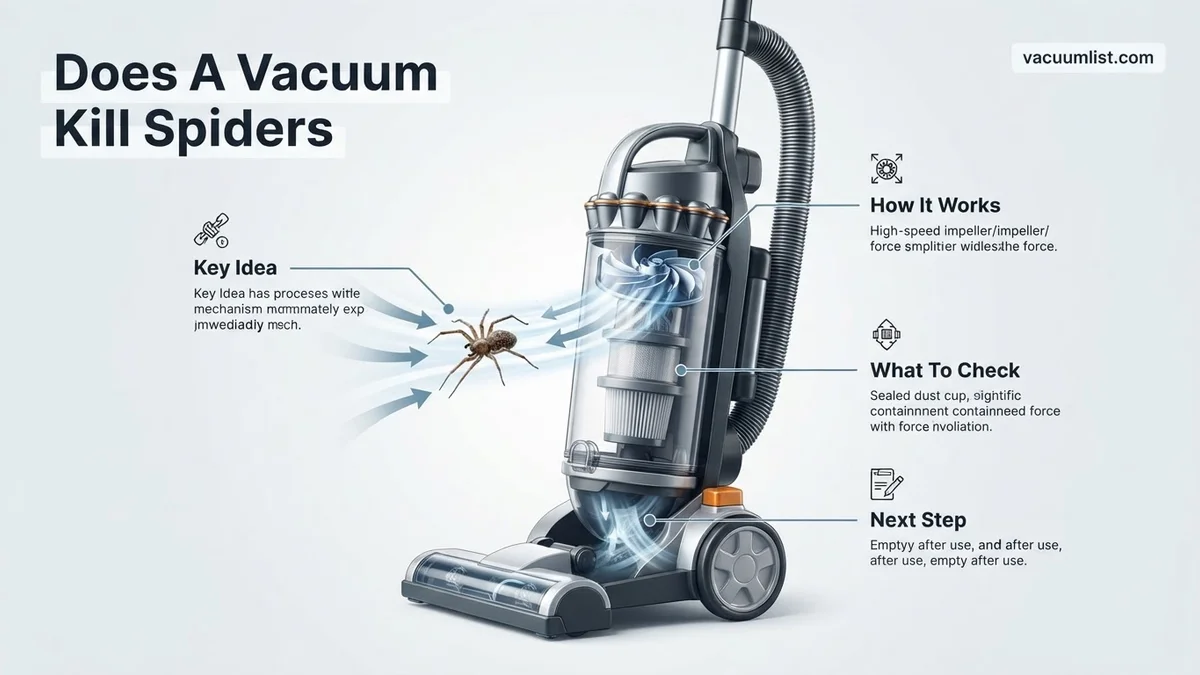
The main reason most spiders do not survive a trip up your vacuum hose is physical trauma. As the spider accelerates through the narrow hose, it collides repeatedly with ridged interior walls, sharp turns, and the spinning impeller fan.
- Impact Force: The centrifugal force inside a canister or bagless cyclone chamber mimics a high-speed car crash for a small insect.
- Debris Barrage: Dust, pet hair, and gravel pulled in alongside the spider act as projectiles, further crushing the arachnid.
- Fragility Factor: Larger wolf spiders or heavy-bodied orb-weavers are more likely to suffer fatal trauma than tiny, lightweight cellar spiders.
Bagged Versus Bagless Vacuum Survival Rates
Your choice of collection system heavily influences whether a surviving spider can escape later. In 2026, home cleaning appliances feature vastly different containment designs that impact pest survival.
- Bagged Vacuums: Spiders trapped inside a multi-layered paper or cloth bag are buried under debris, starved of oxygen, and rarely find a way back out through the intake port.
- Bagless Canisters: Transparent plastic bins allow spiders to land on open surfaces where they can easily crawl up the smooth walls if the suction wasn’t lethal.
How to Safely Trap and Dispose of Spiders Using a Vacuum
Using Specialized Attachments
If you prefer using a vacuum for pest control, your choice of attachment matters for both safety and effectiveness. Crevice tools and extension wands give you the reach you need while increasing the velocity of the airflow.
- Length and Acceleration: A longer hose increases the travel time and the number of surface impacts the spider experiences.
- Keep Your Distance: Long wands allow you to vacuum aggressive or venomous spiders without getting dangerously close.
- Seal the Tip: Turn off the vacuum immediately after capturing the spider to prevent it from reversing direction if the motor spins down slowly.
Post-Vacuum Disposal Protocol
Catching the spider is only half the battle; what you do immediately afterward determines if your vacuum becomes an escape room. Standard emptying procedures need a slight adjustment when dealing with live pests.
- Empty Immediately: Do not let a bagless bin sit for days, as surviving pests will actively look for exit routes.
- Outdoor Disposal: Empty bagless canisters directly into an outside garbage bin rather than an indoor kitchen trash can.
- Bag Disposal: For bagged vacuums, consider spraying a quick burst of insecticide down the hose or tossing the full bag into an exterior bin if you suspect large survivors.
What If Spiders Are Still Crawling Out of Your Vacuum Canister
Finding a live spider crawling out of your vacuum canister can be an alarming experience, but entomologists and pest control experts note that this is entirely possible. Vacuuming sucks up debris, but airflow dynamics and structural barriers do not guarantee immediate mortality. Standard upright models with HEPA filters often trap arachnids in a maze of dust, hair, and suction channels where they can survive for hours.
Bagless Canister Survival Risks
Bagless vacuums present a unique escape route for resilient household spiders. Once suction stops, the internal cyclone chamber loses pressure, allowing agile species like the common house spider to climb back up the hose or slip through poorly sealed canister lids. According to pest management data updated for 2026, opening a bagless vacuum immediately after a capture often results in the spider escaping into the room.
Bagged Vacuum Containment Success
Bagged vacuum cleaners offer a much higher survival prevention rate than bagless models. The physical barrier of a tightly woven paper or cloth bag, combined with the lack of oxygen and the abrasive nature of compressed dust particles, significantly reduces escape potential. However, large wolf spiders or funnel weavers possess enough body mass to occasionally tear through weak generic vacuum bags.
- Empty or seal the vacuum bag immediately after capturing a venomous or aggressive spider species.
- Dispose of the sealed bag in an outdoor waste bin to prevent re-entry into living spaces.
- Spray a targeted burst of insecticide directly into the vacuum hose or canister if live movement is detected inside.
Alternative Proven Methods for Removing Spiders Safely
Relying solely on a vacuum cleaner is not always the most efficient or humane method for household pest control. Integrated pest management guidelines recommend physical capture and release or targeted chemical elimination as superior alternatives to suction removal. These techniques minimize the risk of sudden spider escapes and protect vacuum mechanisms from moisture or debris clogs.
The Classic Catch-and-Release Method
The traditional cup-and-paper technique remains one of the safest ways to handle non-venomous spiders without risking a bite or a messy cleanup. Place a sturdy glass or plastic container directly over the spider, slide a stiff piece of cardstock underneath the rim, and transport the arachnid outside at least 50 feet away from the home foundation.
Targeted Aerosol Sprays
Pyrethrin-based contact sprays provide instant knockdown capabilities without requiring close physical proximity. These commercial formulas neutralize arachnids within seconds by targeting their nervous systems. Unlike vacuuming, contact sprays ensure zero chance of survival or escape.
- Identify the spider species to ensure it is not a dangerous variety like the black widow or brown recluse.
- Use the cup-and-paper method for slow-moving, harmless web-builders found in open areas.
- Apply a registered contact aerosol spray from a safe distance of two to three feet if dealing with fast-moving ground hunters.
What If It Still Doesn’t Work?
Persistent spider infestations or encounters with medically significant species require strategies that go beyond basic household cleaning tools. When standard removal methods fail or population numbers multiply rapidly, homeowners must pivot to advanced structural and professional solutions.
- Seal all exterior entry points, including gaps around window frames, utility penetrations, and door sweeps, using a high-grade silicone caulk.
- Reduce indoor humidity levels below 50 percent using dehumidifiers to naturally deter moisture-seeking pests.
- Apply a residual barrier insecticide along baseboards, crawlspaces, and perimeter foundations.
- Hire a licensed pest control professional for persistent venomous infestations, with average 2026 treatment costs ranging from $200 to $450 depending on home square footage.
Conclusion
While vacuums can successfully capture and occasionally kill household spiders through physical trauma and suffocation, they are not a foolproof extermination method. Surviving arachnids often escape from bagless canisters, making proper post-vacuum maintenance essential. According to verified research and entomology experts, combining sealed containment protocols with physical exclusion techniques offers the most reliable long-term defense. As an immediate next step, inspect your vacuum canister outdoors and seal any vulnerable entry points around your home exterior today.
❓ Frequently Asked Questions
Does a vacuum kill spiders instantly upon suction?
Not always. While the high-speed impact against the fan blades or the inside of the plastic tubing kills many spiders, smaller or softer-bodied spiders can sometimes absorb the shock and survive the journey into the canister.
Is it safe to leave a spider in a bagless vacuum canister?
It is not safe if you want the spider gone permanently. Bagless canisters are smooth plastic chambers that agile spiders can easily scale, allowing them to crawl back out through the hose or around the seal.
How long can a spider survive inside a vacuum bag?
Most spiders trapped inside a sealed vacuum bag will suffocate, dehydrate, or succumb to injuries within a few hours to a couple of days, especially if they are surrounded by dust and debris.
What should I do immediately after vacuuming a large spider?
To prevent any chance of escape, take your vacuum outside, empty the bagless bin directly into a trash bag, tie it securely, and place it in an outdoor bin. If you use a bagged vacuum, consider tossing the disposable bag if the spider was venomous.
Can poisonous spiders like black widows survive being vacuumed?
Yes, dangerous spiders can survive the vacuuming process just like harmless species. If you suspect you have vacuumed a venomous spider, handle the disposal process with extreme caution and wear gloves.
Are there better alternatives to vacuuming up spiders?
Using a traditional catch-and-release cup and piece of paper is a reliable alternative if you prefer not to harm them. Alternatively, commercial insect sprays provide a direct chemical knockdown without risking a live escape.