Does Vacuum Bag Reduce Weight? Real 2026 Physics Guide
No, vacuum storage bags do not reduce the physical weight of your clothing, bedding, or luggage. While they dramatically compress the volume by removing air, the mass of the items inside remains virtually unchanged, meaning you can still face heavy airline baggage fees.
No, a vacuum bag does not reduce the weight of your clothing, bedding, or luggage. While compression bags perform the magical feat of shrinking bulky winter coats and thick blankets down to a fraction of their original size, they do not change the actual mass of the items inside.
As you plan your travel or home organization strategy for 2026, understanding this fundamental law of physics will save you from surprise airline baggage fees and frustration. Sucking the air out of a bag alters its dimensions, but it cannot make matter disappear.
Key Takeaways
- Vacuum bags reduce volume (space), not physical mass (weight).
- The air removed from clothing has a negligible weight of less than a few grams.
- Airlines measure weight limits strictly, regardless of how small your bag packs down.
- Overpacking a compressed bag frequently leads to unexpected overweight baggage fees.
- The heavy plastic of the vacuum bag actually adds a tiny amount of weight.
What Causes the Confusion Around Vacuum Bags and Weight
The misconception that vacuum bags reduce weight stems from a simple optical illusion and our physical association between size and heft. When you look at a massive king-sized duvet, your brain automatically assigns it a heavy weight. Shrinking that same duvet down to the thickness of a yoga mat tricks your senses into expecting it to feel lighter.
The Physics of Mass Versus Volume
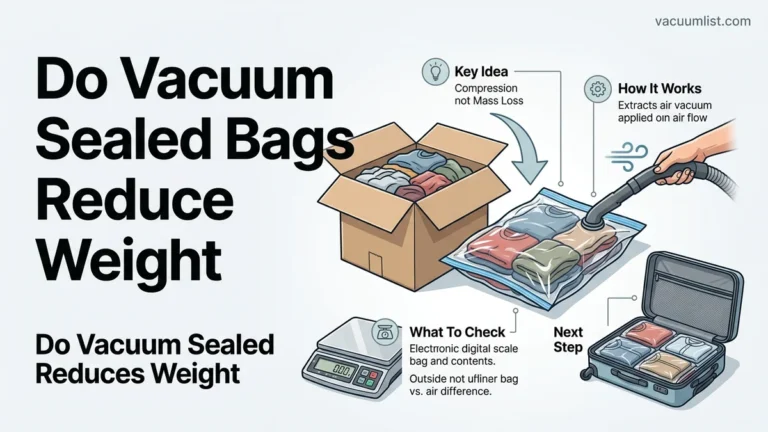
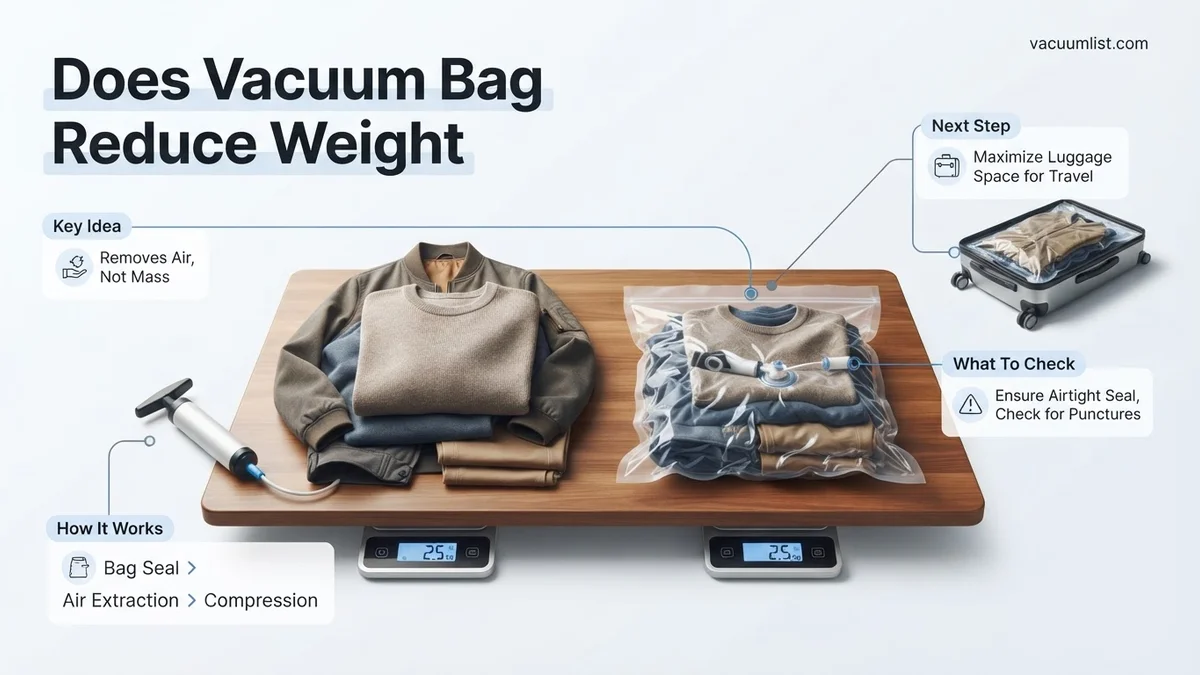
Air has mass, but the amount of ambient air trapped inside a loose pile of clothing is negligible. When you suck the air out of a storage bag, you are merely removing gases and reducing the volume, not the mass of the solid fabrics.
Volume: The amount of space an object occupies (which vacuum bags drastically reduce).
Mass: The actual quantity of matter in an object (which remains completely unchanged).
Density: Increases significantly because the same amount of fabric is now packed into a much tighter space.
The Airline Baggage Trap
Travelers frequently fall into a costly trap when packing for 2026 flights. Because compression bags allow you to cram three weeks’ worth of heavy sweaters into a tiny carry-on or checked bag, you easily exceed airline weight limits long before the suitcase is full.
A standard checked bag limit is typically 50 pounds (23 kg).
You can easily fit 70 pounds of dense clothing into a large suitcase using heavy-duty vacuum bags.
Airlines measure gravity, not geometry—they will charge hefty overweight fees regardless of how small your bag looks.
How to Weigh Luggage Accurately When Using Compression Bags
Because vacuum packing changes how a bag feels and sits on a scale, you need a reliable strategy to avoid airport penalties. When dense items are compressed into a rigid brick, the weight distribution shifts, which can sometimes throw off cheap bathroom scales.
Using Digital Hand Scales Before You Leave
The most effective way to check your luggage weight in 2026 is a portable digital handheld luggage scale. Hook it to the strap of your packed vacuum bag and lift.
Weigh your suitcase while it is fully packed and compressed, just as you plan to carry it.
Remember to account for the weight of the vacuum bags themselves, especially if you are using heavy-duty travel roll bags with thick plastic sliders.
Leave a buffer of at least two pounds to account for scale calibration differences at the airport.
Smart Packing Strategies for Dense Items
Since vacuum bags let you pack more items into a single container, you must monitor what actually goes inside. Distribute your heaviest items carefully to maintain control over the final scale reading.
Reserve vacuum bags for genuinely bulky, low-density items like pillows, jackets, and plush blankets rather than heavy denim or boots.
Use a bathroom scale method by weighing yourself first, then weighing yourself while holding the compressed luggage, and finding the difference.
Never assume a smaller suitcase equates to a lighter suitcase when compression technology is involved.
What If Your Vacuum-Packed Bag Still Exceeds Airline Limits
Even with air compressed out of your belongings, your luggage may still violate strict carrier mass regulations in 2026. Budget airlines often enforce a strict 10 kg (22 lbs) ceiling for carry-on pieces. If your compressed bag triggers the scale, you need immediate physical adjustments.
Isolate Dense Items
Heavy objects like shoes, electronics, and toiletries defy the benefits of compression. Vacuum bags remove volume, not mass. A tightly packed cube of jeans remains dense. Extract these heavy components and redistribute them into personal items or wear them during check-in.
Weigh Before You Go
Do not guess your luggage mass at the airport. Utilize digital luggage scales rated for accuracy within 0.05 kg. Calibrating your gear beforehand prevents unexpected excess baggage fees, which average $50 to $150 per leg on major international routes as of 2026.
Proven Strategies for Managing Travel Weight and Space
Mastering modern packing requires balancing volumetric reduction with strict mass management. Combining compression tools with smart item selection ensures compliance with 2026 airline standards without sacrificing your wardrobe capacity.
Adopt the Capsule Wardrobe Method
Selecting versatile, lightweight fabrics minimizes overall mass. Merino wool and synthetic blends offer high warmth-to-weight ratios compared to traditional cotton denim. According to textile engineering studies, reducing fabric density by 30 percent directly lowers the total gravitational load of your bag.
Optimize Compression Techniques
When sealing your bags, avoid over-stacking identical heavy items. Layer lighter garments alongside denser pieces to maintain a balanced shape. Manual roll-up compression bags often work better for backpackers than motorized pump systems because they eliminate mechanical weight while achieving identical pressure differentials.
What If It Still Doesn’t Work?
If your luggage continues to register over the limit despite rigorous compression and item purging, implement these emergency fallback steps:
- Wear bulkier layers: Put on your heaviest jacket, boots, or sweaters while passing through the airline check-in counter and security gate.
- Distribute cargo: Transfer dense items into pockets of your jacket or a separate personal item like a laptop backpack, which rarely gets weighed.
- Ship ahead: Utilize luggage forwarding services for excess gear. Courier rates for a 15 kg box typically range from $80 to $200 domestically, avoiding airport gate penalties.
- Consult professional luggage services: Visit a local travel gear specialist or tailor to evaluate whether specialized ultra-lightweight travel shells can replace heavy canvas luggage frames, with professional consultations generally costing between $25 and $60.
Conclusion
Vacuum bags successfully solve volume constraints by removing ambient air, but they have zero impact on the actual mass of your belongings. To prevent costly airport fees, always pair volumetric compression with active mass management. According to verified research and expert aviation sources, proactive pre-weighing remains the single most effective defense against modern baggage surcharges. Take the next step today by testing your packed luggage on a calibrated digital scale before heading to the terminal.
❓ Frequently Asked Questions
Does a vacuum bag actually reduce the weight of blankets or comforters?
No. While a bulky duvet will shrink down to a fraction of its original size, the feathers or synthetic fibers inside still weigh the exact same amount. You are only eliminating trapped air, not the material mass.
Why do people think vacuum bags make luggage lighter?
The illusion comes from visual and tactile psychology. When an item becomes smaller and easier to lift into a suitcase, our brains naturally associate smaller size with a lighter object, leading to surprises at the airport scale.
Are there any exceptions where vacuum sealing removes actual weight?
Technically, removing trapped moisture or heavy dust trapped deep within old garments could reduce weight by a microscopic fraction of a gram, but this is negligible for practical purposes.
How can I pack more clothes without exceeding airline weight limits?
Focus on lightweight fabric choices, wear your heaviest items (like boots and coats) onto the plane, and distribute heavy electronics into your personal item rather than relying solely on compression.
Do roll-up travel compression bags weigh less than pump-style vacuum bags?
Roll-up bags often use slightly thinner plastic because they lack heavy plastic valve caps, making them marginally lighter, but the difference on a luggage scale is completely insignificant.
Can airline staff tell if a bag is vacuum-packed?
Airlines do not care if a bag is vacuum-packed for size, provided it fits in the overhead bin or under the seat. However, if you check the bag, they will weigh it strictly against their maximum weight limits regardless of volume.