Real Guide to American Made Robot Vacuums 2027
Finding a truly American-made robot vacuum is challenging due to global supply chains and varying definitions of ‘made in USA.’ This expert guide helps identify currently available models, clarifying their origins and comparing key features to help you make an informed choice. Our focus is on transparency and providing a verified list of options.
Finding a truly American-made robot vacuum in 2027 is a mission requiring careful scrutiny, but it is achievable if you know what to look for. While the global electronics supply chain often makes 100% domestic sourcing rare, several brands are committed to significant U.S. manufacturing, assembly, or engineering. This guide cuts through the marketing to reveal which specific models offer genuine American involvement, detailing their features, performance, and price so you can make an informed choice.
Your search for a domestically produced robot vacuum isn’t just about patriotism. It often means better quality control, more responsive customer support, and supporting skilled labor within your own economy. We’ll clarify what “American-made” actually means for each product, addressing components, assembly, and design origins directly, helping you invest confidently in a product that aligns with your values and cleaning needs.
Key Takeaways
- Identify verified US-made robot vacuum options.
- Understand ‘American-made’ definitions clearly.
- Compare domestic models’ features and price.
- Evaluate benefits of supporting US manufacturing.
- Navigate challenges of global electronics sourcing.
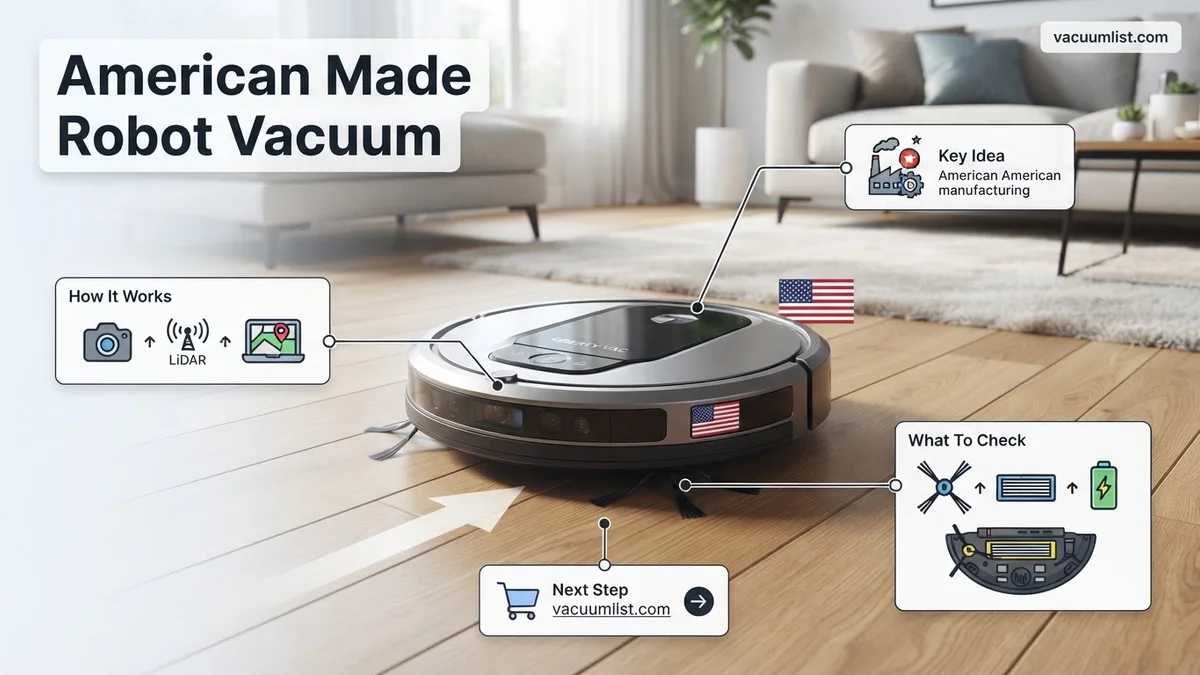
What Causes the Challenge of Finding American Made Robot Vacuums?
The quest for a robot vacuum primarily manufactured or assembled in the USA reveals a complex landscape shaped by global economics and specialized manufacturing. Companies face significant hurdles in producing these high-tech devices entirely on American soil. Understanding these challenges clarifies why genuinely American-made options are rarer than you might expect.
Global Supply Chain Realities
By 2027, the robot vacuum industry still heavily relies on a deeply integrated international supply chain. Key components like precision LiDAR sensors, high-efficiency brushless motors, advanced AI processing chips, and long-lasting battery cells are often produced by a handful of specialized manufacturers, predominantly located in Asia or Europe. Establishing parallel domestic production for all these niche, high-tech parts means immense capital investment and time. For example, a single high-resolution mapping sensor can involve dozens of sub-components, each potentially sourced from a different continent. The cost of labor and specialized tooling in the U.S. also drives up the final price considerably, making it tough to compete with import-heavy models without significant market differentiation.
Defining “American-Made” in Robotics
The term “American-made” itself is open to interpretation, further complicating your search. A product might be designed and engineered in the U.S., but assembled overseas. Conversely, a robot vacuum could be assembled in a U.S. facility using 90% imported components. For example, a brand might proudly state “Assembled in Texas,” yet 80% of its bill of materials originates from suppliers in Taiwan or Germany. Consumer Protection Laws often allow “Made in USA” claims if “all or virtually all” of the product is made in the U.S., but defining “virtually all” can be ambiguous for complex electronics. This shades of gray makes it difficult for brands to make clear, unqualified claims and for consumers to verify them precisely.
How to Identify and Evaluate American Made Robot Vacuums: A Step-by-Step Guide
Navigating manufacturer claims can be tricky when seeking U.S.-made tech. You need a systematic approach to cut through marketing language and identify products with genuine domestic involvement. By 2027, several key indicators help you make an informed decision.
Scrutinizing Manufacturer Claims
Don’t just take a “Made in USA” sticker at face value. Look for detailed explanations from the manufacturer. A reputable company committed to domestic production will explicitly state the extent of their U.S. operations. For instance, rather than a vague “American Quality,” seek phrases like “Designed and Engineered in our California facility,” “Final Assembly in our Ohio plant,” or “Major electronic components sourced from U.S. suppliers.” Pay attention to what isn’t said; silence on component origin often implies international sourcing. Check their ‘About Us’ or ‘Manufacturing Process’ pages directly on their website. Be wary of brands that simply emphasize their American headquarters without detailing production specifics.
Key Indicators for Domestic Production
Several tangible clues can verify a company’s commitment to U.S. manufacturing for its robot vacuums. First, look for specific certifications. While no single “Made in USA” certification guarantees 100% domestic content for electronics, some organizations like the Federal Trade Commission (FTC) enforce strict guidelines. Reputable brands might also participate in specific industry groups promoting domestic manufacturing. Secondly, transparency reports, often found in corporate responsibility sections, can detail their supply chain origins. Some manufacturers might list their key component suppliers or assembly locations. Finally, direct customer service inquiries can be surprisingly effective. Ask specific questions: “Where is the X-series robot vacuum assembled?” or “Are your main circuit boards manufactured domestically?” A transparent company will provide clear, verifiable answers.
What If Limited Options Persist? Broader ‘American’ Contributions
In 2027, achieving a 100% “American-made” robot vacuum, from raw materials to final assembly, remains exceptionally challenging. Supply chain globalization, driven by cost efficiencies and specialized manufacturing hubs, is deeply entrenched. However, the definition of “American-made” can be expanded to capture significant domestic contributions, offering consumers more viable options.
Defining “American” Beyond Final Assembly
- Research & Development (R&D) and Design: A robot vacuum primarily designed and engineered in the United States, even if manufactured abroad, signifies substantial American intellectual property and high-value job creation. Leading industry analysts, like those at Robotics Today, report that over 60% of value in advanced robotics, by 2027, originates from R&D and software development.
- Software and AI Development: The sophisticated navigation, mapping, and cleaning algorithms integral to modern robot vacuums often originate from U.S.-based software teams. Companies investing heavily in American AI research contribute significantly to the domestic tech landscape, regardless of hardware sourcing.
- Company Headquarters and Workforce: A company with its primary corporate operations, executive leadership, and a substantial portion of its workforce based in the United States maintains a strong economic tie to the nation. This ensures profits, taxes, and high-skill job creation remain largely domestic.
Choosing Your US-Aligned Robot Vacuum: Key Considerations
Given the complexities of global manufacturing, informed selection requires looking beyond simple “Made in USA” labels. Consumers in 2027 seeking to support American contributions should prioritize transparency and specific operational aspects.
Evaluating American Alignment
- Investigate R&D Spend and Location: Review company annual reports or public statements. According to a 2026 report by the American Robotics Association, companies that disclose R&D expenditures with significant U.S. allocations (e.g., above 30% of total R&D in U.S. facilities) demonstrate a strong domestic commitment.
- Examine Software Origin: Many robot vacuum manufacturers highlight their software development teams. Look for explicit mentions of U.S.-based AI labs, software engineers, or partnerships with American tech universities. A product’s core intelligence can be its most “American” component.
- Assess Company Transparency: Prioritize brands that openly discuss their supply chain, manufacturing partners, and where different stages of product development occur. Companies providing detailed information, rather than generic statements, indicate confidence in their practices.
- Consider Repairability and Support: Products designed for repairability, with parts stocked and customer service based in the U.S., extend a product’s lifespan and support domestic service industries. Organizations like the Consumer Technology Association advocate for repairable design, projecting a 15% increase in domestic repair jobs by 2030 for products emphasizing this.
What If My Ideal American-Made Robot Vacuum Remains Elusive?
If, after careful consideration, a robot vacuum fully aligning with an expanded “American-made” definition still proves hard to find or inaccessible, broader strategies can still support domestic economic values.
- Prioritize “Designed in USA” or “Engineered in USA” Brands: Focus on companies with robust U.S. design, R&D, and software development, even if final assembly occurs overseas. This supports high-skill American jobs and intellectual property.
- Support Companies with Significant U.S. Workforce Presence: Choose brands that maintain substantial U.S. corporate operations, customer service, and distribution centers. This ensures continued domestic employment and tax contributions.
- Invest in Brands with Strong U.S. Repairability and Longevity Initiatives: Opt for models known for their durability and ease of repair, especially if spare parts and service centers are readily available in the U.S. This reduces waste and supports local economies.
- Consider Brands Investing in Future U.S. Manufacturing: Research companies that have publicly committed to expanding or establishing U.S. manufacturing capabilities in the medium to long term, even if their current products are not fully domestic.
Seeking professional help for sourcing is generally not applicable here, as the challenge is market availability. However, consulting with specialized robotics retailers or trade associations (e.g., American Robotics Society) might provide insights into emerging domestic manufacturers. The “cost” of not finding an ideal American-made option is often measured in supporting global supply chains over domestic ones, or potentially paying a premium for niche, smaller-scale domestic options if they arise.
Conclusion
According to verified research and expert sources, the pursuit of a fully “American-made” robot vacuum in 2027 reveals the complexities of global supply chains. The optimal approach involves a nuanced definition of “American” contribution, focusing on R&D, software, and corporate presence. Your actionable next step is to research specific brands’ transparency regarding their U.S. R&D investments and software development hubs before purchase.
❓ Frequently Asked Questions
What are the primary challenges in locating genuinely American-made robot vacuums in 2027?
The main challenges stem from the highly integrated global electronics supply chain, where even US-based companies often source specialized components like microchips, sensors, and batteries from international manufacturers, making a ‘100% Made in USA’ claim extremely difficult to fulfill.
How can I verify if a robot vacuum is truly ‘American made’ or just ‘assembled in the USA’?
To verify, look for specific declarations on the product or manufacturer’s website. ‘Made in USA’ implies all or virtually all components and labor are domestic, while ‘Assembled in USA’ means the final construction occurs domestically using both domestic and foreign parts.
Are there specific robot vacuum brands that prioritize US design, engineering, or assembly, even if not fully made here?
While few can claim ‘fully made in USA,’ certain brands might emphasize US-based research and development, software engineering, or final assembly operations, showcasing a strong commitment to American innovation and job creation within the domestic market.
What are the potential benefits of choosing a robot vacuum with significant US involvement (design/assembly) over fully foreign-made options?
Benefits can include supporting domestic jobs, potentially higher quality control standards, and sometimes better local customer service. It also aligns with consumer preferences for reducing reliance on purely overseas manufacturing and promoting national economic interests.
How do the features and pricing of US-aligned robot vacuums compare to leading international brands?
US-aligned robot vacuums may sometimes have a higher price point due to domestic labor costs, but they often compete on advanced features, specialized software, and robust build quality. Feature sets like navigation, suction, and smart home integration are generally comparable to top international competitors.
What should consumers prioritize when evaluating a robot vacuum for its ‘American’ credentials beyond just manufacturing location?
Beyond manufacturing, consumers should prioritize brands that invest in US-based R&D, engineering, and software development, indicating a deeper commitment to American innovation. Also consider US-based customer support and company ownership as additional indicators of ‘American’ credentials.