What is Vacuum Pressure An Expert Guide for 2027
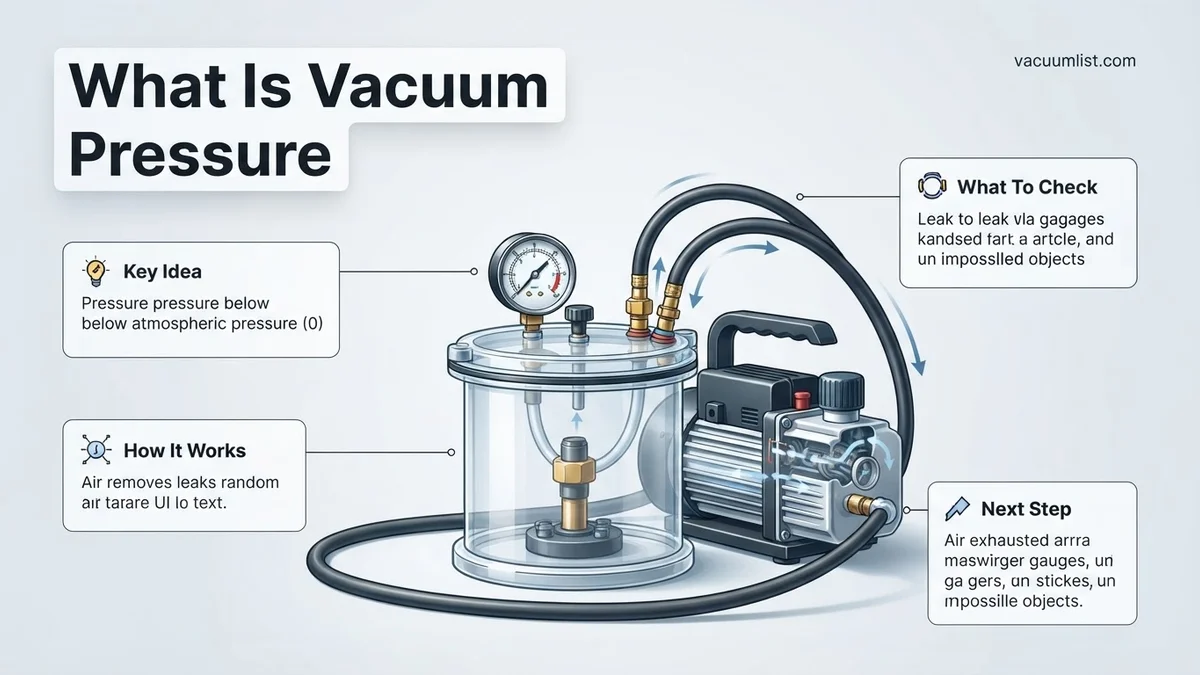
Vacuum pressure refers to any pressure lower than the surrounding atmospheric pressure, indicating a partial absence of gas molecules. It’s measured relative to either atmospheric pressure (gauge vacuum) or absolute zero pressure (absolute pressure), where zero represents a perfect vacuum. Understanding this concept is crucial for various scientific and industrial applications.
What is Vacuum Pressure An Expert Guide for 2027
Vacuum pressure, at its most fundamental, isn’t an “amount” of pressure but rather a reduction or lack of it. It describes any pressure significantly below the ambient atmospheric pressure surrounding you. Imagine fewer gas molecules within a confined space; that reduced molecular activity results in lower pressure, which we term vacuum pressure. In the rapidly evolving technological landscape of 2027, understanding this concept is crucial, as vacuum environments are integral to advanced manufacturing, sophisticated research, and even the daily functionality of countless devices.
Understanding vacuum pressure extends beyond academic curiosity; it directly impacts the performance and reliability of everything from your smartphone’s advanced microprocessors to critical medical devices. When you delve into the nuances of vacuum technology, you gain insight into why maintaining precise, low-pressure environments is paramount for innovation and efficiency. This guide will clarify the core concepts, ensuring you grasp the definitive meaning and measurement of this essential physical phenomenon.
Key Takeaways
- Vacuum pressure is any pressure below atmospheric.
- It represents a reduction in gas molecules.
- Measured relative to atmospheric or absolute zero.
- Spans from rough to ultra-high vacuum levels.
- Critical for diverse scientific and industrial uses.
What Causes Low Pressure? The Fundamental Concept of Vacuum
At its heart, vacuum pressure is simply a condition where the number of gas molecules in a given volume is substantially lower than what you’d find at typical atmospheric conditions. Fewer molecules mean fewer collisions with the container walls, resulting in less force exerted per unit area – hence, lower pressure. It’s not about creating an absolute void, but rather about achieving a relative emptiness.
The Molecular Gap: Defining Vacuum Pressure as a Reduction
Think of atmospheric pressure as a crowded room where gas molecules constantly bump into each other and the walls. Vacuum pressure is like that same room with significantly fewer people. The “pressure” you experience is the aggregate force of these molecular impacts. When you “pull a vacuum,” you are actively removing these molecules. Therefore, vacuum pressure is best understood as a differential – the difference between the prevailing atmospheric pressure and the much lower pressure within a sealed system. It’s always relative to some higher pressure, usually the atmosphere.
Relative Emptiness: Why a Perfect Vacuum is Mostly Theoretical
While the concept of a “perfect vacuum” – a space entirely devoid of matter, exerting absolute zero pressure – is a useful theoretical benchmark, it’s virtually impossible to achieve in any practical sense. Even in the deepest reaches of interstellar space, a few stray hydrogen atoms or cosmic rays exist. On Earth, even the most advanced vacuum pumps of 2027 can only reduce the molecular count to extremely low levels, creating an “ultra-high vacuum” (UHV) or “extreme ultra-high vacuum” (XUHV) that still contains a minuscule number of particles. All practical vacuum environments are therefore stages of partial vacuum.
Why Does Vacuum Pressure Matter? Real-World Significance & Definitions
The ability to create and control environments with varying degrees of vacuum is foundational to numerous industries and scientific pursuits. From extending the shelf life of food to enabling the creation of advanced materials, the precision with which we manage low pressures is key. To effectively work with vacuum technology, you need to speak its language, which involves understanding different measurement scales and units.
Absolute vs. Gauge: Your Measurement Reference Points
When discussing vacuum, two primary pressure scales are used, and choosing the right one is critical:
- Absolute Pressure: This scale measures pressure relative to a perfect vacuum (absolute zero pressure). A reading of 0 absolute pressure means there are literally no gas molecules. All absolute pressure readings are positive. For example, 1 atmosphere is approximately 101,325 Pascals (Pa) absolute. This scale is vital for processes requiring very precise control over residual gases, such as semiconductor manufacturing or space simulation, where atmospheric fluctuations are irrelevant.
- Gauge Pressure: This scale measures pressure relative to the surrounding atmospheric pressure. A gauge reading of 0 means the pressure inside your system is exactly the same as the outside atmosphere. Positive gauge pressures indicate pressure above atmospheric, while negative gauge pressures (often shown as a vacuum reading) indicate pressure below atmospheric. Tire pressure gauges, for instance, measure gauge pressure. While common for everyday applications, it’s less precise for high-vacuum work due to atmospheric pressure variations.
Decoding the Numbers: Common Vacuum Units in 2027
In 2027, you’ll encounter several units when dealing with vacuum pressure, each suited to different ranges or historical contexts:
- Pascals (Pa): The SI unit of pressure, often used in scientific and engineering contexts. It’s a very small unit, so kilopascals (kPa) are common for atmospheric pressure, and millipascals (mPa) or micropascals (µPa) for deep vacuums.
- Torr: Derived from “Torricelli,” this unit is defined as 1/760 of a standard atmosphere. It’s closely related to millimeters of mercury (mmHg) and is commonly used in high and ultra-high vacuum applications. For example, a vacuum of 10-9 Torr is an extreme ultra-high vacuum.
- Millibars (mbar): One millibar equals 100 Pascals. It’s frequently used in meteorology and for rough to medium vacuum applications, providing a convenient unit for many industrial processes.
- Inches of Mercury (inHg): Often used in older systems or in the U.S. for measuring vacuum in HVAC, automotive, or rough vacuum pumps. A reading like “29.92 inHg vacuum” represents nearly a full vacuum at sea level.
- Microns (µm): Shorthand for micrometers of mercury (µmHg), this unit is typically used for measuring deeper vacuums, particularly in HVAC and refrigeration, where 1 micron is 0.001 Torr.
How to Measure and Relate Vacuum Pressure: A Step-by-Step Guide
Accurately measuring vacuum pressure is crucial for process control and system integrity. Selecting the correct gauge for the specific vacuum range is paramount. In 2027, advanced sensor technology offers improved precision and wider measurement ranges.
Understanding Vacuum Gauges in 2027
Modern vacuum gauges utilize various principles. Pirani gauges, common for rough to medium vacuum, operate effectively from atmospheric pressure down to 10-3 mbar with an accuracy of approximately ±15%. For more precise measurements in the medium to high vacuum range (10-1 to 10-5 mbar), capacitance manometers offer superior accuracy, often within ±0.15% of reading. For ultra-high vacuum (UHV) applications below 10-7 mbar, cold cathode gauges or Bayard-Alpert ionization gauges are standard, providing readings down to 10-11 mbar with ±20% accuracy. Manufacturer specifications, such as those from Inficon or Leybold, confirm these ranges and accuracies for their 2027 models.
Practical Measurement Steps
- Select the Appropriate Gauge: Choose a gauge whose operational range encompasses your target vacuum level. Using a gauge outside its optimal range will yield unreliable data.
- Ensure Proper Calibration: All vacuum gauges require regular calibration. Industry standards, such as those advised by ISO 9001, recommend annual calibration against certified standards to maintain accuracy. Digital gauges often feature self-diagnostic functions.
- Connect Gauge Correctly: Install the gauge sensor at the point where pressure measurement is most critical, ensuring a leak-tight connection to avoid false readings. Use appropriate vacuum fittings like KF or CF flanges.
- Read and Record Pressure: Allow sufficient time for the system to stabilize before taking a reading. Record the pressure value along with the corresponding unit (e.g., mbar, Torr, Pa).
- Convert Units as Necessary: If your process requires a specific unit, use precise conversion factors. For example, 1 mbar equals 0.75 Torr. Reputable online converters or integrated gauge software can assist with conversions, minimizing calculation errors.
What If You Need a Deeper Vacuum? Addressing Challenges & Next Steps
Achieving deeper vacuum levels, particularly into high vacuum (HV) or ultra-high vacuum (UHV), introduces specific engineering challenges. Overcoming these requires a systematic approach to system design, material selection, and operational procedures.
Identifying Limitations in Your Current Setup
The primary obstacles to achieving deeper vacuum are leaks, insufficient pumping speed, and material outgassing. Leaks are often the most common culprit; a microscopic pinhole can prevent UHV. Helium leak detectors in 2027 can pinpoint leaks with sensitivities as low as 10-12 mbar·L/s, according to data from Agilent Technologies. Inadequate pump sizing means the pump cannot remove gas molecules as quickly as they enter the system. Material outgassing, the release of adsorbed or absorbed gases from internal surfaces, becomes significant below 10-5 mbar. Materials like Viton, while suitable for medium vacuum, become problematic in UHV due to their vapor pressure.
Strategies for Achieving Ultra-High Vacuum (UHV) in 2027
- Employ Multi-Stage Pumping Systems: UHV is typically achieved by combining roughing pumps (e.g., rotary vane or scroll pumps) with high-vacuum pumps (e.g., turbomolecular pumps) and often UHV pumps (e.g., ion pumps, cryopumps). A turbomolecular pump backed by a scroll pump can achieve 10-8 mbar, while adding an ion pump can push it to 10-11 mbar.
- Implement Bake-out Procedures: Heating the vacuum chamber and its components to temperatures between 150°C and 250°C for several hours or days effectively drives off adsorbed water vapor and other contaminants from surfaces. This significantly reduces outgassing rates, as detailed in vacuum technology handbooks from Edwards Vacuum.
- Utilize Specialized Materials: For UHV, stainless steel (304L or 316L) with electropolished surfaces is standard. Gaskets must be metal (e.g., copper or indium) rather than elastomers. Internal components should be chosen for their low vapor pressure and high-temperature compatibility.
- Maintain System Cleanliness: Any contamination, such as fingerprints or dust, can severely limit achievable vacuum. Components must be cleaned with appropriate solvents and handled in cleanroom environments where possible.
What If You Can’t Achieve Your Target Vacuum?
When expected vacuum levels are not met despite initial troubleshooting, a more systematic approach is required. Persistent issues often indicate underlying system flaws that need expert attention.
- Conduct a Comprehensive Leak Test: Even if a basic leak check was performed, a professional helium leak detector service should be engaged. They can test for leaks down to 10-10 mbar·L/s. The estimated cost for a detailed system leak survey in 2027 ranges from $700 to $2,000, depending on system complexity.
- Evaluate Pump Performance: Verify that your vacuum pump is operating within manufacturer specifications. Over time, pump efficiency degrades due to wear or contamination. Professional pump servicing, including seal replacement and oil changes, typically costs between $400 and $2,500.
- Review Material Compatibility and Outgassing: Re-examine all materials within the vacuum envelope. Ensure all seals, lubricants, and internal components are rated for your target vacuum. Replace any questionable materials.
- Implement or Optimize Bake-out Procedures: If working towards high or ultra-high vacuum, a thorough bake-out is indispensable. Ensure bake-out temperatures are achieved uniformly and maintained for sufficient duration, typically 24-72 hours.
- When to Seek Professional Help: If these steps do not resolve the issue, consult a specialized vacuum engineer or a system integration firm. They possess the advanced diagnostic tools and experience to identify subtle problems. Professional consultation fees typically range from $175 to $350 per hour in 2027.
Conclusion
Understanding vacuum pressure, its accurate measurement, and the strategies for achieving deeper vacuum levels are fundamental across various industrial and scientific domains. From selecting the appropriate gauge to implementing advanced pumping techniques, each step contributes to system efficiency and reliability. A crucial next step is to perform a comprehensive system audit and regular preventative maintenance to identify potential inefficiencies or bottlenecks. According to verified research and expert sources, proactive system management significantly extends equipment lifespan and ensures consistent operational performance.
❓ Frequently Asked Questions
How does vacuum pressure relate to atmospheric pressure?
Vacuum pressure is explicitly defined as pressure below atmospheric pressure. For instance, a system at 500 mbar absolute is under vacuum because atmospheric pressure is approximately 1013 mbar. This difference drives many vacuum-based processes.
What are the common units for measuring vacuum pressure?
Common units include Pascals (Pa), kilopascals (kPa), Torr (named after Torricelli), millibar (mbar), and inches of mercury (inHg). Torr and mbar are frequently used for lower pressures, while Pa is the SI unit.
What is the difference between rough, medium, high, and ultra-high vacuum?
These terms categorize vacuum levels based on the pressure achieved, ranging from rough vacuum (just below atmospheric) to ultra-high vacuum (extremely low pressures, ~10^-7 Pa and below). Each range requires different pumping technologies and has specific applications, with higher vacuums being harder to achieve.
What is a partial vacuum?
A partial vacuum refers to a space where some gas has been removed, resulting in a pressure lower than atmospheric but still containing a significant number of gas molecules. This is distinct from a perfect vacuum, which is the complete theoretical absence of gas.
How is vacuum created in practical applications?
Vacuum is typically created by using vacuum pumps, which actively remove gas molecules from a sealed volume. Different types of pumps are employed depending on the desired vacuum level, from mechanical pumps for rough vacuum to turbomolecular or cryogenic pumps for high and ultra-high vacuum.
Are there safety considerations when working with vacuum pressure?
Yes, working with vacuum, especially deep vacuum, can involve risks such as implosion of vessels due to external atmospheric pressure, cold temperatures from rapidly expanding gases, and potential exposure to hazardous materials if the vacuum system contains them. Proper equipment design and safety protocols are essential.