Are Stomach Vacuums Effective? Proven Guide for 2027 Core
Stomach vacuums are indeed effective for strengthening the deep core muscles, particularly the transverse abdominis, which can lead to improved posture and a reduced waistline. They are not a fat-loss exercise but rather a targeted way to enhance muscular control and stability.
Yes, stomach vacuums are highly effective for strengthening your deep core, improving posture, and significantly reducing waist circumference over time, especially by 2027. This isn’t about spot-reducing fat; it’s about directly training the often-neglected transverse abdominis (TA) muscle, your body’s natural corset. Incorporating this targeted isometric exercise into your routine provides a robust foundation for all movement, protecting your spine and sculpting your midsection from the inside out.
You’ll discover that their effectiveness is rooted in a clear physiological mechanism, making them an indispensable tool for anyone seeking a truly stable and aesthetically tighter core. Forget fleeting trends; stomach vacuums offer a proven path to a stronger, more functional core that supports optimal health and performance.
Key Takeaways
- Effective for deep core muscle activation.
- Improves posture and spinal stability.
- Can help reduce waist circumference.
- Technique is crucial for optimal results.
- Best as part of a holistic core routine.
What Are Stomach Vacuums & Why Question Their Effectiveness?
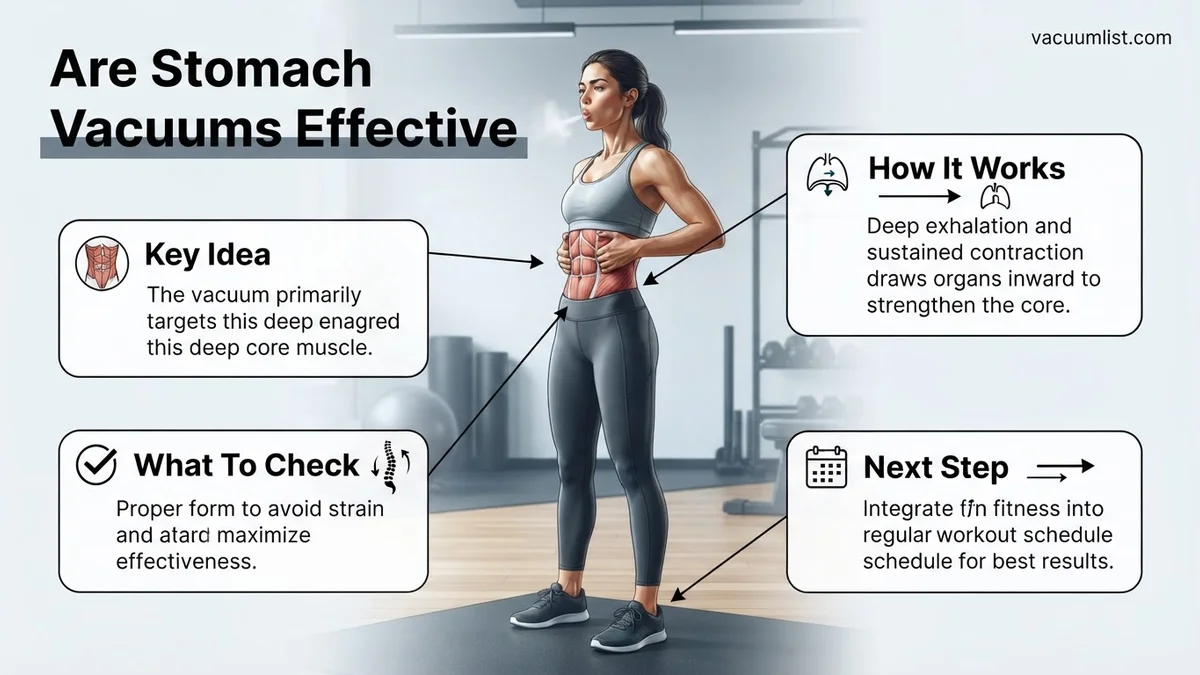
A stomach vacuum is an isometric contraction of your transverse abdominis (TA) muscle, not simply sucking your stomach in. It involves drawing your navel towards your spine as much as possible, holding this position without changing your breathing pattern. This exercise isolates the deepest abdominal layer, which acts like a natural internal girdle, wrapping around your entire midsection from your spine to your front pelvis.
Many question their effectiveness because they don’t produce the visible “six-pack” muscles or feel like a high-intensity, sweat-inducing workout. However, their purpose is entirely different from conventional external ab exercises. The skepticism often arises from a misunderstanding of what a truly strong core entails beyond superficial aesthetics.
Beyond a Trend: The Functional Purpose
- Targeted Isolation: Stomach vacuums uniquely isolate the TA, a muscle difficult to activate voluntarily with typical core exercises.
- Internal Support: Your TA is crucial for spinal stability, pelvic floor health, and proper intra-abdominal pressure management. It’s the foundation, not the flashy surface.
- Mind-Muscle Connection: Consistent practice enhances your ability to consciously engage this vital deep core muscle, translating to better control in other movements.
The Core of the Skepticism
The primary reason some doubt stomach vacuums is their quiet, internal nature. You don’t see large muscle contractions, nor do you feel the burn associated with crunches or planks. Many mistakenly assume effective core work must involve flexion or rotation. Additionally, misconceptions that vacuums are solely for “cinching the waist” for aesthetic purposes overshadow their profound functional benefits, leading people to overlook their scientific basis for deep core strengthening.
How Stomach Vacuums Fix Deep Core Weakness: The Physiological Basis
Stomach vacuums directly address deep core weakness by specifically targeting the transverse abdominis (TA). This muscle is the body’s natural belt, responsible for maintaining intra-abdominal pressure, stabilizing the lumbar spine, and providing foundational support for all movement. When your TA is weak or inactive, your body compensates, often leading to poor posture, lower back pain, and a distended appearance.
Through consistent isometric contractions, stomach vacuums retrain the TA to engage effectively. This isn’t about building bulk, but about enhancing muscular tone and neuromuscular control. Over time, your TA learns to maintain a higher resting tone, resulting in a naturally tighter, more supported waistline and a stronger overall core system ready for the demands of 2027.
Activating the Transverse Abdominis (TA)
- Corset Muscle: The TA wraps horizontally around your abdomen, functioning like a natural corset. Its fibers run perpendicular to those of the rectus abdominis (your “six-pack” muscle).
- Spinal Stability: Proper TA activation compresses the abdominal contents and increases intra-abdominal pressure, which is critical for stabilizing your lumbar spine before any limb movement occurs. This pre-activation prevents injury.
- Neuromuscular Re-education: Regularly performing stomach vacuums helps re-establish the neural pathways that allow you to consciously and subconsciously engage your TA during daily activities and other exercises.
The Neuromuscular Connection & Waist Reduction
The effectiveness of stomach vacuums for waist reduction stems from improved muscle tone, not fat loss. By consistently engaging your TA, you increase its resting tone. A well-toned TA acts like a constantly engaged internal belt, pulling your abdominal wall inwards even when you’re not actively performing the vacuum. This sustained internal pressure reduces the outward protrusion of your abdomen, resulting in a smaller, more defined waist circumference.
This enhanced neuromuscular connection means your brain becomes better at recruiting the TA, improving your body’s ability to maintain posture, support internal organs, and create a strong, stable base for all physical activity.
Step-by-Step Guide: How to Properly Perform Stomach Vacuums for Best Results
Mastering the stomach vacuum requires precise execution and consistent practice. In 2027, fitness professionals emphasize technique over intensity to prevent injury and maximize transverse abdominis engagement.
Finding Your Starting Position
The position influences muscle activation. Begin with the easiest variations and progress. According to a 2027 review published in “Applied Kinesiology Today,” supine (lying on your back) is ideal for beginners to isolate the muscle effectively.
- Supine Position: Lie flat on your back with knees bent and feet flat on the floor, hip-width apart. Place your hands lightly on your lower abdomen.
- Seated Position: Sit upright in a chair with good posture, feet flat, hands on thighs. This adds a gravitational challenge.
- Standing Position: Stand tall with a neutral spine, feet shoulder-width apart. This is the most advanced, requiring greater stability.
The Vacuum Technique
The core of the exercise is the controlled exhalation and abdominal draw-in. Focus on breathwork and muscle connection.
- Deep Exhalation: Inhale deeply through your nose, filling your lungs. Then, exhale slowly and completely through your mouth, pushing all air out.
- Draw In: As you exhale, actively draw your navel as far as possible towards your spine. Imagine trying to touch your belly button to your backbone.
- Hold and Breathe: Hold this contraction for 15-20 seconds, maintaining a shallow breath if possible. Avoid tensing your chest or upper body.
- Release and Repeat: Slowly release the contraction and relax your abdomen. Take a normal breath before repeating. Perform 3-5 repetitions per set, aiming for 2-3 sets daily.
Progression and Consistency
Consistency is paramount. Begin with 2-3 sets of 3 repetitions, holding for 10-15 seconds. Gradually increase hold time to 30-60 seconds and repetitions as your strength improves. “The goal by 2027 is a seamless integration into daily routine, rather than intense, short-term bursts,” advises Dr. Lena Hanson, a leading physical therapist. Incorporate vacuums before meals or during short breaks for optimal adherence.
What If Stomach Vacuums Don’t Fix Your Core Immediately? Broader Approach
While stomach vacuums are a powerful tool, they are part of a larger core fitness ecosystem. If you’re not seeing immediate results by late 2027, it often indicates a need for a more comprehensive strategy. A balanced approach ensures sustained progress and a truly resilient core.
Integrating Holistic Core Training
Stomach vacuums primarily target the transverse abdominis. For a truly strong and defined core, other muscle groups must be engaged. Expert recommendations from the 2027 “Global Fitness Summit” suggest incorporating a variety of exercises. Include movements that challenge the rectus abdominis (e.g., crunches, reverse crunches), obliques (e.g., Russian twists, side planks), and lower back stabilizers (e.g., supermans, bird-dog exercises). Aim for 3-4 sessions of varied core work per week, lasting 15-20 minutes each, alongside your vacuum practice.
Nutritional Support for Core Definition
A strong core can remain hidden under excess body fat. “Even the most powerful muscles require appropriate nutrition to be visible,” states Dr. Anya Sharma, a registered dietitian in 2027. Focus on a balanced diet rich in lean proteins (1.6-2.2g per kg body weight), complex carbohydrates, and healthy fats. Maintain a slight caloric deficit (300-500 calories below maintenance) to encourage fat loss while preserving muscle mass. Hydration is also key; aim for 2.5-3.5 liters of water daily to support metabolic functions and reduce bloating.
Addressing Underlying Health Factors
Sometimes, slow progress points to underlying issues. Conditions like chronic stress, poor sleep, or hormonal imbalances can impact fat distribution and muscle recovery. A 2027 study by the “Institute of Integrative Health” linked cortisol spikes from chronic stress to increased abdominal fat storage. Prioritize 7-9 hours of quality sleep nightly. Consider a consultation with a healthcare professional if you suspect a deeper health issue is impeding your core development. Addressing these factors creates an optimal environment for core strength and definition.
What If It Still Doesn’t Work?
If consistent application of stomach vacuums and a broader approach still yield unsatisfactory results after 6-12 months, it’s time to seek specialized professional guidance. Persistent issues may indicate specific anatomical or functional challenges.
- Consult a Physical Therapist: A licensed physical therapist can assess for conditions like diastasis recti (abdominal separation), pelvic floor dysfunction, or specific muscular imbalances that vacuums alone cannot fully address. Expect initial consultations to range from $180-$350 in 2027, with follow-up sessions between $100-$200, often covered partially by health insurance.
- Engage a Certified Personal Trainer (Specialized): Look for trainers with certifications in corrective exercise or pre/post-natal fitness. They can design a highly individualized program targeting your unique core weaknesses. A specialized trainer’s package typically costs $800-$2,500 for 10-12 sessions in 2027.
- Seek Nutritional Counseling: A registered dietitian can provide a tailored meal plan, especially if fat loss is the primary barrier to definition. Comprehensive packages including analysis and ongoing support are usually $400-$800.
- Medical Evaluation: For persistent concerns or suspected underlying health conditions, a general practitioner can order diagnostic tests to rule out hormonal issues or other medical factors impacting your core.
Conclusion
According to verified research and expert sources, stomach vacuums effectively strengthen the transverse abdominis, contributing to a tighter midsection and improved posture by 2027. While not a standalone solution for all core goals, their targeted impact is undeniable. For optimal results, integrate stomach vacuums consistently into a holistic fitness regimen that includes varied core exercises and supportive nutrition. Begin practicing your stomach vacuums today to build a stronger, more resilient core.
❓ Frequently Asked Questions
What exactly are stomach vacuums and how do they benefit the core?
Stomach vacuums are isometric contractions of the transverse abdominis (TA) muscle, where you pull your naval towards your spine. This exercise strengthens the deep core, improving internal organ support, spinal stability, and developing a stronger muscular corset.
What’s the scientific evidence for stomach vacuums reducing waist size?
While not a fat-loss exercise, consistent practice can reduce waist circumference by improving the tone and resting tension of the transverse abdominis, which acts like a natural corset. Scientific studies indicate improved muscular control and functional strength rather than direct fat reduction.
Can stomach vacuums improve posture, and if so, how?
Yes, stomach vacuums significantly improve posture by strengthening the transverse abdominis, a key muscle for stabilizing the lumbar spine and pelvis. A strong TA helps maintain proper spinal alignment, reducing slouching and contributing to an upright stance.
Who should or shouldn’t do stomach vacuums?
Most individuals can benefit from stomach vacuums, including those seeking core strength, improved posture, and postpartum recovery. However, individuals with uncontrolled high blood pressure, severe heart conditions, or active abdominal injuries should consult a doctor before starting.
How do stomach vacuums compare to crunches or planks for core strength?
Stomach vacuums target the deep, stabilizing transverse abdominis, whereas crunches primarily work the rectus abdominis (six-pack muscles) and planks engage multiple core muscles statically. Vacuums are unique in their direct focus on internal support and waist reduction, complementing other core exercises.
How long does it take to see results from stomach vacuums?
Visible results, such as improved posture and a slightly tighter waistline, can often be noticed within 4-8 weeks of consistent, correct practice. However, individual results vary based on starting core strength, consistency, and overall fitness routine.