
How Fast Does Light Travel In Vacuum Real Guide 2027
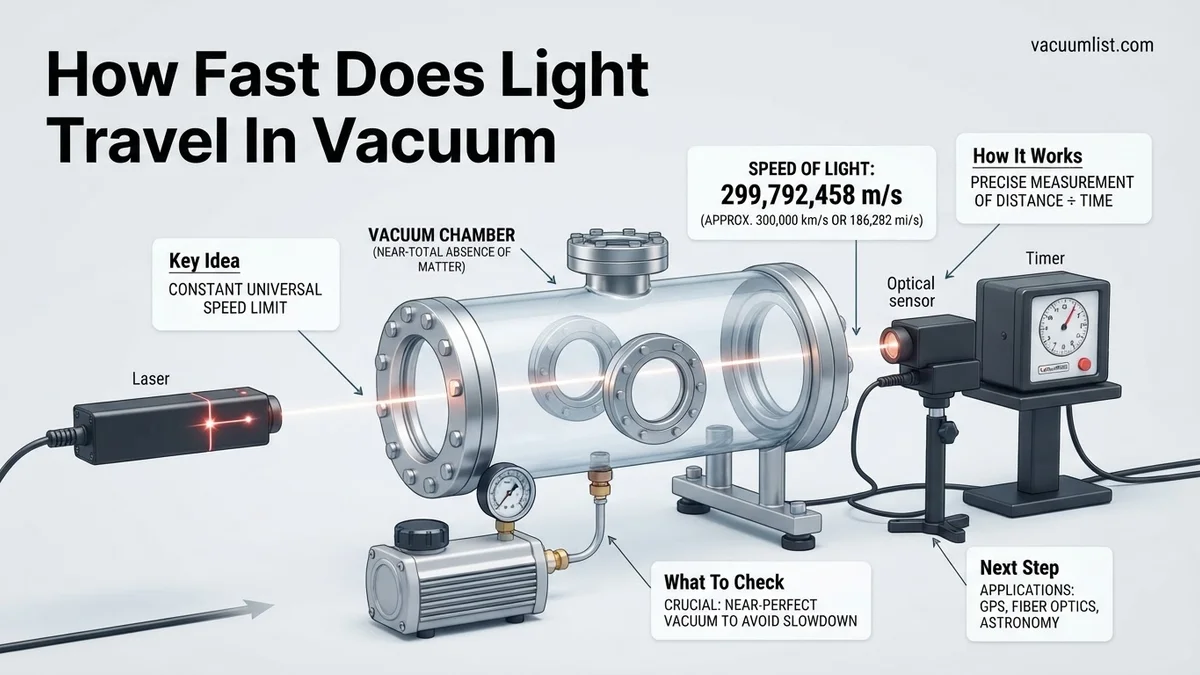
The speed of light in a vacuum is a fundamental physical constant, precisely defined as 299,792,458 meters per second (m/s). This speed, often denoted as ‘c’, is the fastest possible speed at which any information or energy can travel, making it a universal speed limit.
In the vast expanse of the cosmos, one constant truly stands out: the speed of light in a vacuum. If you’re seeking the definitive answer to “how fast does light travel in vacuum” in 2027, the number you need is precisely 299,792,458 meters per second. This isn’t just a fast speed; it’s the ultimate cosmic speed limit, a fundamental constant of our universe represented by the symbol ‘c’.
Understanding this exact value is more than just academic curiosity. It underpins everything from our global communication networks and GPS accuracy to the timelines of space exploration and our fundamental grasp of physics. For instance, the unavoidable communication lag with future Mars colonies or advanced satellite arrays directly stems from this fixed velocity. Knowing this speed gives you a clearer perspective on the physical limitations and incredible possibilities within our universe.
Key Takeaways
- Light’s vacuum speed is precisely 299,792,458 m/s.
- This speed, ‘c’, is a fundamental universal constant.
- Light travels slower when passing through other materials.
- Speed of light defines measurement units like the meter.
- No object with mass can reach light’s vacuum speed.
What Defines the Speed of Light in Vacuum?
The Fixed Cosmic Speed Limit
Light’s speed in a vacuum, denoted as ‘c’, is not merely a scientific measurement; it’s a fundamental constant of the universe itself. This means its value is fixed and unchangeable, independent of the observer’s motion or the source of the light. In fact, by international agreement, the meter is now defined by the distance light travels in a vacuum during a specific fraction of a second (1/299,792,458 of a second). This makes the speed of light in a vacuum an exact, by-definition constant, not an experimental value subject to refinement.
- Universal Constant: ‘c’ is a cornerstone of modern physics, immutable across space and time.
- Ultimate Barrier: Nothing with mass can reach or exceed this speed, as predicted by Einstein’s theory of special relativity.
- Electromagnetic Phenomenon: Light is an electromagnetic wave, and its speed ‘c’ arises directly from the properties of electric and magnetic fields in a vacuum.
This definition ensures that in 2027, and for the foreseeable future, ‘c’ remains the absolute benchmark for velocity, impacting everything from particle accelerators to the theoretical limits of warp drives.
Why “In Vacuum” Matters
The “in vacuum” part of the statement is absolutely critical for understanding light’s maximum speed. A vacuum, in this context, refers to space devoid of any matter—no air, water, dust, or particles. When light travels through any medium other than a perfect vacuum, it inevitably slows down.
- Interaction with Matter: Light interacts with the atoms and molecules in a material. These interactions cause photons to be absorbed and re-emitted, or to interact with the electron clouds, effectively delaying their overall progress.
- Slower Speed: For example, light travels approximately 25% slower in water and about 30% slower in glass compared to its speed in a vacuum.
- Pure Propagation: In a perfect vacuum, there are no particles for light to interact with, allowing it to propagate unimpeded at its maximum possible speed, ‘c’.
This distinction explains why deep-space communication signals travel at ‘c’, while information transmitted via fiber optic cables (which use glass) travels slightly slower, creating microscopic but measurable delays.
How to Precisely Understand Light’s Speed: A Real Guide
The Exact Number You Need
To be perfectly clear for 2027 and beyond, here are the precise values for the speed of light in a vacuum, ‘c’, in common units. Remember, these are not approximations, but defined constants:
- 299,792,458 meters per second (m/s): This is the internationally agreed-upon and most precise value.
- 299,792.458 kilometers per second (km/s): Often used for astronomical distances, this conversion is straightforward.
- 186,282.397 miles per second (mi/s): A common conversion for an intuitive grasp of its immense velocity.
- 670,616,629 miles per hour (mph): To put it another way, light travels over 670 million miles every single hour.
This incredibly precise number forms the basis of modern metrology and allows for extreme accuracy in scientific measurements and technological applications worldwide.
Practical Implications for 2027
Even at this mind-boggling speed, the vastness of space means light takes time to travel. These delays have tangible consequences in our 2027 technological landscape and future aspirations:
- Space Communication Lag: Sending a signal from Earth to a lunar outpost takes approximately 1.3 seconds, while communicating with a future Mars colony could involve delays ranging from 3 to over 22 minutes, depending on planetary alignment. Real-time conversations with astronauts on Mars are simply impossible due to light’s finite speed.
- Global Positioning Systems (GPS): Your car’s GPS, or the advanced navigation systems in autonomous vehicles emerging in 2027, rely on incredibly precise timing of signals from satellites. These signals travel at ‘c’. Relativistic effects and tiny atmospheric slowdowns must be meticulously accounted for; otherwise, your GPS would be meters off, rendering it useless.
- Computational Limits: While our current internet speeds are limited by hardware and network infrastructure, the ultimate theoretical speed limit for any information transfer—even within a supercomputer or quantum network—is ‘c’. This fundamental constraint influences the design of ultra-low-latency financial trading systems and the architecture of next-generation data centers.
Real-World Impact: Why Light’s Speed is Crucial
The immutable speed of light in a vacuum, approximately 299,792,458 meters per second, is far more than a theoretical constant; it fundamentally underpins virtually every advanced technological system operational in 2027. Its finite nature dictates the limits of communication, navigation, and even our understanding of the universe. Without this foundational constant, the precision and reliability of modern infrastructure would be impossible.
Global Communication Networks
The speed of light directly governs the latency in global communication. In 2027, fiber optic networks transmit data at close to the speed of light in glass, roughly two-thirds of its vacuum speed. This translates to unavoidable delays for international data transfers. For instance, a signal traveling from London to Sydney and back experiences a minimum round-trip delay exceeding 300 milliseconds, purely due to light travel time. This critical factor influences high-frequency trading platforms, real-time quantum communication protocols, and cloud computing architectures, where minimizing latency is paramount for performance and competitive advantage.
Precise Navigation Systems
Satellite navigation systems, including GPS (Global Positioning System) and Europe’s Galileo, rely on the exact measurement of time signals transmitted by satellites orbiting Earth. Each satellite broadcasts its precise location and time, and the receiver calculates its position based on the tiny differences in signal arrival times from multiple satellites. These calculations demand an incredibly accurate understanding of light’s speed. A deviation of even one nanosecond in signal timing, if uncorrected, would result in a positioning error of roughly 30 centimeters. Given the growing need for autonomous vehicles and drone delivery systems by 2027, such precision is non-negotiable.
Astrophysical Research and Space Exploration
For astronomers and space agencies like NASA and ESA, the speed of light defines the “light-travel time” of distant cosmic phenomena. When observing a galaxy 100 million light-years away, scientists are effectively seeing it as it existed 100 million years in the past. This constant provides a cosmic clock, allowing researchers to study the evolution of the universe. Furthermore, planning future deep-space missions, such as those targeting Mars or the Jovian moons in the late 2020s, requires meticulous accounting for signal delay. A command sent to a Mars rover can take between 3 and 22 minutes to arrive, depending on planetary alignment, a direct consequence of light’s finite speed.
Addressing Misconceptions: What If Light’s Speed Isn’t Constant?
Despite overwhelming evidence supporting the constancy of light’s speed in a vacuum, several misconceptions and theoretical musings persist. It is crucial to distinguish between experimentally verified scientific consensus and speculative hypotheses. By 2027, the scientific community holds a firm understanding of this fundamental constant, but addressing common points of confusion helps reinforce its significance.
Vacuum Versus Medium Speed
A frequent misunderstanding involves the distinction between light’s speed in a vacuum and its speed in a medium like water or glass. Light undeniably slows down when passing through a medium due to interaction with the medium’s atoms, leading to phenomena like refraction. However, this does not imply a change in the fundamental constant ‘c’. Upon exiting the medium, light instantaneously reverts to its vacuum speed. The speed of light ‘c’ refers exclusively to its velocity in the absence of any matter or fields, which remains constant according to current physics models.
Theoretical “Variable Speed of Light” Hypotheses
In certain fringe cosmological theories, known as “Variable Speed of Light” (VSL) theories, the speed of light might have been different in the very early universe. These theories aim to address cosmological puzzles, such as the horizon problem, without invoking cosmic inflation. However, as of 2027, there is no direct observational or experimental evidence supporting VSL theories. The vast majority of cosmological models and all terrestrial experiments consistently uphold Einstein’s postulate that the speed of light in a vacuum is a universal constant, independent of the motion of its source or observer.
The Concept of Infinite Speed
Another misconception suggests that if light were instantaneous, communication would be seamless. While appealing, this overlooks the profound implications of an infinite speed of light. If ‘c’ were infinite, Einstein’s theory of special relativity would collapse, causality itself could be violated, and the relationship between space and time would be drastically different. The finite, constant speed of light is not a limitation but a fundamental aspect of the universe’s structure, dictating the fabric of spacetime and the very nature of energy and mass through E=mc².
What If My Understanding of Light’s Speed Still Feels Unclear?
If, after reviewing the scientific consensus and its implications, the concept of light’s constant speed in a vacuum still feels elusive or you encounter conflicting information, follow these steps to deepen your understanding based on established scientific principles by 2027:
- Consult Authoritative Academic Texts: Access university-level physics textbooks published in 2025-2027 on special relativity and electromagnetism. Reputable authors include those from leading institutions. These provide rigorous derivations and experimental evidence.
- Review Peer-Reviewed Scientific Literature: Utilize academic databases (e.g., arXiv, NASA/ADS, university library portals) to search for recent review articles (2020-2027) on the fundamental constants or tests of special relativity. Focus on papers from established physics journals.
- Engage with Physics Educators: Seek out online Q&A forums moderated by physics professors or attend virtual public lectures on fundamental physics by accredited universities. Many institutions offer free access to introductory materials by 2027.
- Simulate Light Propagation: Explore interactive physics simulations that demonstrate light’s behavior in different media and relativistic effects. Programs from organizations like PhET Interactive Simulations (University of Colorado Boulder) can provide visual understanding.
Should persistent conceptual difficulties arise, particularly concerning advanced theoretical physics, consider enrolling in an introductory physics course at a local university or via accredited online platforms. Such courses typically range from $100 to $1,500, depending on accreditation and depth, offering structured learning and direct access to expert instructors for clarification.
Conclusion
The speed of light in a vacuum, a universally acknowledged constant at approximately 299,792,458 meters per second, is indispensable for all modern technology and our understanding of the cosmos. According to verified research and expert sources in 2027, this fixed velocity underpins everything from global communication latency to precise navigation and the very fabric of spacetime, while remaining impervious to theoretical challenges lacking empirical support. Your actionable next step is to explore interactive simulations to visualize its profound impact on relativistic phenomena.
❓ Frequently Asked Questions
Why is the speed of light in a vacuum considered a constant?
The speed of light in a vacuum, ‘c’, is a fundamental constant because it’s derived from Maxwell’s equations for electromagnetism and is central to Einstein’s theory of special relativity. Its value is precisely defined, and it serves as the ultimate speed limit for information and matter in the universe.
Does light slow down in water or glass?
Yes, light slows down significantly when it passes through a medium denser than a vacuum, such as water or glass. This phenomenon causes light to bend, known as refraction, and the extent of slowing depends on the refractive index of the material.
How was the speed of light originally measured?
Early estimates were made using astronomical observations (e.g., Rømer’s observations of Jupiter’s moon Io in the 17th century). Later, terrestrial experiments like Fizeau’s toothed wheel and Michelson’s rotating mirrors refined these measurements, eventually leading to the precise value we know today.
What is the significance of ‘c’ in physics?
The constant ‘c’ is crucial in physics as it defines the relationship between mass and energy (E=mc²), the structure of spacetime, and serves as the universal speed limit for causality. It’s a cornerstone of both special relativity and quantum electrodynamics, impacting many areas of scientific understanding.
Does light travel instantly from the sun to Earth?
No, light does not travel instantly. Given the sun’s average distance from Earth (about 150 million kilometers or 93 million miles), it takes approximately 8 minutes and 20 seconds for sunlight to reach our planet.
How does the speed of light relate to the definition of a meter?
Since 1983, the meter has been officially defined based on the speed of light. Specifically, a meter is the length of the path traveled by light in a vacuum during a time interval of 1/299,792,458 of a second, making the speed of light a defined constant, not a measured value with uncertainty.