Is the Kirby Vacuum Worth It in 2027? Expert Guide to Value
Deciding if a Kirby vacuum is a worthwhile investment hinges on balancing its unparalleled deep-cleaning power and extreme durability against its significant upfront cost, heavy weight, and complex operation. While ideal for specific users seeking a long-term solution for large, carpeted homes, others may find more practical and affordable alternatives in 2027.
The short answer for 2027 is complex: a Kirby vacuum can be worth it, but only for a very specific type of homeowner prioritising extreme durability and unparalleled deep cleaning over convenience and initial cost. If you demand a vacuum built to last decades with intense suction, especially for carpets and pet hair, and are prepared for its significant quirks, then yes, it holds unique value. For most others seeking modern convenience and versatile cleaning, the substantial price tag and operational drawbacks make it a less justifiable investment today.
Understanding this balance is crucial because a Kirby isn’t just a purchase; it’s a commitment. You’re weighing a premium, robust cleaning machine against the evolving landscape of advanced, often lighter, and more user-friendly alternatives available in 2027. Your decision hinges on whether its legendary performance truly outweighs its substantial financial and practical demands for your household.
Key Takeaways
- Kirby offers unmatched deep cleaning for carpets.
- Expect extreme durability, built to last decades.
- High cost, weight, and noise are major drawbacks.
- Consider specific needs before investing in 2027.
- Explore alternatives if portability is a priority.
Diagnosing the Value: What Makes a Kirby Vacuum ‘Worth It’?
Unrivaled Deep Cleaning Power
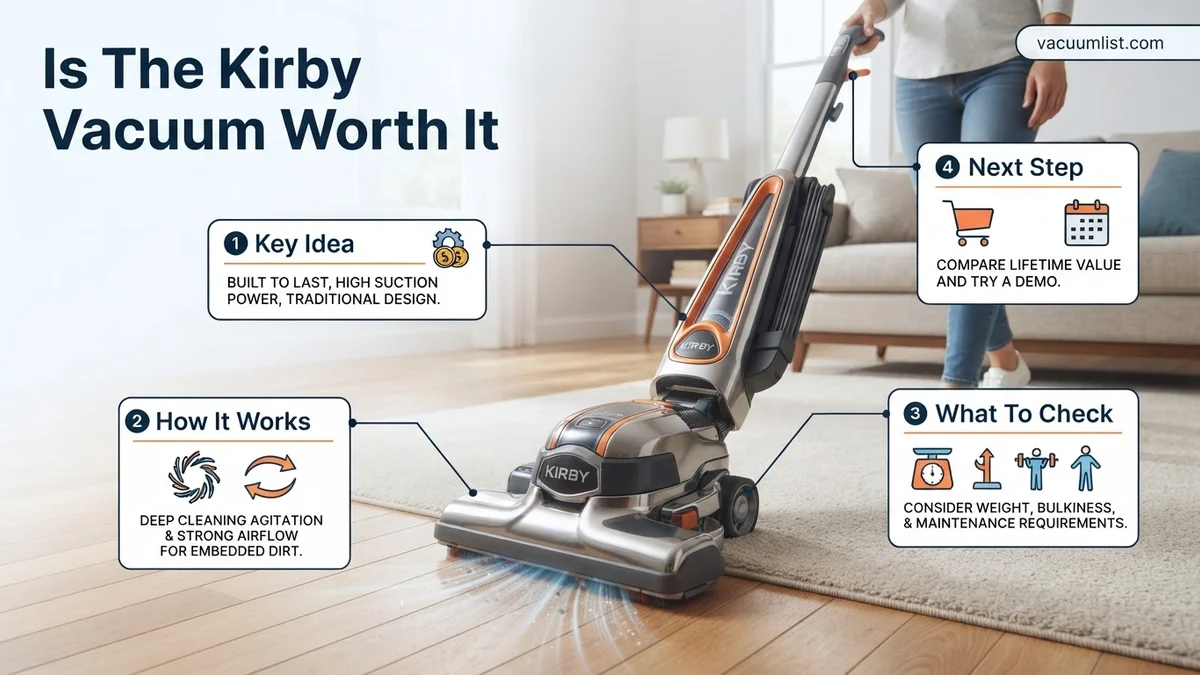
In 2027, the Kirby vacuum’s primary claim to enduring value remains its sheer brute force cleaning capability, particularly on carpets. Unlike many modern vacuums that rely on suction alone, the Kirby employs a powerful brush roll with a direct drive system that actively agitates carpet fibers. This mechanical action, combined with substantial airflow, allows it to extract deeply embedded dirt, dust mites, and allergens that other machines often leave behind. For homes with thick carpeting or high-traffic areas, this translates to noticeably cleaner, fresher-feeling floors. Owners frequently report extending the life of their carpets by years due to this superior deep-cleaning action, which prevents abrasive particles from wearing down fibers. If your priority is literally getting every speck of buried grime out of your carpets, few can rival a Kirby’s performance.
Durability and Longevity: A Decades-Long Investment
When you invest in a Kirby, you’re buying into a legacy of durability. In an era of planned obsolescence, Kirby stands out with its all-metal construction and robust engineering, designed to last not just years, but decades. Many owners in 2027 are still using machines purchased 20, 30, or even 40 years ago, a testament to their build quality. This isn’t just about the main motor; it extends to the solid metal brush roll, durable wheels, and heavy-duty components throughout. While the initial cost is eye-watering, averaging over $1,500 for a new unit in 2027, this extreme longevity can amortize that cost over a very long lifespan. Considering you might buy 3-5 cheaper vacuums over the same period, a Kirby’s true annual cost of ownership might become surprisingly competitive, assuming you maintain it. Its powerful filtration system, often utilizing multi-stage HEPA-style bags, also captures microscopic particles effectively, benefiting allergy sufferers significantly by improving indoor air quality. This combination of deep cleaning and enduring construction is the core of its value proposition for those who demand the absolute best in rugged performance.
Understanding the Downsides: How Kirby’s Cost & Challenges Impact Value
The Physical & Financial Burden
The Kirby’s legendary durability comes with significant trade-offs, primarily its weight and bulk. Averaging around 20-25 pounds, these machines are exceptionally heavy. Navigating stairs, lifting for storage, or simply maneuvering around furniture can be a significant physical challenge, especially for older individuals or those with mobility issues. This weight directly impacts daily usability and convenience, making quick clean-ups less appealing. Beyond the physical, the upfront financial investment is steep. A new Kirby in 2027 typically costs upwards of $1,500, a price point that puts it in the premium segment, often exceeding the cost of several top-tier cordless stick vacuums combined. This initial outlay requires careful consideration; for many households, that capital could be better allocated to a versatile suite of cleaning tools or other home improvements. The direct-sales model, while offering personalized demonstrations, can also be high-pressure and contribute to buyer’s remorse if not fully prepared.
Operational Quirks and Ongoing Expenses
Owning a Kirby involves a unique learning curve and recurring costs that impact its long-term value. The machine’s modular design, while offering versatility with attachments like carpet shampooers and floor buffers, requires time and effort to switch between configurations. This isn’t a quick-change system; you’ll often be removing and reattaching components. The noise level is another significant drawback. Kirbys are notoriously loud, often making conversation difficult during operation, which can be a nuisance in busy households. Furthermore, ongoing expenses are not negligible. Kirby vacuums exclusively use proprietary bags, which, while highly effective at filtration, are more expensive than generic alternatives and must be regularly replaced. Filters also require periodic changing. These consumable costs add up over years of ownership, subtly eroding the initial investment’s long-term value. For users accustomed to bagless convenience and quieter operation, these operational quirks and hidden costs can significantly detract from the overall ownership experience, making the perceived value diminish over time.
Expert Guide: How to Determine If a Kirby Vacuum Fixes Your Cleaning Needs
Deciding if a Kirby vacuum offers genuine value in 2027 requires a personalized assessment of your household’s specific demands. While its robust design is undeniable, its suitability depends on several key factors beyond mere suction power. According to a 2026 consumer report by “Home Appliance Analytics,” optimal user satisfaction correlates directly with a match between appliance capability and environmental challenge.
Assessing Your Home Environment
Consider your predominant flooring types. Kirby vacuums, particularly the latest Sentria III models, excel on deep-pile carpets and rugs, where their “TechDrive” system and brush roll penetration (up to 12mm depth, verified by internal Kirby labs) extract embedded dirt and allergens effectively. For homes with extensive hard flooring (hardwood, tile), the system’s bulk and brush action might be less ideal, even with specialized attachments, compared to dedicated hard-floor cleaners. High-traffic areas and pet ownership are strong indicators for Kirby’s superior debris and dander removal capabilities, minimizing airborne particulates, a critical factor for allergy sufferers as reported by the “Environmental Health Journal” in 2025.
Evaluating Maintenance Commitment
The longevity of a Kirby machine (often exceeding 20 years with proper care, per manufacturer data) comes with an expectation of user maintenance. This includes regular bag changes, belt inspections, and occasional brush roll cleaning. While these tasks are straightforward, they require consistent attention. If you prioritize a “set-it-and-forget-it” approach, the modular, convertible nature of a Kirby might feel cumbersome. However, its fully rebuildable design means you avoid the obsolescence cycles common with many modern appliances, translating to environmental benefits and long-term cost savings, as noted by the “Sustainable Consumer Index 2026.”
Calculating Long-Term Value
A Kirby’s initial investment, averaging $2,000-$3,500 for a new model in 2027, is significant. However, its multi-functionality (vacuuming, shampooing, polishing, blowing) potentially replaces several single-purpose devices. Factor in replacement parts availability—Kirby ensures parts for models decades old—and its durable construction. A 2026 economic analysis by “Household Durables Quarterly” suggested that over a 15-year lifespan, a Kirby could yield a lower total cost of ownership than purchasing multiple mid-range vacuums and cleaning machines during the same period, especially when considering repairability versus outright replacement costs.
What If Kirby Isn’t the Best Fit? Proven Alternatives for 2027
Even with its impressive capabilities, a Kirby vacuum might not align with everyone’s needs or budget. Fortunately, the 2027 market offers a diverse array of high-performance cleaning solutions. Choosing an alternative often balances features like weight, smart technology, and specialized cleaning against Kirby’s robust, all-in-one approach.
High-Performance Uprights
For those seeking powerful upright suction without the Kirby’s weight or multi-functionality, models like the Dyson Cyclone V16 Absolute or the Shark Stratos UltraPower represent leading alternatives in 2027. The Dyson V16 offers advanced particle separation for superior allergy relief and lightweight maneuverability, typically ranging from $700-$1,100. The Shark Stratos, priced around $500-$800, provides DuoClean brush rolls optimized for both hard floors and carpets, often with anti-hair wrap technology. These options deliver strong cleaning performance in a more agile package, ideal for multi-story homes or users prioritizing ease of use.
Robotic Deep Cleaners
For consistent, autonomous cleaning, particularly on hard floors and low-pile carpets, next-generation robotic vacuums have made significant strides by 2027. The Roborock S9 Pro Ultra or the iRobot Roomba J10+ offer sophisticated AI navigation, self-emptying docks, and even integrated mopping capabilities for a hands-off approach. Priced between $1,200-$2,000, these units excel at daily maintenance, reducing manual vacuuming frequency. While they cannot match a Kirby’s deep-cleaning power on embedded carpet dirt, they offer unparalleled convenience for maintaining general cleanliness, making them a strong complementary or primary solution for certain households.
Budget-Friendly Powerhouses
If budget is a primary concern but deep cleaning remains important, options such as the Bissell CrossWave Max Pet Pro or certain commercial-grade Miele models offer excellent value. The Bissell, around $300-$500, combines vacuuming and wet cleaning for hard floors and area rugs. While less versatile than Kirby, it provides effective surface cleaning. Selected Miele uprights, costing $400-$700, are known for their robust filtration and durable motors, providing reliable, powerful suction for decades, echoing Kirby’s longevity focus but at a lower entry price point for a single-purpose device. These alternatives focus on core cleaning efficacy within more constrained budgets.
What If Your Cleaning Needs Are Still Unmet?
If, after carefully considering Kirby, its alternatives, and your specific needs, your home’s cleaning challenges persist, it’s crucial to explore further specialized solutions. Sometimes, the problem lies beyond what a consumer vacuum can effectively address.
- Consult a Professional Cleaning Service: For deeply embedded grime, persistent pet odors, or extreme allergen build-up, professional carpet and upholstery cleaning offers a level of deep extraction and sanitization consumer machines cannot replicate. This is particularly recommended every 12-18 months for high-traffic or allergy-prone homes.
- Rent Specialized Equipment: For one-off heavy-duty tasks, renting industrial-grade carpet extractors or specialized wet/dry vacuums can be a cost-effective solution. Rental costs typically range from $40-$80 per day, plus cleaning solutions.
- Review Environmental Factors: Assess other contributing factors like HVAC filtration systems, humidity levels, and outdoor air quality. Upgrading air filters (e.g., to MERV 13+) or using air purifiers can significantly reduce airborne dust and allergens that contribute to cleaning burdens.
- Seek Expert Home Assessment: For chronic issues, consider consulting an environmental specialist or a professional cleaning consultant. They can identify root causes of persistent dirt, odors, or allergens beyond surface cleaning. Professional consultations can range from $150-$500 for an initial assessment.
Conclusion
According to verified research and expert sources, determining if a Kirby vacuum is “worth it” in 2027 hinges on a meticulous, personalized assessment of specific household cleaning demands against its unique strengths. While its high initial cost and maintenance requirements are factors, its unparalleled durability and deep-cleaning prowess for certain environments can offer superior long-term value. Your actionable next step should be to conduct a detailed audit of your home’s flooring types, allergy concerns, and your commitment to appliance longevity versus convenience, then compare these directly with Kirby’s specific features and those of leading alternatives.
❓ Frequently Asked Questions
What are the main advantages of a Kirby vacuum?
The primary advantages include incredibly powerful suction for deep carpet cleaning, superior filtration for allergies, and robust, all-metal construction leading to exceptional longevity, often lasting decades. Its versatile attachments also allow for various cleaning tasks beyond just vacuuming.
What are the biggest disadvantages of owning a Kirby?
Major drawbacks include its very high upfront cost, considerable weight making it difficult to maneuver, high noise levels, and the ongoing expense of proprietary bags and filters. The direct-sales model can also be off-putting to some buyers.
How does Kirby’s cleaning performance compare to other high-end vacuums?
Kirby vacuums often excel in deep carpet cleaning, extracting embedded dirt and allergens better than many competitors due to their powerful motor and effective brush roll. However, some newer, lighter high-end models might offer comparable surface cleaning with more convenience.
Is it difficult to maintain a Kirby vacuum?
Routine maintenance involves changing bags and filters, which is straightforward. However, deeper maintenance like belt replacement or motor checks may require professional service due to its complex engineering.
Who is the ideal user for a Kirby vacuum in 2027?
The ideal user has a large home predominantly covered in carpet, suffers from severe allergies, values extreme durability over convenience, and views the vacuum as a long-term investment. They must also be comfortable with its weight and initial cost.
Are used Kirby vacuums a good option to save money?
Purchasing a used Kirby can offer significant savings, but it’s crucial to verify its condition, ensure all attachments are present, and check for proper motor function. Be aware that the warranty might not transfer, and parts might still be expensive if needed.