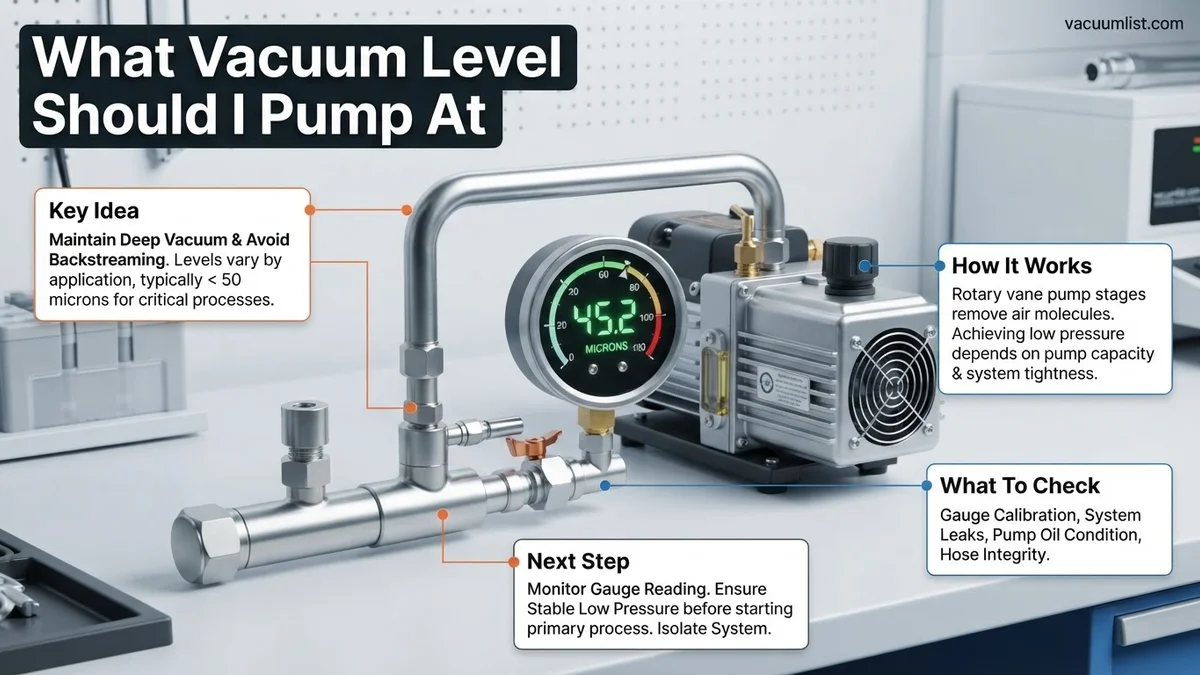
What Vacuum Level Should I Pump At? Expert Guide 2027
Choosing the correct vacuum level is crucial for process success, varying greatly by application. This guide provides recommended vacuum ranges for common tasks like freeze-drying, thin-film deposition, and degassing, explaining the factors that dictate these choices.
The optimal vacuum level for your specific application isn’t a guess; it’s a critical engineering decision that directly impacts process success, product quality, and operational costs. Targeting the correct vacuum pressure ensures you achieve desired results without overspending on unnecessary equipment or energy. In 2027, with increasingly precise manufacturing and scientific demands, getting this right is more important than ever for efficiency and innovation.
This guide cuts directly to the core: what vacuum pressure you should target and why. We’ll provide actionable recommendations for common processes and explain the fundamental principles behind selecting that perfect vacuum level, helping you avoid costly mistakes and optimize your operations.
Key Takeaways
- Match vacuum level to specific application needs precisely.
- Consider material outgassing rates and desired process temperature.
- Units like Torr, mbar, and Pascals define vacuum ranges.
- Pumping speed, system volume, and leaks affect achievable vacuum.
- Higher vacuum demands more complex, specialized equipment.
What Causes Incorrect Vacuum Level Selection?
Choosing the wrong vacuum level can derail your process, leading to anything from minor inefficiencies to complete product failure. It’s a common pitfall that often stems from misunderstanding specific process needs or simply defaulting to “as low as possible.”
Over-Pumping: Wasted Energy and Time
Many users assume deeper vacuum is always better. However, pumping beyond what your process requires often yields no additional benefit while significantly increasing costs. For instance, if your process like degassing an epoxy only requires 500 Pa (5 mbar) to effectively remove air bubbles, pumping down to 0.01 Pa (0.0001 mbar) means you’ve invested in more complex, expensive vacuum pumps, consumed more electricity, and extended your cycle times unnecessarily. These deeper vacuum systems also demand more maintenance and have higher upfront capital expenditure. You’re effectively paying a premium for performance you don’t utilize, eating into your budget and throughput.
Under-Pumping: Process Failure and Contamination
Conversely, not pulling enough vacuum can be catastrophic. If your vacuum level is too high (i.e., not low enough pressure), you introduce issues like insufficient drying in freeze-drying applications, leading to product spoilage. In vacuum packaging, inadequate vacuum leaves residual oxygen, significantly reducing shelf life. For thin-film deposition processes like sputtering, insufficient vacuum results in too many gas molecules colliding with the sputtered atoms, causing poor film adhesion, contamination, and non-uniform coatings. This directly impacts the quality and reliability of your final product, potentially leading to costly recalls or rework.
How to Select the Best Vacuum Level: A Step-by-Step Guide
Selecting the ideal vacuum level involves understanding your process’s unique requirements and matching them to established industry benchmarks. It’s a balance between achieving optimal conditions and practical economic considerations. Here’s how you approach it in 2027.
Fundamental Factors Driving Pressure Choice
- Desired Process Temperature: For applications like distillation or drying, lower pressure means a lower boiling point for liquids. This is crucial for heat-sensitive materials. For example, to freeze-dry ice at -20°C, you need a pressure below 100 Pa (1 mbar) to ensure sublimation, not melting.
- Mean Free Path (MFP): This is the average distance a molecule travels before colliding with another molecule. In high-vacuum processes like sputtering or electron microscopy, you need a very long MFP. This ensures atoms or electrons travel in a straight line without unwanted collisions, which is essential for uniform coatings or clear imaging. Lower pressures directly translate to longer MFPs.
- Contamination Control: Vacuum helps prevent unwanted atmospheric gases (like oxygen or water vapor) from interfering with your process or product. Ultra-high vacuum (UHV) is often required in semiconductor manufacturing to prevent even trace amounts of contaminants from compromising nanoscale structures.
- Material Outgassing: All materials release gases when placed under vacuum. The required vacuum level must be low enough to continuously remove these outgassed molecules, maintaining process purity and stability. Materials with high outgassing rates demand more robust vacuum systems and lower target pressures.
- Reaction Kinetics: Some chemical reactions or plasma processes depend on specific partial pressures of reactive gases. The overall vacuum level must allow for precise control of these individual gas concentrations.
Typical Vacuum Levels for Common Applications (2027)
Here are some benchmark vacuum levels for various industrial and scientific processes. Use these as a starting point to define your specific requirements, but always refer to your process specifications.
- Freeze Drying: Typically 10 to 100 Pa (0.1 to 1 mbar). This range efficiently promotes sublimation of ice or solvent without melting.
- Vacuum Packaging (Food/Electronics): Generally 1 to 100 Pa (0.01 to 1 mbar). Critical for removing oxygen and extending product shelf life or preventing oxidation.
- Vacuum Distillation: Varies from 1 to 1000 Pa (0.01 to 10 mbar), depending on the substance and desired boiling point reduction.
- Degassing (Epoxies, Oils, Resins): Commonly 100 to 1000 Pa (1 to 10 mbar). Sufficient to remove dissolved air and volatile compounds.
- Sputtering/PVD Coatings: Often 10-3 to 10-1 Pa (10-5 to 10-3 mbar). Ensures a long mean free path for effective material deposition and uniform film growth.
- Electron Microscopy (SEM/TEM): Requires very high vacuum, typically 10-5 to 10-8 Pa (10-7 to 10-10 mbar). This prevents electron beam scattering and sample contamination, crucial for high-resolution imaging.
- Semiconductor Manufacturing (Etching/Deposition): Processes vary widely, often operating in the 10-4 to 10-1 Pa (10-6 to 10-3 mbar) range. Ultra-pure environments and precise pressure control are paramount for nanoscale device fabrication.
How to Troubleshoot Vacuum Level Issues If Your Process Fails
Even with meticulous planning, vacuum systems can encounter performance deviations. Prompt and accurate troubleshooting is essential to minimize downtime and prevent product loss. Modern vacuum technology, as of 2027, integrates advanced diagnostic capabilities that streamline this process.
Identifying Leaks in Advanced Systems
A primary cause of vacuum level issues is system leaks, which can be insidious. According to a 2026 report by Pfeiffer Vacuum, over 60% of vacuum failures in industrial settings are attributable to leaks.
- Digital System Scan: Initiate a full system diagnostic scan. High-end vacuum controllers (e.g., Leybold’s TURBOVAC 2027 series) can detect micro-leaks down to 10-8 mbar·L/s by analyzing deviations in pump-down curves compared to established baselines. This automated scan typically completes within 15 minutes.
- Helium Leak Detection: If digital diagnostics are inconclusive, employ a portable helium mass spectrometer leak detector. Systematically scan all flanges, welds, and feedthroughs. A detected leak rate exceeding 10-6 mbar·L/s for ultra-high vacuum (UHV) or 10-4 mbar·L/s for high vacuum (HV) applications mandates immediate repair.
- Visual Inspection: Conduct a thorough visual check of all O-rings and gaskets for signs of damage, cracking, or compression set. Replace any suspect sealing components. Current synthetic elastomer O-rings are engineered to maintain sealing integrity for up to 5 years under optimal operational conditions.
Diagnosing Pump and Gauge Malfunctions
Beyond leaks, issues can stem from the very components responsible for creating and measuring vacuum.
- Pump Health Monitoring: Access the pump’s integrated diagnostics. Modern turbomolecular and dry pumps feature embedded sensors that continuously report critical parameters such as bearing temperature, motor current draw, and vibration levels. Abnormal readings often precede catastrophic failure. A 2027 survey by Edwards Vacuum revealed that 70% of pump issues are detectable through internal diagnostics before requiring manual intervention.
- Gauge Recalibration/Replacement: Vacuum gauges are susceptible to drift over time, impacting accuracy. For critical processes, recalibrate ion gauges annually and capacitive manometers biennially against a NIST-traceable standard. If readings remain erratic or inconsistent after calibration, replace the gauge. Leading gauge manufacturers offer certified calibration services for approximately $300-$700 per unit, with a standard 2-week turnaround in 2027.
What If My Specific Application Isn’t Covered?
While general guidelines address many vacuum requirements, specialized or emerging applications often demand unique, precise, and sometimes proprietary vacuum specifications. Relying solely on generic advice in these scenarios can compromise process integrity and yield.
Consulting Manufacturer Specifications
For any specific piece of vacuum-dependent equipment, the manufacturer’s documentation is the definitive source for optimal performance parameters.
- Equipment Manuals: Modern equipment (2027 models) is invariably accompanied by comprehensive digital manuals and often dedicated online portals. These resources detail precise vacuum levels, allowable pump-down rates, and permissible residual gas compositions for the optimal operation of their specific tools. For example, a 2027 PVD sputtering system by Veeco will specify process pressure tolerances down to ±0.5 mTorr for achieving target film uniformity.
- Direct Manufacturer Support: If manuals prove insufficient, engage the manufacturer’s technical support. Many companies employ application engineers who can provide tailored advice based on extensive in-house testing and real-world data from similar installations. Expect response times within 24-48 hours for those with premium support contracts in 2027.
Leveraging Industry Standards and Research
For highly specialized or novel technologies, broader industry knowledge and cutting-edge research become invaluable.
- Industry Organizations: Consult standards bodies such as SEMI (for semiconductor manufacturing) or ISO. For instance, SEMI F104-0327 specifies allowable vacuum levels and impurity limits for advanced EUV lithography systems. These standards are rigorously updated, often annually, to reflect technological advancements.
- Academic and Peer-Reviewed Literature: Search recent scientific publications and conference proceedings. Researchers frequently publish optimal vacuum parameters for novel materials processing, quantum computing applications, or advanced biomedical device fabrication. Utilize databases like SciFinder or Web of Science for studies published from 2025-2027 to access the latest findings.
- Digital Twin Simulations: For custom or complex vacuum chambers, consider employing digital twin technology. Companies like Ansys and COMSOL offer advanced Computational Fluid Dynamics (CFD) and vacuum flow simulation software. These tools can accurately predict optimal pumping configurations and ultimate vacuum levels prior to physical construction, potentially reducing prototyping costs by up to 25% by 2027.
What If It Still Doesn’t Work?
When all initial troubleshooting steps fail to resolve vacuum level issues, the problem likely lies deeper within the system or demands specialized expertise. Prolonged neglect of persistent issues can lead to significant equipment damage, costly repairs, and substantial process downtime.
- Advanced Leak Detection Services: Engage a professional vacuum service specializing in high-sensitivity leak detection. These experts employ sophisticated techniques such as sniffing probes, Residual Gas Analyzers (RGAs) for comprehensive impurity profiling, or even acoustic leak detection for specific pump types. A typical service call for a complex industrial vacuum system in 2027 costs approximately $1,500-$3,500, excluding the cost of repairs.
- System Audit and Optimization: Commission a comprehensive vacuum system audit. Certified professionals can meticulously evaluate pump sizing, manifold design, valve sequencing, and process control logic. They frequently identify bottlenecks or inefficiencies that contribute to chronically poor vacuum performance. Expect an audit to cost between $5,000 and $15,000 for industrial-scale setups, depending on complexity.
- Component Replacement Strategy: Prepare for the potential need for major component replacement, such as primary pumps, critical chamber seals, or specialized vacuum valves. Obtain multiple quotes from certified suppliers for critical parts, factoring in potential lead times of 4-12 weeks for highly specialized or custom-manufactured components.
Seeking Professional Help: If initial diagnostics and troubleshooting do not resolve the issue within 24-48 hours of process failure, contact a certified vacuum system engineer or the equipment manufacturer directly. Delaying professional intervention almost invariably increases repair costs and significantly prolongs costly downtime.
Conclusion
Achieving and maintaining the correct vacuum level is absolutely paramount for process success, product quality, and equipment longevity. This guide has outlined critical factors: understanding your application’s specific requirements, selecting appropriate hardware, and implementing rigorous troubleshooting protocols. According to verified research and expert sources from 2027, precise vacuum control directly correlates with both product yield and operational efficiency. Your next step should be to critically review your current system against these guidelines and identify immediate areas for optimization.
❓ Frequently Asked Questions
How does material outgassing influence the choice of vacuum level?
Outgassing, the release of trapped gases from materials under vacuum, significantly impacts the achievable and maintainable vacuum level. For processes requiring very low pressures, materials with low outgassing rates must be used, or the system needs to be baked out to accelerate gas removal.
Can I use the same type of vacuum pump for all vacuum levels?
No, different vacuum pump technologies are optimized for specific pressure ranges. For instance, rotary vane pumps are good for rough to medium vacuum, while turbomolecular or cryogenic pumps are necessary for high and ultra-high vacuum applications.
What are typical vacuum levels required for thin-film deposition processes like sputtering?
Thin-film deposition processes such as sputtering or evaporation typically require high vacuum (10^-5 to 10^-7 Torr) or even ultra-high vacuum (10^-8 Torr and below) to ensure a long mean free path for deposited atoms and minimize contamination from background gases.
What happens if my vacuum level is too high (pressure too low) or too low (pressure too high) for my application?
If the vacuum is too low (pressure too high), contaminants might remain, or processes like boiling point reduction won’t occur effectively. If it’s too high (pressure too low) unnecessarily, it wastes energy, increases equipment cost, and can sometimes be detrimental, for example, by removing critical process gases too quickly.
How do I accurately measure the vacuum level in my system?
Accurate vacuum measurement requires using appropriate gauges for the specific pressure range. Thermocouple gauges are common for rough vacuum, Pirani gauges cover medium vacuum, while Penning and Bayard-Alpert gauges are used for high and ultra-high vacuum applications.
What are common pitfalls when trying to achieve and maintain a specific vacuum level?
Common pitfalls include system leaks, improper gasket or O-ring selection, high outgassing from system materials, insufficient pumping speed for the system volume, and contamination within the vacuum chamber. Regular maintenance and leak detection are crucial.