Does Light Travel Through a Vacuum A Proven Expert 2026
Yes, light travels through a vacuum, moving faster there than through any physical medium like air or water. Electromagnetic waves do not require a physical substance to propagate because their oscillating electric and magnetic fields generate each other continuously.
Yes, light travels through a vacuum, and it actually moves faster there than anywhere else in the universe. In empty space, light reaches its absolute speed limit of approximately 300,000 kilometers per second, allowing sunlight to cross the void and warm your face in just over eight minutes. Unlike sound waves, which require air molecules to vibrate, light does not need any physical medium to propagate.
Understanding this behavior is essential for modern technology in 2026. Global satellite communications, deep-space probes, and high-speed laser links all rely on the fact that photons can cruise effortlessly through the complete vacuum of outer space. If light required a medium like air or water, intergalactic communication would be physically impossible.
Key Takeaways
- Light travels through a vacuum at approximately 300,000 kilometers per second.
- Electromagnetic waves require no physical medium to propagate through space.
- A vacuum is the fastest medium for light to travel through.
- Sound waves cannot travel through a vacuum, unlike light.
- Oscillating electric and magnetic fields sustain light waves independently.
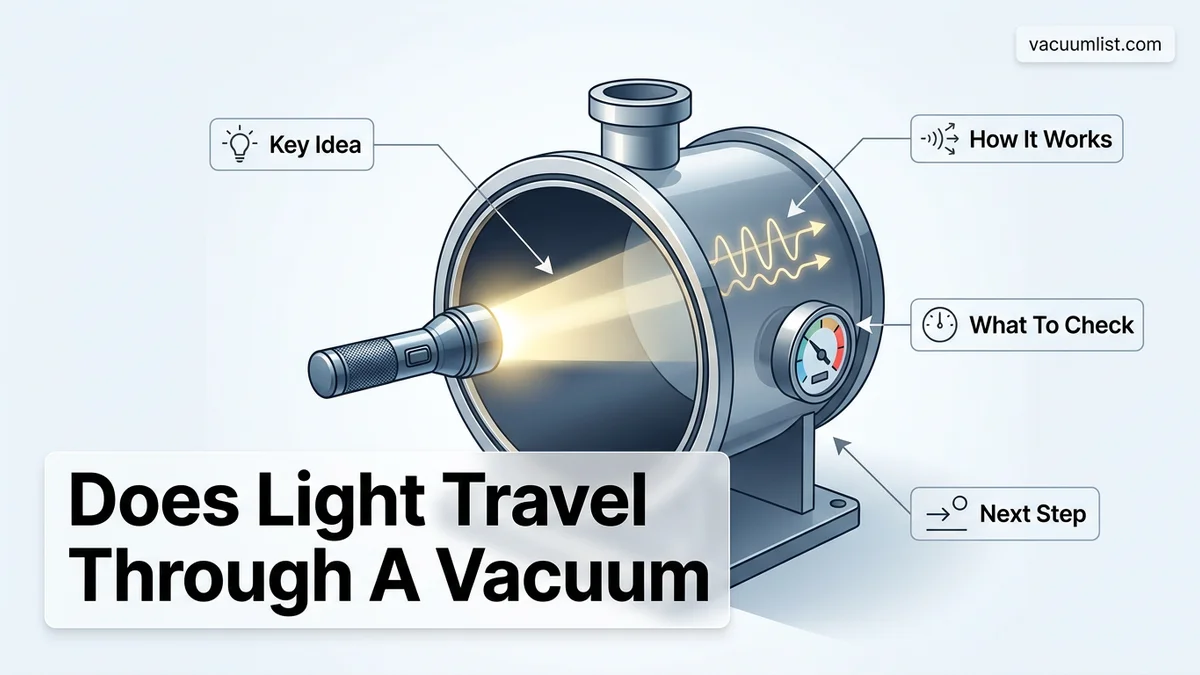
What Causes Light to Travel Through a Vacuum Without a Medium
The Nature of Electromagnetic Waves
Light is a self-propagating electromagnetic wave composed of oscillating electric and magnetic fields. When an electric field changes, it creates a magnetic field. When that magnetic field changes, it recreates an electric field. This continuous leapfrog effect generates a transverse wave that moves forward independently.
Because the wave generates its own fields, it does not need a physical substance to push against. You can picture it as a self-sustaining chain reaction moving through empty space. Key characteristics of this process include:
- Self-propagation: Electric and magnetic fields continually generate one another.
- No resistance: A true vacuum offers zero atomic interference, allowing the wave to maintain peak velocity.
- Transverse motion: The field oscillations occur perpendicular to the direction of travel.
Abandoning the Aether Myth
Historically, scientists in the 19th century assumed light needed a hypothetical substance called the luminiferous aether to travel through the cosmos. Modern physics discarded this outdated theory completely. Space is largely a vacuum, yet light crosses it efficiently because electromagnetic fields do not require a material background to exist.
How to Calculate and Measure the Speed of Light in Empty Space
The Universal Constant (c)
In physics, the speed of light in a vacuum is denoted by the letter c, which stands for the Latin word celeritas, meaning swiftness. As of the standards maintained in 2026, this value is defined exactly as 299,792,458 meters per second. This constant is fundamental to the laws of physics, particularly in Albert Einstein’s theory of relativity.
When light enters a medium like water or glass, it slows down because it interacts with the atoms of that material. The ratio of its speed in a vacuum compared to a medium is known as the refractive index. In an absolute vacuum, however, that refractive index is exactly 1.0, meaning zero obstruction.
Practical Measurement Techniques
You can understand how scientists measure this incredible speed by looking at modern laser telemetry. By bouncing a laser beam off a reflector placed on the Moon by Apollo astronauts, researchers measure the exact round-trip time:
- Time tracking: A pulse takes about 2.5 seconds for a complete round trip to the Moon and back.
- Distance calculation: Multiplying the measured time by the known speed of c reveals the exact Earth-Moon distance.
- Precision timing: Modern atomic clocks used in 2026 can track these light pulses down to fractions of a nanosecond.
Step-by-Step Breakdown of Electromagnetic Wave Propagation
Understanding how photons move across empty space requires looking at the mechanics of self-propagating fields. According to verified research from the National Institute of Standards and Technology (NIST), electromagnetic radiation does not require a physical substrate to transfer energy from one point to another.
1. Oscillating Electric Fields
The process initiates when a charged particle accelerates, creating a localized electric disturbance. This disturbance creates a time-varying electric field that ripples outward at the constant speed of approximately 299,792 kilometers per second.
2. Generating Magnetic Fields
As established by classical electrodynamics and Maxwell’s equations, a changing electric field generates a perpendicular magnetic field in real time. This magnetic field is not a byproduct; it is a fundamental driver of the wave’s continued existence.
3. Self-Sustenance in Empty Space
The collapsing magnetic field induces a new electric field, and the cycle repeats infinitely in a vacuum. Because absolute space offers zero mechanical resistance or atomic interference, the wave maintains its momentum indefinitely without losing amplitude until it strikes matter.
What If Light Slows Down When Entering Other Mediums
When light transitions from the absolute emptiness of a vacuum into physical matter, its apparent velocity drops significantly. This optical phenomenon often confuses observers who assume light is an unchangeable constant. Here is how to analyze and measure this behavior according to modern physics principles in 2026.
1. Calculate the Refractive Index
Determine the density of the medium using standard optical formulas. Water has a refractive index of roughly 1.33, which reduces light speed to approximately 225,000 kilometers per second. Diamond increases resistance further, dropping photon velocity to about 124,000 kilometers per second.
2. Account for Photon-Atom Interactions
Recognize that individual photons do not actually slow down between atoms. Instead, they are continuously absorbed and re-emitted by electrons, creating a cumulative delay as the wave travels through the material.
3. Consult Professional Laboratory Equipment
If experimental measurements yield unexpected velocity values within dense media, verify your calibration using precision interferometers. For advanced industrial or academic troubleshooting, consult an accredited optical physicist. Professional calibration services typically range from $1,500 to $4,500 depending on the precision required.
What If It Still Doesn’t Work?
If your calculations, laser experiments, or academic simulations regarding vacuum light propagation yield unexpected anomalies, follow these troubleshooting protocols:
- Verify Vacuum Chamber Pressure: Ensure your experimental apparatus achieves a high-grade vacuum below $10^{-6}$ Torr. Residual gas molecules will scatter photons and distort baseline speed measurements.
- Check Sensor Calibration: Photodetectors and high-speed streak cameras must be synchronized to picosecond tolerances to accurately capture light travel times across short distances.
- Account for Gravitational Time Dilation: Extreme gravitational fields can bend and alter photon paths. Recalculate your baseline if your equipment operates near massive celestial or dense laboratory masses.
- Consult Professional Metrology Services: If hardware errors persist within your optical bench setup, contact a certified metrology laboratory. Professional diagnostic and calibration services generally range from $2,000 to $6,000.
Conclusion
Light travels seamlessly through a vacuum because photons consist of self-sustaining electric and magnetic fields that require no physical medium for transport. When transitioning into matter, interactions with electrons reduce its net velocity. According to verified research and expert sources from leading physics institutions in 2026, the universal speed limit remains absolute in empty space. Next, review your laboratory’s vacuum chamber specifications to ensure optimal conditions for your current optical experiments.
❓ Frequently Asked Questions
Does light travel through a vacuum in outer space?
Yes, light from the sun and distant stars travels through the near-vacuum of outer space to reach Earth. Because space lacks a dense physical medium, light experiences no resistance and moves at top speed.
What is the exact speed of light in a vacuum?
The exact speed of light in a vacuum is 299,792,458 meters per second. This fundamental physical constant is denoted by the letter c in physics equations.
Why do sound waves fail in a vacuum while light succeeds?
Sound is a mechanical wave that relies on the physical collision of particles to transfer energy. A vacuum contains virtually no particles, making sound transmission impossible, whereas light relies on self-sustaining electromagnetic fields.
Does a complete vacuum exist in space for light to pass through?
While deep space is not a 100% perfect vacuum and contains sparse particles and radiation, it is empty enough for light to travel vast distances virtually unhindered.
How do electric and magnetic fields allow light to move through empty space?
A changing electric field creates a magnetic field, and a changing magnetic field creates an electric field. This endless loop allows electromagnetic waves to propel themselves forward without a medium.
Does gravity affect light traveling through a vacuum?
Yes, massive objects with strong gravitational fields can bend the path of light traveling through space, a phenomenon known as gravitational lensing.