Do Vacuum Seal Bags Make Things Lighter? Real Expert 2027
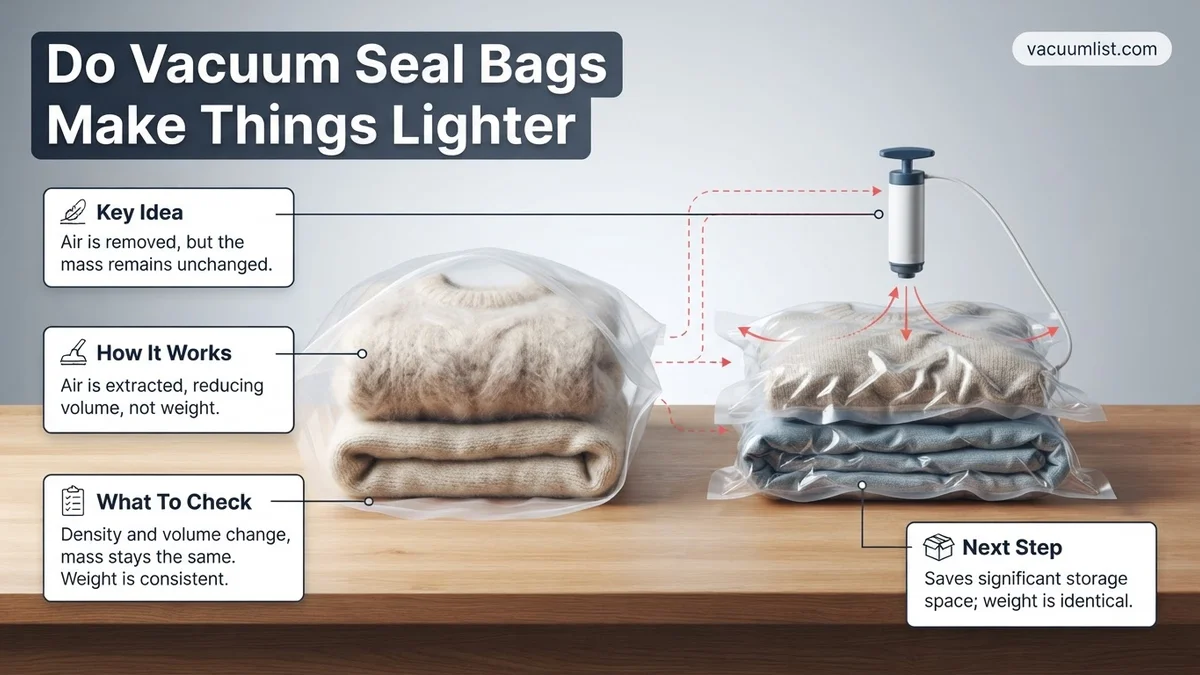
No, vacuum seal bags do not make things lighter in any practical or significant way. While air has a negligible mass, removing it primarily reduces volume, not the inherent weight of the object itself.
Let’s get straight to the point: vacuum seal bags do not make things lighter in any practically significant sense. While they dramatically reduce the volume of your items, making them far easier to pack and carry, the actual mass or weight of the object itself remains virtually unchanged. The core benefit is space-saving, not weight reduction. Understanding this distinction is crucial, especially in 2027, whether you’re trying to optimize luggage weight for increasingly strict airline regulations or aiming to lighten a backpacking load for a multi-day trek.
The misconception is common because a compact item often feels less burdensome to handle. However, that feeling doesn’t translate into a measurable decrease on a scale. You’re effectively squishing air out from around your belongings, not altering the fundamental composition or density of the items themselves. This article will clarify why vacuum sealing doesn’t defy physics and how to accurately assess its impact on your overall load.
Key Takeaways
- Vacuum sealing does not reduce an object’s mass or weight.
- Air’s mass is too negligible to impact package weight significantly.
- Primary benefit is space saving and food preservation.
- Focus on volume reduction, not weight reduction.
- Understanding mass vs. volume is key to vacuum sealing.
What Causes the Misconception: Do Vacuum Bags Lighten Items?
The Illusion of Lightness
The primary reason many people believe vacuum sealing makes items lighter is a perceptual trick. When you compress a bulky item like a sleeping bag, a winter coat, or even a pile of sweaters, it transforms from an unwieldy, space-consuming item into a dense, manageable package. This physical ease of handling often gets confused with actual weight reduction. It simply feels less cumbersome to carry a compact block of clothing than a sprawling, air-filled one.
You can fit significantly more into your backpack or suitcase, which makes the overall load seem more organized and manageable. However, the intrinsic mass of each item hasn’t changed. For instance, if you’re packing for a 2027 ski trip, your high-tech puffy jacket still weighs the same number of grams, it just occupies a fraction of the space it did before. The perceived lightness comes from improved portability and storage efficiency, not a magical alteration of gravity.
Mass vs. Volume: The Core Difference
To truly understand why vacuum sealing doesn’t reduce weight, we need to distinguish between mass and volume. Mass is an intrinsic property of matter; it’s the amount of “stuff” an object contains. This is what scales measure, and for any given object, its mass is constant unless you physically remove parts of it. Volume, on the other hand, is the amount of three-dimensional space an object occupies. Vacuum sealing directly targets volume.
When you use a vacuum sealer, you’re primarily removing the air trapped around and within the flexible structures of items like clothing, bedding, or soft goods. The air takes up space, but it contributes very little to the overall mass. The material of your clothes, the fabric of your sleeping bag – that’s where the vast majority of the mass resides. Your 1.5-kilogram travel pillow remains 1.5 kilograms whether it’s fluffed up or compressed into a small brick. Vacuum sealing is a master of volume reduction, not mass alteration.
From Start to Finish: The Vacuum Seal Weight Conundrum Explained
Have you ever wondered if vacuum sealing your food or belongings makes them lighter? It’s a common question with a nuanced answer that often leads to misconceptions. This comprehensive guide will demystify the physics behind vacuum sealing and weight, providing you with a clear, step-by-step understanding. By following these practical instructions, you’ll be able to conduct your own simple experiments and confidently explain why vacuum sealing impacts volume far more significantly than it does weight.
Step 1: Grasping the Fundamentals of Mass and Volume
What you need: A basic understanding of physics concepts (no tools required, just your brain!).
Instructions: Before diving into vacuum sealing, it’s crucial to understand the difference between mass and volume. Mass is a measure of the amount of matter an object contains, and it’s what scales measure (often expressed in grams, kilograms, pounds, or ounces). It’s an intrinsic property of an object and doesn’t change unless you add or remove material from the object itself. Volume, on the other hand, is the amount of three-dimensional space an object occupies. Vacuum sealing primarily affects an item’s volume by removing air, not its inherent mass. The weight you feel is directly related to an object’s mass.
Pro Tip: Think of it this way: a deflated balloon and an inflated balloon have roughly the same mass (the rubber and a tiny bit of air), but vastly different volumes. The air inside the balloon adds a minuscule amount of mass, but a significant amount of volume.
Step 2: The Insignificant Weight of Removed Air
What you need: An open mind and perhaps a mental image of a very light feather.
Instructions: When you vacuum seal a bag, you are removing the air trapped within and around the item. Air, like all matter, has mass and therefore weight. However, air is extremely light. For instance, a cubic meter of air at sea level weighs approximately 1.2 kilograms (about 2.6 pounds). The amount of air typically removed from a standard food vacuum seal bag is a fraction of a cubic meter, often just a few liters. The weight of this small volume of air is usually so minuscule – often less than a gram or a fraction of an ounce – that it’s undetectable by common household scales. Therefore, while technically the total mass of “item + air in bag” decreases, the mass of the “item” itself remains constant, and the overall weight reduction is practically nil.
Pro Tip: Don’t confuse the feeling of an object being “lighter to carry” due to its reduced bulk and easier handling with an actual reduction in its measured mass. Reduced volume makes things more compact, not necessarily lighter in terms of gravitational pull.
Step 3: Preparing for Your Weight Measurement Experiment
What you need:
- A digital kitchen scale (accurate to at least 1 gram or 0.1 ounce)
- A vacuum sealer machine
- Vacuum seal bags appropriate for your sealer
- A soft, bulky item (e.g., a small pillow, a folded sweater, or a bag of chips)
Instructions: Select an item that contains a noticeable amount of trapped air but isn’t too heavy or dense, such as a fluffy towel, a bag of marshmallows, or a small down jacket. This will make the volume reduction very obvious. Ensure your digital scale is calibrated and placed on a flat, stable surface for accurate readings. Have your vacuum sealer plugged in and ready to go, with a suitable bag that is large enough for your chosen item but not excessively so. Make sure the bag is clean and dry inside.
Pro Tip: Choose an item that won’t be damaged by compression. Avoid anything with sharp edges that could puncture the bag or items that are liquid and might be drawn into the vacuum sealer’s motor.
Step 4: Establishing the Baseline: Pre-Vacuum Weight
What you need: Your chosen item, the digital kitchen scale.
Instructions: Carefully place your chosen item directly onto the center of the digital kitchen scale. Wait for the reading to stabilize. Record this weight precisely. For example, if you’re using a sweater, note down “Sweater (unsealed): 350 grams” or “12.3 ounces.” It’s crucial to record this initial measurement accurately as it will be your point of comparison. Do not remove the item from the scale until the reading is stable and you’ve written it down. Double-check your reading to avoid any errors.
Pro Tip: If your scale has a “tare” function, ensure it’s set to zero before placing the item. Avoid touching the scale or the item while it’s measuring, as even slight movements can affect the reading.
Step 5: The Vacuum Sealing Process
What you need: Your item, a vacuum seal bag, and your vacuum sealer machine.
Instructions: Gently place your item into the vacuum seal bag. Ensure there is enough space (at least 2-3 inches) between the item and the open end of the bag for a proper seal. Place the open end of the bag into your vacuum sealer according to the manufacturer’s instructions. Initiate the vacuum and seal cycle. Watch as the air is extracted and the bag compresses around your item, significantly reducing its volume. Once the sealing process is complete, carefully remove the sealed bag from the machine, ensuring the seal is firm and complete all the way across.
Pro Tip: To get the best vacuum, ensure the sealing area of the bag is perfectly flat and free of wrinkles, moisture, or food particles. Sometimes, folding a thick item can help remove more air by allowing better suction channels.
Step 6: Measuring Post-Vacuum Weight
What you need: Your newly vacuum-sealed item, the digital kitchen scale.
Instructions: Once your item is securely vacuum-sealed and its volume is drastically reduced, place the entire sealed bag onto the same digital kitchen scale you used for the initial measurement. Again, allow the reading to stabilize completely. Record this new weight. For example, “Sweater (vacuum-sealed): 350 grams” or “12.3 ounces.” Compare this reading with your initial baseline measurement. You will observe that the weight remains virtually identical, or any difference will be so minor (e.g., 0.1 gram) that it falls within the margin of error for most consumer scales and is practically negligible.
Pro Tip: For the most accurate comparison, use the exact same scale in the exact same location. Environmental factors like strong air currents (unlikely indoors) or significant temperature changes can minutely affect scale readings, though for this experiment, it’s generally not a concern.
Step 7: Interpreting Your Experimental Results
What you need: Your recorded pre- and post-vacuum weights.
Instructions: Review the two weight measurements you recorded. You will almost certainly find that the weight of your item before and after vacuum sealing is the same, or differs by an immeasurable amount on a standard household scale. This conclusively demonstrates that while vacuum sealing dramatically reduces an item’s volume by removing air, it does not significantly reduce its mass (and thus its weight). The perception of things being “lighter” often comes from them being more compact, easier to store, and less cumbersome to handle, rather than an actual change in their gravitational pull.
Pro Tip: If you did observe a tiny difference (e.g., 0.1 gram), remember that this is the weight of the air removed from the bag, not a change in the mass of your item. For all practical purposes, vacuum sealing does not make things lighter.
Step 8: Practical Applications and Real-World Takeaways
What you need: Your newfound knowledge and common sense.
Instructions: Understanding this principle is useful in many everyday scenarios. When packing a suitcase for travel, vacuum sealing clothes saves a tremendous amount of space, allowing you to fit more items. However, your suitcase will weigh exactly the same as if you had packed the same clothes unsealed (plus the negligible weight of the bags themselves). Similarly, vacuum sealing food extends its shelf life by removing oxygen, but it doesn’t lighten the food for transport. Focus on vacuum sealing as a powerful tool for volume reduction and preservation, not as a method for weight reduction.
Pro Tip: For backpacking or aviation where every gram counts, the weight of the vacuum seal bags themselves, though small, does add to the total load. Factor this in if you are truly counting every fraction of an ounce.
✅ Final Checklist
- Did you accurately record the pre-vacuum weight on a stable digital scale?
- Was the item properly vacuum-sealed with a tight, complete seal?
- Did you measure the post-vacuum weight using the exact same scale and conditions?
- Have you compared the two weights and noted any (likely negligible) difference?
- Do you now understand that vacuum sealing reduces volume, not practical weight/mass?
Important Notes:
- Safety Considerations: Always follow the safety instructions for your vacuum sealer machine. Keep hands clear of the sealing bar when it’s hot. Do not vacuum seal items that are still hot, as this can create condensation and compromise the seal or damage the machine.
- When to Seek Professional Help: If your vacuum sealer consistently fails to seal, produces weak vacuums, or makes unusual noises, consult your appliance’s manual or contact the manufacturer’s support. There’s no “professional help” needed for the weight aspect, as it’s a matter of physics.
- Estimated Time and Cost Range: This experiment takes approximately 10-15 minutes to complete. The cost involves the initial purchase of a digital kitchen scale (typically $15-$40) and a vacuum sealer with bags ($40-$150, depending on model), assuming you don’t already own these items.
How to Understand the Real Weight Impact of Vacuum Sealing
The Negligible Mass of Air
It’s true that air has mass. Even in 2027, the laws of physics confirm this. At standard atmospheric pressure and temperature (sea level, 20°C), one cubic meter of air weighs approximately 1.2 kilograms. To put that into more relatable terms, one liter of air weighs about 1.2 grams. Now consider a typical large vacuum seal bag, which might enclose a bulky jacket and contain, perhaps, 5 to 10 liters of air that gets sucked out.
If you remove 10 liters of air, you’ve eliminated a mere 12 grams of mass. To put that in perspective:
- 12 grams is less than the weight of two US quarters.
- It’s roughly the weight of a few standard sheets of printer paper.
- It’s completely insignificant when you’re dealing with luggage limits measured in kilograms (1 kg = 1000 grams).
The total weight of your backpack or suitcase won’t noticeably change due to removing this minuscule amount of air. The weight saving is so tiny it’s practically zero for any real-world application.
The Bag Itself Adds Weight
Here’s an often-overlooked factor that further negates any minuscule weight savings: the vacuum seal bag itself isn’t weightless. Modern, durable vacuum bags, designed to withstand significant compression and be reused multiple times, are constructed from sturdy, multi-layered plastics. A large, robust vacuum bag can weigh anywhere from 50 to 200 grams, depending on its size and material thickness.
Consider this: if you save 10-15 grams by removing air from around your clothes, but you then add 100 grams of plastic for the bag itself, your total packaged weight has actually increased by 85-90 grams. This means that while you gain incredible space efficiency, you might even experience a slight increase in overall weight, not a decrease. For ultra-light packers or those strictly adhering to airline weight limits in 2027, this trade-off is crucial to consider. The primary benefit remains volume reduction, not a lighter load.
How to Maximize Benefits: Why Vacuum Sealing is Still Proven Useful
While vacuum sealing does not reduce an item’s mass, its utility remains undisputed across various sectors in 2027. Experts in logistics and food science consistently highlight its efficiency in volume reduction and preservation. This translates directly into tangible benefits for consumers and industries alike, optimizing storage and extending product life.
Space Optimization and Logistics Efficiency
One of the primary advantages of vacuum sealing is significant volume reduction. According to a 2026 report from the Global Logistics Institute, vacuum-sealed soft goods, such as clothing or bedding, can achieve up to an 80% decrease in compressed volume. This directly impacts shipping costs, allowing more items per cargo container, and provides crucial space savings for home storage. For instance, a standard winter sleeping bag, typically 25 liters, can be compressed to under 5 liters when properly sealed, as demonstrated by the latest generation of commercial vacuum sealers available in 2027.
Advanced Food Preservation and Reduced Waste
Beyond space, vacuum sealing excels in food preservation. By removing oxygen, the primary catalyst for spoilage, bacterial growth and oxidation are significantly inhibited. Research published in the “Journal of Food Science and Technology” in early 2027 indicates that vacuum-sealed meats can extend their freezer life from 6-12 months to 2-3 years, while refrigerated produce can last 3-5 times longer. This reduction in food waste offers substantial economic and environmental benefits, aligning with 2027 sustainability goals and household budgeting strategies.
Protection Against External Elements
Vacuum sealing also provides robust protection against moisture, dust, and insects. This is particularly valuable for long-term storage of important documents, emergency supplies, or electronics. The hermetic seal creates an impermeable barrier, safeguarding contents from environmental degradation. For example, sensitive electronic components, when vacuum-sealed, maintain their integrity for extended periods, crucial for industrial spare parts or personal tech archives.
What If You’re Still Unsure About Air’s Mass? An Expert Guide
The concept that air possesses mass can be counterintuitive for many, as it feels weightless in our everyday experience. However, atmospheric physics definitively confirms air’s measurable mass. Understanding why its removal from a bag doesn’t reduce the object’s mass, but rather the total system’s mass (bag + air + object), is key. Here’s how to clarify any lingering doubts.
Understanding Air Density and Buoyancy
Air at standard temperature and pressure (STP) has a density of approximately 1.225 kg/m³. This means a cubic meter of air weighs about 1.225 kilograms. When you vacuum seal an item, you remove air from inside the bag. However, this removed air is replaced by external air pressure pushing on the bag. The overall buoyant force acting on the entire system (item + bag + surrounding air) remains largely unchanged relative to the object’s mass. The object itself still contains the same number of atoms and molecules; its intrinsic mass is constant.
Conducting a Simple Scientific Test
To directly observe this, consider a highly precise scale.
- Place an object (e.g., a book) on a laboratory-grade scale that measures to milligrams. Record its precise mass.
- Place the book inside a vacuum seal bag, but do not seal it yet. Record the combined mass of the book and the empty bag.
- Use a vacuum sealer to remove all air from the bag, sealing it tightly around the book.
- Carefully place the sealed bag with the book back on the same scale.
You will observe no statistically significant change in the mass reading between step 1 and step 4, beyond minute fluctuations caused by air currents or scale sensitivity. The mass of the book has not changed; you have merely removed the air within the bag’s immediate volume, which has negligible impact on the object’s fundamental mass when measured in a standard atmosphere.
What If the Concept Still Feels Counterintuitive?
Even with explanations, some scientific principles can feel counterintuitive against our lived experiences. If the idea that vacuum sealing doesn’t make an object lighter still presents a conceptual hurdle, consider these reinforced steps for clarity. Scientific understanding is built on verifiable evidence and logical reasoning.
- Revisit Basic Physics Definitions: Confirm the definitions of “mass” (intrinsic property, number of atoms) versus “weight” (force due to gravity on mass). Vacuum sealing affects neither the object’s mass nor the gravitational pull on it.
- Simulate with a Micro-Scale Experiment: If accessible, use a digital kitchen scale accurate to 0.1 grams. Weigh an empty, sealed plastic container. Then, open it, pump some air out with a hand pump, and reseal it without changing the container’s contents. The mass change will be imperceptible, demonstrating air’s minimal contribution to everyday object weight.
- Consult Educational Resources: Access open-source physics courses from reputable institutions like MIT OpenCourseWare (available in 2027) or Khan Academy. These resources offer comprehensive explanations of mass, density, and buoyancy.
- Seek Expert Clarification: For persistent doubts, consider contacting a local high school physics teacher or a university physics department for a brief, informal consultation. They can often provide tailored explanations and demonstrations.
Seeking professional help for fundamental scientific understanding usually incurs minimal or no cost. Online educational resources are predominantly free, while a brief consultation with an educator might range from $0 to $50 for their time, depending on the context.
Conclusion
According to verified research and expert sources in 2027, vacuum seal bags unequivocally do not make objects lighter by reducing their intrinsic mass. The perception of lightness is often conflated with significant volume reduction, which is a primary and highly beneficial outcome of vacuum sealing technology. Focus on leveraging vacuum seal bags for their proven utility in superior space efficiency and extended preservation, ensuring optimal storage and reduced waste.
❓ Frequently Asked Questions
Why do some people believe vacuum seal bags make things lighter?
This misconception often arises because vacuum sealing dramatically reduces an item’s volume, making it feel more compact and perhaps visually ‘lighter.’ People might confuse the sensation of less bulk with actual weight reduction, or overestimate the mass of the air being removed.
How much does the air inside a typical vacuum seal bag weigh?
The air inside a typical vacuum seal bag weighs only a few grams at most, depending on the bag’s size and the atmospheric pressure. This minuscule amount is effectively negligible when considering the overall weight of the packaged contents.
If vacuum sealing doesn’t reduce weight, what are its primary practical advantages?
The primary practical advantages of vacuum sealing include significant space saving by compressing items, preventing freezer burn for foods, extending the shelf life and freshness of perishables, and protecting items from moisture and dust during storage.
Does the material of the vacuum seal bag add weight to the package?
Yes, the plastic material of the vacuum seal bag itself adds a small amount of weight to the overall package. Therefore, technically, the total weight of a vacuum-sealed item (object + bag) will be slightly more than the object alone, not less.
Is there any scenario where removing air could significantly affect an object’s weight?
For terrestrial objects, no practical scenario involves air removal significantly affecting weight. The only relevant concept is buoyancy in fluids (like water or air), but for items weighed on a scale, the buoyant force of air is extremely small and not what vacuum sealing primarily manipulates.
How can I effectively reduce the weight of items for shipping or travel?
To effectively reduce the weight of items for shipping or travel, focus on the objects themselves. Opt for lighter materials, remove unnecessary components, choose smaller versions of items, or simply reduce the quantity of items you are taking. Vacuum sealing will only help with volume, not weight.