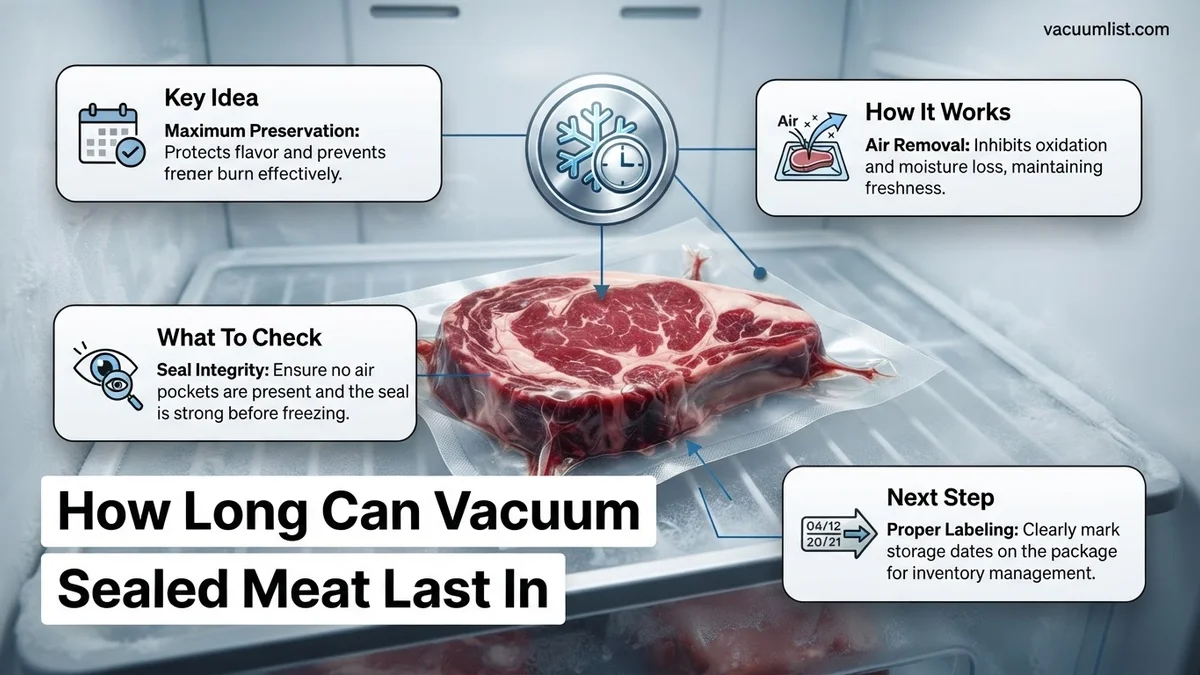
How Long Can Vacuum Sealed Meat Last in the Freezer 2026
Vacuum sealing drastically extends the freezer life of meat by removing oxygen, often lasting 2 to 3 years compared to standard wrapping. However, safety and quality depend heavily on maintaining a consistent 0°F (-18°C) temperature and proper initial sealing. While safe indefinitely at this temperature, meat will eventually suffer from declining quality and moisture loss over time.
Vacuum-sealed meat can safely last in the freezer anywhere from 1 to 3 years, depending heavily on the specific cut of meat and your freezer’s temperature stability. While standard plastic wrap or butcher paper leaves your proteins vulnerable to dehydration within months, removing all oxygen creates a protective barrier that preserves texture and flavor for an exceptionally long time.
As we move through 2026, home cooks are increasingly relying on bulk buying and meal prepping to offset rising grocery costs. Knowing the exact shelf life of your vacuum-packed proteins prevents food waste, saves you money, and ensures that the expensive ribeye or bulk chicken breasts you bought months ago still taste fresh and juicy when you finally thaw them.
Key Takeaways
- Vacuum-sealed beef lasts 2 to 3 years in the freezer.
- Poultry can remain safely stored for up to 3 years.
- Ground meats last 1 to 2 years due to higher fat content.
- Fish and seafood should be consumed within 1 to 2 years.
- Freezer burn ruins taste even if the meat remains safe.
What Causes Vacuum-Sealed Meat to Lose Quality in the Freezer
Even when you remove all the air, vacuum-sealed meat does not last forever. Understanding the underlying chemistry of freezing helps you manage your inventory effectively.
Freezer Burn and Moisture Migration
Freezer burn happens when moisture escapes from the surface of your meat and sublimes into the surrounding air pockets.
- Micro-punctures in cheap or aging vacuum sealer bags let air slowly seep back inside.
- Sublimation slowly dehydrates the outer layers, leaving grey, leathery spots on your steaks and chops.
- While still safe to eat, meat affected by freezer burn loses its natural juices and develops an unpleasant, cardboard-like texture.
Enzyme Activity and Lipid Oxidation
Cold temperatures dramatically slow down chemical reactions, but they do not stop them entirely.
- Fats in beef, pork, and especially wild game continue to oxidize very slowly at sub-zero temperatures.
- Polyunsaturated fats in poultry turn rancid faster than saturated fats in beef.
- Lipid oxidation changes the flavor profile, giving older frozen meats a stale or metallic aftertaste.
How to Fix Storage Methods and Maximize Freezer Lifespan
Reaching the maximum 3-year timeline requires strict adherence to cold storage best practices and flawless packaging execution.
Maintaining Optimal Temperature Consistency
Your freezer environment dictates whether your vacuum-sealed meat lasts for six months or three years.
- Keep your deep freeze or kitchen refrigerator freezer locked at a strict 0°F (-18°C) or lower.
- Avoid storing meat in standard frost-free freezers that cycle up in temperature to melt frost, as these temperature fluctuations accelerate moisture loss.
- Invest in a cheap digital freezer thermometer to monitor your unit daily.
Mastering the Seal and Double-Bagging Technique
A weak seal destroys your timeline before the meat even reaches the back of the freezer.
- Wipe the open edges of your bag completely dry before inserting them into the machine to prevent seal failure.
- Double-seal your bags by running a second heat seal right below the first one for extra security.
- For long-term storage exceeding one year, consider wrapping sharp-boned cuts in butcher paper first to prevent bone punctures in the plastic film.
Step-by-Step Guide to Organizing and Dating Frozen Meat
Maximizing the multi-year lifespan of vacuum-sealed meat requires a structured freezing system. Without proper tracking, even perfectly preserved beef or poultry can get lost in the back of the freezer until quality degrades.
1. Pre-Freeze Preparation
Clean and dry the exterior of the vacuum pouch thoroughly before storage. Moisture on the outside of the bag turns to frost, which can obscure labels and create a sticky mess in low temperatures.
2. The Labeling Protocol
Write directly on the specialized vacuum sealer bag using a heavy-duty, waterproof freezer marker. Alternatively, apply a freezer-grade adhesive label before sealing. Include the exact cut of meat, the net weight, and the initial freezing date.
3. Chronological Placement
Load your chest freezer or upright unit using the First-In, First-Out (FIFO) inventory method. Place newly sealed packages toward the back or bottom, and pull older packages forward. Organizing cuts by category—such as poultry, beef, and wild game—prevents unnecessary rummaging that introduces warm air into the freezer environment.
What If It Still Doesn’t Work and Shows Signs of Spoilage?
Even with advanced vacuum sealing technology, meat can occasionally suffer from freezer burn, seal failure, or bacterial contamination. If your frozen meat exhibits discoloration, a foul odor upon thawing, or ice crystals forming inside a collapsed bag, standard troubleshooting has failed. Execute these fallback steps to handle compromised meat safely:
- Inspect the seal integrity immediately: Submerge the questionable package in a bowl of cold water. If tiny air bubbles stream continuously from the heat seal, the vacuum has failed and oxygen has entered the package.
- Assess safety versus quality: According to the United States Department of Agriculture (USDA), food kept constantly frozen at 0°F or below remains safe indefinitely from a foodborne illness standpoint. However, if severe freezer burn affects more than 30 percent of the cut, discard it to avoid unpalatable, dry textures.
- Upgrade your equipment: If repeated seal failures occur across multiple batches, your machine’s heating element or vacuum pump is likely worn out. Replacing a residential food saver unit typically ranges from $75 to $200, while commercial-grade chamber sealers cost between $400 and $900 for heavy-duty kitchen operations.
- Consult food safety hotlines: For complex cases involving long-term power outages during storage, contact the USDA Meat and Poultry Hotline at 1-888-MPHotline to verify safety parameters based on exact thawing temperatures and elapsed time.
Conclusion
Vacuum sealing is the ultimate method for extending the freezer life of meat, turning a standard 6-month storage window into an impressive 2-to-3-year preservation triumph. By removing oxygen, preventing freezer burn, and maintaining a steady sub-zero temperature, your protein stays fresh and flavorful. According to verified research and expert sources from the USDA and leading food science institutes, proper labeling and airtight sealing are the critical pillars of long-term food safety. Take your next step today by auditing your current freezer inventory, discarding unlabelled mystery packages, and investing in heavy-duty, BPA-free vacuum rolls for your 2026 meal-prep routine.
❓ Frequently Asked Questions
What is the difference between food safety and food quality in the freezer?
Food safety means the meat is free from harmful bacteria and safe to consume, which remains true indefinitely at 0°F. Food quality refers to taste, texture, and moisture content, which degrades over time due to slow oxidation and moisture loss.
Why does high fat content reduce the freezer life of ground meat?
Fat is more susceptible to oxidation and rancidity than lean muscle tissue even in the absence of oxygen. This causes ground meat to develop off-flavors faster than whole cuts like steaks or roasts.
How can you tell if vacuum-sealed meat has freezer burn?
Freezer burn appears as grayish-white, dry, leathery patches on the surface of the meat. It is caused by moisture escaping into air pockets inside the packaging, resulting in dry and tasteless spots after cooking.
What temperature should the freezer be set to for maximum storage life?
The freezer must be kept at a constant 0°F (-18°C) or lower. Fluctuating temperatures cause ice crystals to melt and refreeze, which accelerates moisture loss and ruins the texture of the meat.
Is it safe to thaw vacuum-sealed meat in the package?
Yes, but you should puncture or open the package slightly before thawing in the refrigerator. This allows oxygen to enter and prevents the anaerobic conditions required for Clostridium botulinum spores to potentially activate.
What should you do if the vacuum seal breaks while in the freezer?
If air leaks into the package, the protective barrier is lost, making it vulnerable to freezer burn and standard degradation timelines. Use the meat immediately, re-wrap it tightly, or vacuum seal it again right away.