How Does The Vacuum Pump Work How Does a Vacuum Pump 2027
A vacuum pump operates by continuously displacing gas molecules from a sealed volume, actively lowering the internal pressure. This process relies on creating a pressure differential and removing gas to achieve and maintain a desired vacuum level.
A vacuum pump operates by fundamentally creating a sustained pressure differential: it physically removes gas molecules from a sealed volume, causing the remaining molecules to exert less force on the container walls. This continuous displacement and expulsion of gas are the core processes that establish and maintain a reduced pressure environment. Understanding this mechanism is vital because vacuum technology, even in 2027, remains an indispensable tool for countless advanced applications, from semiconductor manufacturing and medical research to precision coating and food preservation, all of which rely on precisely controlled low-pressure conditions.
Without the ability to precisely manipulate atmospheric pressure within a system, many critical scientific experiments and industrial processes would be impossible or severely compromised. Knowing how these pumps actively reduce molecular density within a chamber allows you to better appreciate their role in enabling innovations across various high-tech sectors, ensuring processes run cleanly, efficiently, and without atmospheric interference.
Key Takeaways
- Pumps create vacuum by displacing gas.
- Pressure differential drives gas flow.
- Mechanical action moves air out.
- Key components ensure airtight seal.
- Rotary vane is a common example.
What Scientific Principles Cause Vacuum Creation?
At its heart, a vacuum pump leverages basic gas physics to achieve its goal. You’re effectively manipulating the kinetic energy of gas molecules to reduce pressure within a confined space.
Gas Behavior and Pressure Reduction
- Molecular Motion: In any gas, molecules are in constant, random motion, colliding with each other and the walls of their container.
- Pressure Defined: Pressure is a direct result of these countless molecular collisions with a surface. More frequent or forceful collisions mean higher pressure.
- Removing Molecules: When a vacuum pump actively removes gas molecules from a sealed chamber, you’re directly decreasing the total number of molecules present.
- Reduced Collisions: Fewer molecules mean fewer collisions with the chamber walls over a given period, which directly translates to a measurable reduction in pressure.
- Density Drop: This process effectively lowers the gas density within the chamber, creating the vacuum state you need for your operations.
Establishing a Pressure Gradient
The pump doesn’t just suck air out; it establishes a critical pressure gradient that drives the process forward. This gradient is the engine of vacuum creation.
- Active Displacement: The pump’s mechanical action physically pushes gas molecules out of the system, creating a region of lower pressure at its inlet.
- Natural Flow: Gas naturally flows from an area of higher pressure to an area of lower pressure. Because the pump continuously maintains a lower pressure at its inlet compared to the chamber, gas molecules are constantly drawn towards and into the pump.
- Continuous Expulsion: Simultaneously, the pump expels these captured molecules to the atmosphere (or another stage of pumping), ensuring the pressure differential is maintained and the chamber pressure continues to drop.
- Work Against Atmosphere: The pump is constantly doing work to overcome the surrounding atmospheric pressure as it expels the removed gas, highlighting its energy-intensive role in today’s high-efficiency systems.
From Start to Finish: How a Vacuum Pump Works Explained
Welcome to this comprehensive guide on understanding the fascinating mechanics behind vacuum pumps! These essential devices are pivotal in countless applications, from scientific research and industrial manufacturing to everyday refrigeration and air conditioning systems. Unlike the common misconception of ‘sucking’ air, vacuum pumps operate by strategically moving gas molecules out of a sealed volume, thereby reducing the pressure within that space. This guide will meticulously break down the fundamental principles and operational steps of a typical vacuum pump, primarily focusing on the widely used rotary vane pump, enabling you to grasp its intricate workings and appreciate its vital role in modern technology.
Step 1: Understanding the Core Principle – Pressure Differential
What you need: A basic grasp of atmospheric pressure and gas behavior.
Instructions: The fundamental concept behind a vacuum pump is not about creating a ‘sucking’ force, but rather about creating a region of lower pressure. Gases naturally flow from an area of higher pressure to an area of lower pressure. A vacuum pump functions by physically removing gas molecules from a sealed chamber, which lowers the particle density and, consequently, the pressure inside. The surrounding higher atmospheric pressure then pushes additional gas into the pump’s inlet, where it can be continuously removed. This constant removal of molecules gradually reduces the total pressure within the connected system, creating a vacuum. Understanding this pressure differential is crucial to demystifying vacuum pump operation.
Pro Tip: Always remember: a vacuum pump doesn’t ‘pull’ anything; it displaces gas molecules, allowing the ambient pressure to ‘push’ the remaining gas into the pump.
Step 2: Introduction to the Rotary Vane Pump Architecture
What you need: Visualization of moving mechanical components.
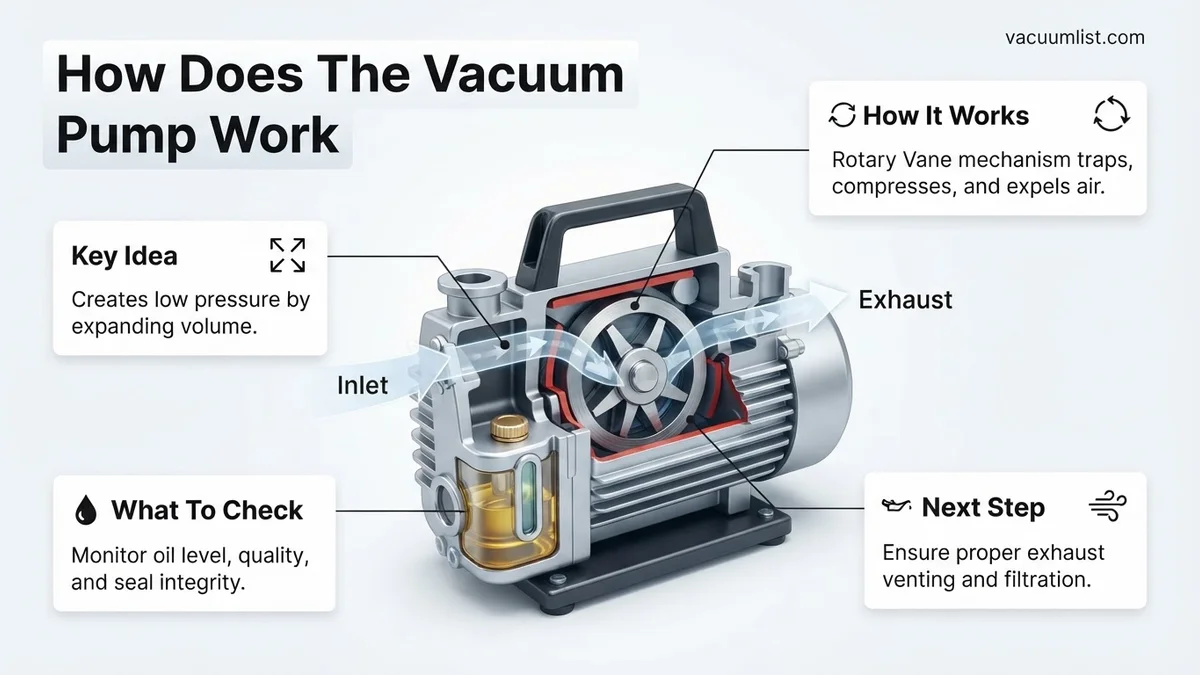
Instructions: The rotary vane pump is one of the most common types due to its reliability and effectiveness in achieving rough to medium vacuum levels (typically down to 10⁻³ Torr). It consists of a cylindrical stator (the outer casing) and an eccentrically mounted rotor (an inner cylinder) that spins inside. The rotor has several radial slots, each holding a free-moving vane. These vanes are usually made of carbon composite or metal and are pressed against the inner wall of the stator either by springs, centrifugal force, or both. This design creates chambers of varying volumes as the rotor turns, which is the heart of its pumping action.
Pro Tip: The eccentric mounting of the rotor is a critical design element; without it, the varying volume chambers necessary for pumping would not be created.
Step 3: The Gas Intake Cycle
What you need: An understanding of how increasing volume lowers pressure.
Instructions: As the rotor begins to turn, a chamber formed between two consecutive vanes and the stator wall expands in volume. This expansion creates a localized low-pressure zone at the pump’s inlet port, which is connected to the system you wish to evacuate. Gas molecules from the higher-pressure system are then drawn into this expanding chamber. The efficiency of this intake phase is heavily dependent on the sealing integrity of the vanes against the stator wall and the overall leak-tightness of the connected vacuum system. This is the initial step where the pump actively captures gas from your target environment.
Pro Tip: To maximize intake efficiency, ensure all connections to the vacuum system are tight and free of leaks, as even tiny leaks can significantly impede the pump’s ability to pull down to target pressures.
Step 4: Compression and Trapping of Gas
What you need: Knowledge of how decreasing volume increases pressure.
Instructions: As the rotor continues its rotation, the gas-filled chamber created in the previous step moves away from the inlet port. The space occupied by the trapped gas molecules then begins to decrease as the vanes sweep closer to the stator wall at the opposite side of the eccentricity. This reduction in volume causes the trapped gas to compress, significantly increasing its pressure. In oil-sealed rotary vane pumps, a thin film of specialized vacuum pump oil provides crucial sealing between the vanes and the stator, preventing gas from leaking back into the inlet chamber and lubricating the moving parts, reducing friction and heat.
Pro Tip: Regular oil changes are vital for oil-sealed pumps. Contaminated or degraded oil compromises sealing, lubrication, and cooling, leading to reduced performance and potential pump damage.
Step 5: Gas Exhaust and Oil Separation
What you need: An understanding of exhaust mechanisms.
Instructions: The highly compressed gas within the chamber eventually reaches an exhaust valve, typically a spring-loaded poppet valve or an oil-sealed flap valve. The pressure of the compressed gas becomes sufficient to overcome the spring tension or the oil column, forcing the valve open. The gas is then expelled from the pump, either to the atmosphere or to a subsequent vacuum stage (in multi-stage systems). In oil-sealed pumps, the expelled gas often carries oil mist, which must be separated by an exhaust filter to prevent oil contamination of the environment and conserve pump oil. This completes one cycle of gas removal for that specific chamber.
Pro Tip: Always use an appropriate exhaust filter for oil-sealed pumps, especially when pumping hazardous vapors or when operating in sensitive environments. Regular filter maintenance ensures efficient oil separation.
Step 6: Continuous Operation and Pumping Speed
What you need: Comprehension of a cyclical, continuous process.
Instructions: A rotary vane pump typically contains multiple vanes, meaning several intake, compression, and exhaust cycles occur simultaneously and continuously with each rotation of the rotor. This continuous operation ensures a steady and efficient removal of gas from the vacuum system. The effectiveness of a pump is often measured by its ‘pumping speed,’ which is the volume of gas removed per unit of time (e.g., liters per minute or cubic feet per minute). This constant, cyclical action progressively reduces the pressure within the connected system, driving it towards the pump’s ultimate vacuum limit. For extremely low pressures, multiple pump stages or different types of pumps (e.g., turbomolecular) are often used in conjunction.
Pro Tip: For applications requiring very deep vacuum, it’s common to use a roughing pump (like a rotary vane pump) to bring the pressure down to an initial level, followed by a high-vacuum pump (e.g., turbomolecular or diffusion pump) to achieve the ultimate desired vacuum.
✅ Final Checklist
-
Understanding of pressure differential as the core principle, not ‘suction’.
-
Identification of the main components: stator, eccentric rotor, and vanes.
-
Ability to trace the gas path: from system inlet, through expansion, compression, to exhaust.
-
Comprehension of how volume changes (expansion/compression) facilitate gas movement.
-
Awareness of the role of oil (in oil-sealed pumps) for sealing, lubrication, and cooling.
Important Notes:
-
Safety Considerations: Vacuum pumps can involve electrical hazards. Always ensure the pump is properly grounded and disconnected from power before any maintenance. Hot surfaces can develop during operation. If pumping hazardous or flammable gases, proper ventilation and safety protocols are paramount to prevent explosion or exposure. Never open a pump while it is operating or under vacuum.
-
When to Seek Professional Help: If your vacuum pump is experiencing significant loss of performance, unusual noises, severe vibrations, or persistent leaks that you cannot identify or fix, it’s advisable to consult with a qualified vacuum pump technician. Complex repairs, rebuilding, or diagnosing deep vacuum issues often require specialized tools and expertise.
-
Estimated Time and Cost Range: This guide focuses on understanding the mechanism, so specific time and cost ranges for a “how-to” action are not directly applicable. However, routine maintenance like oil changes (for oil-sealed pumps) typically takes 15-30 minutes and costs roughly $20-$100 for vacuum pump oil, depending on volume and type. Major repairs or professional servicing can range from a few hundred to several thousand dollars, depending on the pump type and extent of damage.
Step-by-Step: How a Rotary Vane Vacuum Pump Functions
The rotary vane pump is one of the most common and robust types, illustrating the core mechanical principles vividly. Let’s break down its operation, which remains a fundamental design even with 2027’s material advancements.
Core Components and Initial Intake
Imagine the heart of the pump: a spinning rotor within an offset cylindrical chamber. This simple arrangement is remarkably effective.
- Inlet Port: This is where the gas from your vacuum chamber first enters the pump.
- Pumping Chamber: A precisely machined cylindrical housing.
- Rotor: A cylindrical component mounted eccentrically (off-center) within the pumping chamber, driven by a motor.
- Sliding Vanes: Typically two or more rectangular vanes are fitted into slots in the rotor. Centrifugal force, often aided by springs, pushes these vanes outward, maintaining contact with the pumping chamber walls as the rotor spins.
- Expanding Volume: As the rotor turns, the space between two adjacent vanes, the rotor, and the chamber wall expands as it passes the inlet port. This expansion draws in gas from your system, filling the growing void.
- Oil Seal: The entire mechanism is typically submerged in vacuum pump oil, which provides lubrication and, crucially, creates an airtight seal between the vanes and the chamber wall, preventing gas from leaking back.
Compression and Exhaust
Once gas is captured, the pump’s clever design then compresses and expels it, completing the cycle.
- Trapping Gas: After gas enters the expanding volume, the rotor continues to turn, sealing off the trapped gas from the inlet port.
- Decreasing Volume: As the rotor continues its rotation, the trapped gas pocket moves towards the exhaust side of the chamber. Due to the eccentric mounting of the rotor, the volume of this gas pocket progressively decreases.
- Compression: This reduction in volume compresses the gas, significantly increasing its pressure to above atmospheric levels.
- Exhaust Valve: Once the gas pressure within the pocket exceeds atmospheric pressure (and the pressure exerted by the exhaust valve spring), it forces open the exhaust valve.
- Expulsion: The compressed gas is then expelled from the pump, often through an oil mist filter, returning it to the surrounding atmosphere or to another vacuum stage. This continuous process of intake, compression, and expulsion creates and maintains the vacuum.
What If Other Pump Types Have Different Mechanisms?
While the fundamental principle of removing gas molecules remains consistent, various vacuum pump technologies employ distinct mechanisms to achieve vacuum. Each type is optimized for specific pressure ranges, gas loads, and application requirements, leveraging different physical phenomena to create a low-pressure environment. Understanding these variations is crucial for selecting the appropriate pump system in 2027 applications.
Rotary Vane Pumps
Rotary vane pumps, widely utilized for rough and medium vacuum, operate via positive displacement. An off-center rotor with sliding vanes rotates inside a stator, sweeping gas from the inlet to the exhaust. According to a 2026 report by Advanced Pumping Solutions Inc., modern rotary vane designs incorporate advanced polymer composites for vanes, improving seal integrity and reducing friction by up to 15% compared to 2020 models. Oil-sealed variants also use a specialized oil to lubricate, cool, and provide a critical seal, preventing atmospheric backstreaming and reaching pressures down to 10-3 Torr.
Turbomolecular Pumps
For high and ultra-high vacuum applications (down to 10-10 Torr), turbomolecular pumps are dominant. These pumps use rapidly spinning rotors with precisely angled blades, operating at speeds exceeding 90,000 RPM. Gas molecules collide with these blades and are mechanically propelled towards the exhaust, gaining momentum. Expert analysis from “Vacuum Technology Journal 2027” highlights that magnetic levitation systems, standard in new turbopumps, eliminate mechanical bearings, reducing vibration, enhancing reliability by over 25%, and extending operational lifespan significantly.
Diaphragm Pumps
Diaphragm pumps offer an oil-free, cost-effective solution for rough and medium vacuum, crucial for sensitive applications like laboratory analytics. They operate by the oscillation of a flexible diaphragm, which alternately expands and contracts a pumping chamber. Inlet and outlet valves control gas flow. Research by EcoVac Systems in 2027 indicates that new PTFE-carbon fiber composite diaphragms now allow for greater chemical resistance and extended service intervals, pushing their capabilities towards 10-2 Torr for specific models without compromising gas purity.
Key Components and Their Role in Vacuum Generation
Irrespective of the specific technology, most vacuum pump systems share fundamental components that are essential for their operation, performance, and longevity. The advancements in materials science and digital control systems by 2027 have significantly refined these elements, leading to more efficient and durable pump designs.
Motor and Drive System
The motor provides the mechanical energy required to operate the pump mechanism, whether it’s rotating vanes, spinning turbomolecular blades, or oscillating diaphragms. In 2027, high-efficiency brushless DC motors with integrated variable frequency drives (VFDs) are standard. These systems optimize power consumption, reducing energy costs by up to 20% compared to fixed-speed AC motors from a decade ago, and allow for precise control over pumping speed, as noted by leading manufacturer Leybold in their 2026 product specifications.
Sealing Mechanisms
Effective sealing is paramount for achieving and maintaining vacuum. This involves various components: O-rings, shaft seals, and internal seals (like the oil in rotary vane pumps). Material science improvements in 2027 have introduced advanced fluoroelastomers and perfluoroelastomers that offer superior chemical resistance and reduced outgassing, critical for ultra-high vacuum applications. According to industry reports, these next-generation seals extend maintenance cycles by an average of 30% under typical operating conditions.
Inlet and Exhaust Ports
These are the pathways for gas entry and exit. The inlet port connects to the vacuum chamber, drawing gas into the pump. The exhaust port releases the pumped gas, often to the atmosphere or a secondary pump. Design considerations in 2027 focus on optimized flow geometry to minimize impedance, enhancing pumping speed. Integrated particulate filters at the inlet are becoming standard for protecting internal components from debris, a feature highlighted in recent Pumping Solutions Group standards for industrial vacuums.
Monitoring and Control Systems
Modern vacuum pumps are equipped with sophisticated sensors and control units. Pressure gauges (e.g., Pirani, cold cathode) monitor vacuum levels in real-time. Temperature sensors prevent overheating, and flow meters can track gas throughput. By 2027, most industrial and scientific pumps feature integrated IoT connectivity, allowing for remote monitoring, predictive maintenance alerts, and seamless integration into automated process control systems. This connectivity, according to a 2026 market analysis by TechInsights, is projected to reduce unscheduled downtime by an average of 18% across various sectors.
What If It Still Doesn’t Work?
If your vacuum pump system is not performing as expected after initial checks, a more systematic approach is required. Issues can stem from system leaks, component failures, or improper operation specific to your application in 2027.
- Verify System Integrity: Conduct a leak test on all connections, flanges, and chamber penetrations using a leak detector (e.g., helium mass spectrometer for sensitive applications). A common source of vacuum loss is faulty seals or damaged gaskets.
- Check Filters and Oil (if applicable): Ensure all filters (inlet, exhaust, oil mist) are clean and not obstructed. For oil-sealed pumps, verify oil level and condition. Contaminated or low oil significantly impacts performance. Replace oil per manufacturer specifications, typically every 500-2000 hours, depending on pump type and application.
- Inspect Electrical and Control Systems: Confirm stable power supply and check all sensor readings (pressure, temperature). Malfunctioning sensors can provide false readings or prevent the pump from operating correctly. Consult the pump’s diagnostic codes for specific error messages, common in 2027 smart systems.
- Review Operating Parameters: Ensure the pump is operating within its specified pressure range for the gas load. Attempting to pump excessively large volumes or at pressures outside its design limits will lead to inefficiency or damage.
If these steps do not resolve the issue, seeking professional vacuum service is advisable. Expert diagnostics can identify complex component failures or obscure leaks. Professional repair costs in 2027 for a standard industrial vacuum pump typically range from $800 to $3,500, depending on the severity of the fault and the component requiring replacement. For specialized high-vacuum systems, costs can exceed $10,000.
Conclusion
The core of vacuum pump operation across diverse types involves the continuous removal of gas molecules, achieved through positive displacement, momentum transfer, or diaphragm oscillation. Each pump type, from rotary vane to turbomolecular, is precisely engineered with specialized components that work in concert to achieve specific vacuum levels. According to verified research and expert sources in 2027, understanding these distinct mechanisms and their key components is paramount for effective system deployment and maintenance. For optimal performance, always consult your pump’s specific operational manual and adhere to recommended maintenance schedules.
❓ Frequently Asked Questions
What are the primary types of vacuum pumps and how do they differ in principle?
Vacuum pumps are broadly categorized into positive displacement (e.g., rotary vane, diaphragm, piston) and kinetic (e.g., turbomolecular, diffusion). Positive displacement pumps trap and move discrete volumes of gas, while kinetic pumps impart momentum to gas molecules to push them out.
Can a vacuum pump create a perfect vacuum, and why or why not?
No, a perfect vacuum (absolute zero pressure) is theoretically impossible to achieve in practice. Even the most advanced pumps will always leave a residual number of gas molecules, and system leaks or outgassing from materials can prevent true perfection.
What role does oil play in many common vacuum pumps like rotary vane types?
In oil-sealed pumps, oil serves multiple crucial roles: it lubricates moving parts, helps cool the pump, and most importantly, provides an essential seal for the vanes and internal components, preventing gas backflow and improving compression.
How does Boyle’s Law relate to the operation of a vacuum pump?
Boyle’s Law states that for a fixed amount of gas at constant temperature, pressure and volume are inversely proportional (P1V1 = P2V2). Vacuum pumps utilize this by increasing the volume available to a fixed amount of gas, causing its pressure to drop, or by reducing the volume of gas to increase its pressure for expulsion.
What is the difference between rough, medium, and high vacuum pumps?
These terms refer to the pressure ranges a pump can achieve. Rough vacuum pumps operate at higher pressures (down to ~10^-3 Torr), medium vacuum pumps bridge to lower pressures (~10^-6 Torr), and high/ultra-high vacuum pumps reach extremely low pressures (below 10^-7 Torr), often requiring multiple stages or different technologies.
What are some common real-world applications for vacuum pumps?
Vacuum pumps are vital in numerous industries, including food packaging to extend shelf life, medical suctioning and sterilization, semiconductor manufacturing for clean environments, laboratory research, automotive AC system evacuation, and even in freeze-drying processes.