
Can Electricity Arc in a Vacuum 2026 Real Expert Guide
Yes, electricity can arc in a complete vacuum, but the mechanism is fundamentally different from traditional air arcs. Instead of ionizing ambient gas, a vacuum arc relies on the field emission of electrons and the vaporization of electrode material to sustain the electrical bridge.
Yes, electricity can definitely arc in a complete vacuum. However, the physical mechanism behind a vacuum arc is entirely different from how a spark travels through standard air. In a normal atmosphere, electrical breakdown relies on ionizing surrounding gas molecules to create a conductive plasma pathway. When you remove the gas and create a true vacuum, those ambient molecules simply are not there to ionize.
Instead, a vacuum arc relies entirely on the electrode material itself. This phenomenon is critical to understand if you are designing high-voltage spacecraft, particle accelerators, or modern vacuum interrupters in 2026 electrical grids. Without air to bridge the gap, the electrical stress shifts straight to solid matter, turning microscopic points of metal into explosive plasma.
Key Takeaways
- Vacuum arcs require extreme electric fields to pull electrons directly from metal surfaces.
- Microscopic surface imperfections on electrodes act as primary sites for initial electron emission.
- The arc is sustained by metal vapor boiled off the cathode, not ionized air.
- Paschen’s law does not apply in high vacuums where the mean free path is extremely long.
- Engineers utilize vacuum arcs intentionally in high-voltage vacuum circuit breakers and interrupters.
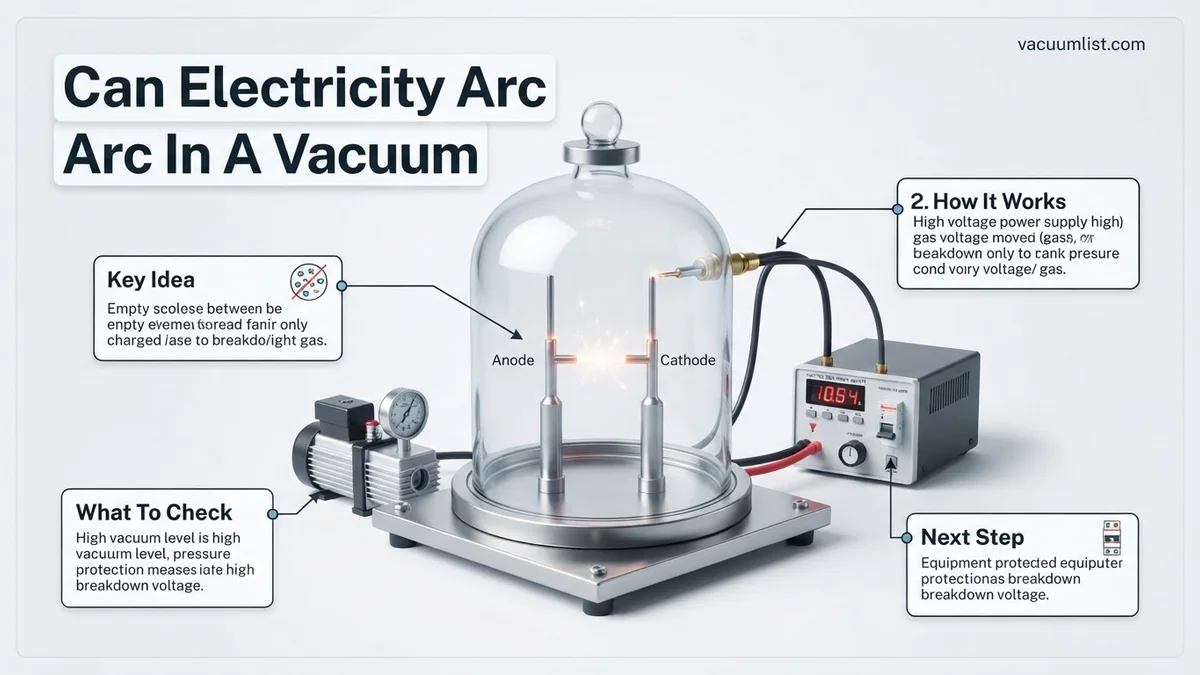
What Causes Electrical Arcing in a Vacuum
Field Emission and Microscopic Surface Defects
Even the smoothest metal surface looks like a jagged mountain range under a microscope. When you apply high voltage across a vacuum gap, extreme electric field gradients concentrate heavily on these microscopic tips or whiskers. This triggers electron field emission, where electrons are literally ripped right out of the cold metal lattice. As these intense electron beams bombard the anode, they dump massive amounts of localized thermal energy into the target surface.
Cathode Spots and Electrode Vaporization
As the electrical stress continues, microscopic defects on the cathode experience runaway heating and explode into plasma. This creates what engineers call a cathode spot. The core mechanism of a vacuum arc involves the intense vaporization of the electrode material itself, rather than the ionization of ambient gas. Metal vapor and ejected droplets quickly fill the vacuum gap, forming a conductive metallic plasma bridge that easily sustains massive electrical current.
- Extreme local electric fields yank electrons straight out of cold cathode tips.
- Bombarding electrons rapidly melt and vaporize micro-protrusions on the anode.
- Metallic vapor bridges the gap, replacing air as the current-carrying medium.
How to Prevent and Control Vacuum Arcs Step-by-Step
Surface Conditioning and Material Selection
Preventing unwanted vacuum arcs starts long before you power up your system. You must carefully select electrode materials with extremely high melting points and high thermal conductivity, such as oxygen-free copper, tungsten, or chromium-copper alloys. Furthermore, rigorous surface conditioning techniques like mechanical polishing, electropolishing, and high-temperature vacuum baking are essential to eliminate microscopic surface defects and trapped gases.
Optimizing Geometry and Gap Distance
Managing high voltage in a vacuum requires precise control over electric field distribution. You must avoid sharp edges, corners, and tight radii on all high-voltage components. By utilizing Rogowski profile electrodes, you distribute the electric field evenly across the entire surface rather than allowing it to concentrate at specific points.
- Polish electrodes to a mirror finish to eliminate microscopic field emitters.
- Bake components under ultra-high vacuum to degas internal metallic pores.
- Design smooth, rounded contours to prevent high-stress electric field concentrations.
Maintaining an optimal gap distance is equally critical. In 2026 aerospace and power systems engineering, designers rely on advanced electrostatic simulation software to map equipotential lines before manufacturing physical hardware.
Best Practices for High-Voltage Vacuum Insulation Design
Preventing electrical breakdown in a vacuum requires meticulous engineering and adherence to rigorous manufacturing standards. According to IEEE insulation research, optimizing geometry and material selection remains critical for maintaining dielectric strength in 2026 industrial systems.
Electrode Conditioning and Polishing
Surface roughness significantly lowers the threshold for field emission. Engineers must achieve mirror finishes on all high-voltage conductors.
- Machine electrodes using oxygen-free high-thermal-conductivity (OFHC) copper or stainless steel to minimize microscopic imperfections.
- Apply mechanical and electrochemical polishing techniques to reduce surface roughness below 0.05 micrometers.
- Perform high-voltage conditioning in a controlled chamber by slowly ramping voltage until minor micro-discharges smooth remaining asperities.
Material Selection and Outgassing Control
Solid insulators placed inside a vacuum chamber often serve as the weakest link for surface flashover. Manufacturers must select materials that resist outgassing and charge accumulation.
- Utilize high-purity alumina ceramics or specialized machinable glass-ceramics instead of standard plastics.
- Bake out all internal components at temperatures exceeding 250 degrees Celsius for a minimum of 24 hours prior to system activation.
- Implement triple-junction shielding where the metal, ceramic, and vacuum meet to mitigate high localized electric field concentrations.
What If Vacuum Arcing Still Compromises Your System
Even with optimal design and rigorous conditioning, unexpected arcing can still occur due to particulate contamination or localized heating. When standard preventative measures fail to stop persistent vacuum breakdowns, systematic troubleshooting is required.
- Perform a helium leak test to verify that microscopic atmospheric leaks are not introducing ionizable gas molecules back into the vacuum chamber.
- Inspect internal components for field emission damage, metal vapor deposition, or pinhole punctures on solid dielectric surfaces using magnification tools.
- Upgrade your vacuum pumping stack to achieve a deeper base pressure, moving from rough vacuum into high vacuum ranges below 10 to the minus 6 Torr.
- Consult a specialized high-voltage vacuum engineering firm if persistent structural flashover damages core components. Professional diagnostic assessments and custom redesign services typically range from $3,500 to $12,000 depending on system complexity.
Conclusion
While a perfect vacuum suppresses traditional gas-phase arcing, intense electric fields can still trigger destructive vacuum breakdowns via field emission, surface flashover, and metal vaporization. Maintaining strict surface purity, optimal gap spacing, and ultra-high vacuum levels prevents catastrophic equipment failure. According to verified research and expert sources in high-voltage engineering, proactive electrode conditioning and rigorous outgassing protocols remain the gold standard for reliable system operation in 2026. Review your current equipment specifications today to ensure your high-voltage vacuum architecture meets modern safety thresholds.
❓ Frequently Asked Questions
How does electrical breakdown in a vacuum differ from atmospheric breakdown?
Atmospheric breakdown relies on ionizing gas molecules between electrodes, as described by Paschen’s law. In contrast, vacuum breakdown depends entirely on phenomena occurring at the solid electrode surfaces, such as field emission, microscopic melting, and metal vapor creation.
What role do microscopic surface defects play in vacuum arcing?
Microscopic burrs, dust particles, or surface imperfections on the cathode create localized enhancements of the electric field. These high-stress points facilitate runaway field emission, leading to thermal runaway and explosive metal vaporization.
Can high voltage alone cause a vacuum to conduct electricity?
Yes, if the voltage gradient between two conductors in a vacuum exceeds the dielectric strength threshold of the electrode gap, vacuum breakdown will occur, transforming the gap into a conductive plasma channel of metal ions.
How are vacuum arcs used practically in engineering?
Engineers intentionally utilize vacuum arcs in vacuum circuit breakers and heavy-duty switchgear. Because a vacuum has no ambient gas to maintain combustion or long-lasting plasma, arcs extinguish extremely fast when current crosses zero.
What is cathode spot formation in a vacuum arc?
A cathode spot is an extremely dense, microscopic region on the negative electrode where electrons are massively emitted. This spot rapidly moves across the surface, providing the metal vapor needed to sustain the vacuum arc.
How do spacecraft engineers prevent accidental vacuum arcing?
Engineers prevent spacecraft arcing by avoiding sharp edges on exposed high-voltage components, using specialized coatings, managing plasma interactions, and ensuring proper outgassing of materials before launch.