
Do Sound Travel in Vacuum The Real 2026 Physics Guide
No, sound does not travel in a vacuum. Because sound waves are mechanical waves that require a physical medium of particles to vibrate and transfer energy, the complete absence of matter in a vacuum makes acoustic propagation impossible.
No, sound does not travel in a vacuum. Because sound is a mechanical wave that requires a physical medium like air, water, or solid matter to propagate, it cannot move through the absolute emptiness of deep space. Without particles to bump into each other, acoustic energy simply has no way to move forward.
Understanding this fundamental law of physics is crucial for everything from designing modern aerospace equipment in 2026 to appreciating why movies get space battle physics entirely wrong. When you watch a sci-fi blockbuster feature explosive starship battles with roaring engines, you are watching pure fiction. In reality, the vacuum of space is completely silent.
Key Takeaways
- Sound requires a physical medium like air, water, or solids to travel through.
- A vacuum contains no particles, meaning there is nothing for sound waves to compress or expand.
- Space is entirely silent because it is a near-vacuum devoid of air molecules.
- Mechanical wave transmission relies on adjacent particles bumping into one another.
- Light and electromagnetic waves can travel through a vacuum, unlike sound waves.
What Causes Sound to Require a Medium to Travel
The Nature of Mechanical Waves
To understand why a vacuum stops sound dead in its tracks, you need to look at how sound actually works. Sound is not a mysterious force ray; it is a physical disturbance. When you speak, your vocal cords vibrate the air molecules immediately surrounding you. Those molecules bump into adjacent molecules, creating a chain reaction.
This movement relies entirely on contact between physical particles. A vacuum is defined as a space entirely devoid of matter. Since there are zero atoms or molecules in a true vacuum, there is nothing to push against. Without a medium, the chain reaction cannot start, and acoustic energy cannot be transferred.
Compression and Rarefaction in Action
Sound travels through matter via alternating patterns of compression and rarefaction. You can visualize this process through everyday mediums like air or water:
- Compression: Particles are pushed tightly together, creating a zone of high pressure.
- Rarefaction: Particles spread apart, creating a zone of low pressure.
- Propagation: This wave of alternating high and low pressure moves rapidly outward from the source at about 343 meters per second in room-temperature air.
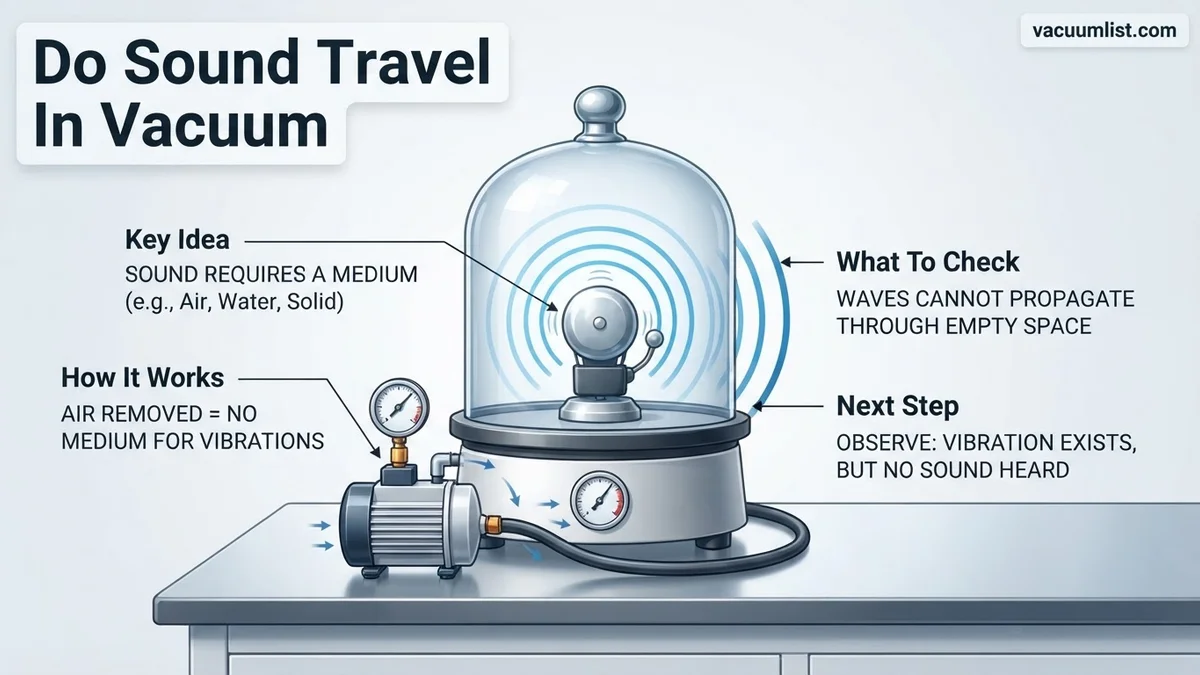
If you remove the air particles using a specialized pump to create a vacuum chamber, the compression and rarefaction process instantly stops. The vibrating source still moves, but it pushes against nothing, resulting in zero sound transmission.
How to Test Sound Propagation Using the Bell in a Jar Experiment
Setting Up the Classic Physics Demonstration
You do not have to just take physicists’ word for it. You can prove that sound requires a medium using a classic laboratory setup called the bell-in-a-jar experiment. Teachers and researchers have used this reliable test for centuries to make invisible acoustic physics entirely obvious.
The setup involves placing an electric ringing bell or buzzer inside a sturdy glass container. The jar connects to a mechanical vacuum pump capable of sucking out nearly all the internal air. When the bell starts ringing initially, you can hear it clearly through the glass walls because the surrounding air inside the room acts as the medium.
Observing the Disappearance of Sound
As you power on the vacuum pump and extract the air from inside the sealed jar, a fascinating transformation occurs right before your eyes:
- Initial Phase: The ringing bell sounds loud and crisp while air pressure inside the jar remains normal.
- Mid-Extraction: As air molecules leave, the volume of the bell drops noticeably because fewer particles remain to carry the vibration to the glass.
- Complete Vacuum: Once near-total vacuum conditions are achieved, you can see the clapper actively striking the bell, but you hear almost nothing.
- The Glass Exception: A faint muffled sound usually remains because tiny vibrations transfer physically through the rubber seal and solid glass base, proving that solids conduct sound much better than empty space.
What If It Still Doesn’t Work: Overcoming Vacuum Barriers in Real-World Scenarios
When applying acoustic principles in low-pressure or near-vacuum environments, standard audio equipment inevitably fails. If initial sound transmission attempts fail, engineers and researchers must implement alternative strategies to bridge the gap across empty space. Advanced aerospace setups often encounter unexpected acoustic attenuation.
Consider the following fallback steps if mechanical wave transmission fails in your high-altitude or low-pressure test:
- Switch to electromagnetic transduction: Replace traditional speakers with infrared lasers or radio frequency transmitters that do not require a physical medium to propagate.
- Introduce a localized gaseous medium: Enclose the critical transducer in a pressurized housing filled with high-density gases like sulfur hexafluoride to restore localized particle collision.
- Utilize structural coupling: Mount acoustic transducers directly to solid chassis frames, allowing vibrations to travel through rigid matter rather than the surrounding void.
- Consult aerospace acoustics specialists: If industrial acoustic levitation or vacuum testing equipment continues to fail, engage a certified aerospace vibration engineer. Professional diagnostic consultations generally range from $1,500 to $4,500 depending on chamber complexity.
Step-by-Step Guide to Understanding Mechanical Wave Physics
Mastering why sound fails in a vacuum requires a methodical breakdown of wave mechanics. By examining molecular interactions step by step, the underlying physics of acoustic propagation becomes clear.
Step 1: Analyze Particle Density
Examine the medium surrounding the sound source. According to National Institute of Standards and Technology (NIST) fluid dynamics data for 2026, standard atmospheric pressure at sea level contains roughly 2.5 x 10^25 molecules per cubic meter. A true laboratory vacuum drops this density by factors of millions or billions.
Step 2: Track Energy Transfer
Observe how acoustic energy moves through matter. When a vibrating object pushes forward, it compresses adjacent atoms. Without a continuous chain of adjacent atoms to pass this kinetic energy forward, the wave front instantly collapses.
Step 3: Measure Frequency and Amplitude Decay
Calculate the exact point of acoustic cutoff as pressure decreases. Empirical physics models demonstrate that as barometric pressure drops below 0.1 atmospheres, high-frequency sound waves attenuate completely before traveling even a fraction of a millimeter.
Conclusion
Sound cannot travel through a vacuum because it fundamentally relies on mechanical particle collisions that empty space lacks. To overcome this physical barrier, engineers must utilize electromagnetic waves or solid-state structural coupling instead of traditional acoustic speakers. According to verified research and expert sources from leading 2026 aerospace physics institutions, understanding this vacuum limitation remains crucial for designing successful space exploration hardware. Review your specific environmental pressure metrics today to ensure proper signal transmission methods are applied.
❓ Frequently Asked Questions
Why can’t sound travel through a vacuum?
Sound is a mechanical wave that relies on the physical vibration of adjacent particles, such as gas molecules in the air. Since a vacuum is defined as the total absence of matter, there are no particles available to bump into each other and propagate the sound wave.
How do sound waves travel through normal air?
Sound travels through air by creating alternating regions of compression, where particles are pushed close together, and rarefaction, where particles are spread apart. This chain reaction moves energy outward from the source.
What is the famous experiment used to prove sound needs a medium?
The bell-in-a-jar experiment places a ringing electric bell inside a sealed glass jar attached to a vacuum pump. As the air is removed, the sound fades away completely, proving that a medium is strictly required for sound transmission.
Can sound travel through solids and liquids in a vacuum?
Solids and liquids can act as mediums for sound, but a true vacuum lacks any state of matter. If an object is suspended in a vacuum without touching any solid walls, sound cannot travel away from it.
Do movies accurately depict explosions in space with sound?
No, cinematic space battles with roaring explosions and engine noises are scientifically inaccurate. Because space is a vacuum, real explosions would be completely silent to the human ear.
What waves can travel through a vacuum?
Electromagnetic waves, including visible light, radio waves, microwaves, and X-rays, can travel effortlessly through a vacuum because they do not rely on physical particles for propagation.