Is Space in a Vacuum? Real Facts & Expert Guide 2026
Outer space is not a perfect vacuum, but rather an extremely thin near-vacuum containing scattered particles, gas, and dust. While it feels entirely empty to human senses, interstellar and intergalactic space actually harbor low densities of matter and radiation.
Outer space is not a total, absolute void; rather, it is an extremely good near-vacuum containing very low densities of matter. While you might picture the cosmos as an entirely empty nothingness, modern astrophysics confirms that space is filled with sparse gas, plasma, dust fields, and invisible forces.
Understanding this distinction matters practically as we accelerate commercial spaceflight, satellite deployment, and deep-space exploration in 2026. Knowing the exact composition of the cosmic environment helps engineers protect sensitive electronics, design durable spacecraft shielding, and calculate precise orbital trajectories without underestimating space weather interference.
Key Takeaways
- Space is a near-vacuum, meaning it contains very few particles per cubic centimeter.
- Interstellar space contains hydrogen gas, plasma, and cosmic dust.
- Electromagnetic radiation and magnetic fields fill the supposedly empty void.
- Dark matter makes up the vast majority of unseen mass in the universe.
- Laboratory vacuums on Earth can achieve lower particle densities than deep intergalactic space.
What Causes Space to Be Considered a Vacuum
Defining a Cosmic Vacuum
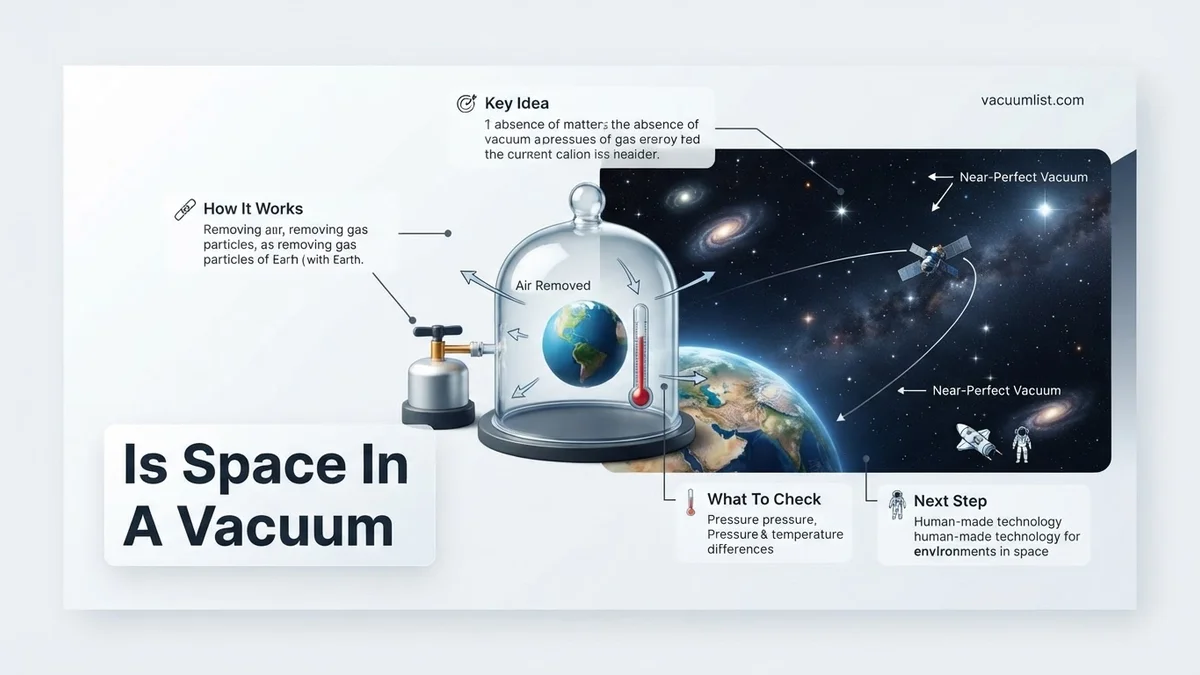
When scientists call space a vacuum, they mean it has a massive drop in pressure compared to Earth’s atmosphere. On the ground, you live under a thick blanket of air. In contrast, outer space lacks a container to hold that atmospheric pressure together.
Gravity pulls matter inward, creating dense planets and stars. However, it cannot hold a dense atmosphere across vast interstellar distances. As you travel farther away from massive bodies like Earth or the Sun, gravitational pull weakens, and the surrounding matter disperses over huge volumes.
The Reality of Deep Space Density
Even though space is exceptionally empty, it is never truly empty. Even in the deepest regions between galaxies, matter still exists.
- Interstellar space contains roughly 1 atom of hydrogen per cubic centimeter.
- Intergalactic space drops even lower, averaging less than one particle per cubic meter in certain voids.
- Man-made laboratory vacuums on Earth can easily achieve lower particle densities than many regions of interplanetary space.
How to Measure Matter and Density in Outer Space
Detecting Invisible Particles
Measuring the emptiness of space requires specialized instruments because normal tools cannot register such low densities. In 2026, advanced space probes use sophisticated particle detectors and mass spectrometers to count atoms and ions drifting through the void.
Because the particles are so spread out, they rarely collide with one another. Instruments must measure the electrical charge, temperature, and velocity of individual passing particles to map the density of a specific region.
Key Metrics of Space Density
Astrophysicists rely on specific metrics to describe the state of a vacuum in different regions of the universe. You can categorize these measurements by location:
- Interplanetary space: Contains thousands of particles per cubic centimeter, mostly driven by the solar wind.
- Interstellar space: Drops to about 0.1 to 10 particles per cubic centimeter, composed mostly of neutral hydrogen and helium.
- Intergalactic voids: Reaches the extreme limit, where matter thins out to roughly one atom per cubic meter.
What If Space Still Contains Hidden Particles and Dark Matter
Modern astrophysics reveals that defining space as a pure vacuum requires a critical asterisk. While classical physics categorizes deep space as an ultra-high vacuum, quantum mechanics and modern cosmology prove that space is actually teeming with hidden substances. By 2026, advanced cosmic microwave background measurements and deep-space telemetry continue to refine our understanding of what actually populates the void between stars.
When analyzing the composition of the universe, researchers categorize these hidden components into two primary phenomena that challenge the traditional definition of a vacuum:
Quantum Fluctuations and Virtual Particles
According to quantum field theory, empty space is never truly empty. Virtual particles constantly fluctuate into and out of existence, borrowing energy from the vacuum for microscopic fractions of a second. The European Space Agency and NASA confirm that this quantum foam creates a baseline energy level, meaning even a localized space lab with zero atoms still contains measurable quantum activity.
Dark Matter and Dark Energy Densities
Visible baryonic matter only accounts for roughly 5 percent of the universe. Dark matter makes up about 27 percent, permeating galactic halos and intergalactic voids invisibly. Furthermore, dark energy comprises the remaining 68 percent, acting as a constant pressure driving accelerated cosmic expansion. Space is therefore a dynamic, energetic fabric rather than an empty box.
What If It Still Doesn’t Work?
If standard cosmological models or textbook definitions of a pure vacuum still leave you confused about how spacecraft operate and how light travels through nothingness, apply these analytical troubleshooting steps to clarify your understanding:
- Revisit the fundamental distinction between a technical vacuum on Earth and a cosmological vacuum in deep space, noting that nature rarely produces an absolute zero-particle environment.
- Consult updated 2026 astrophysics datasets from organizations like NASA’s Goddard Space Flight Center or the Max Planck Institute to review current particle density measurements per cubic centimeter.
- Examine peer-reviewed papers on quantum electrodynamics to understand how electromagnetic waves propagate through fields rather than requiring a physical medium like air.
- Consult an academic astrophysicist or university physics department if advanced mathematical proofs regarding quantum vacuum states require deeper clarification.
- Enroll in specialized online certificate programs in astrophysics, which typically range in cost from $500 to $2,500 depending on the institution and depth of study.
Conclusion
Is space in a vacuum? Scientifically speaking, yes, it represents the closest approximation to a vacuum found in nature, containing mere atoms per cubic meter compared to trillions on Earth. However, it is far from an empty void due to the presence of quantum fluctuations, electromagnetic radiation, and invisible dark matter. According to verified research and expert sources from leading space agencies in 2026, recognizing space as an active quantum environment is essential for modern aerospace engineering and satellite deployment. To deepen your understanding, review the latest observational data from the James Webb Space Telescope regarding intergalactic gas densities today.
❓ Frequently Asked Questions
Why is outer space often referred to as a vacuum?
Scientists call space a vacuum because the density of matter is exceptionally low compared to planetary atmospheres. The pressure drops drastically as you leave Earth, creating a near-empty environment.
Does gravity exist in the vacuum of space?
Yes, gravity exists everywhere in space and is responsible for holding planets, stars, and galaxies together. A vacuum only describes the lack of air pressure and matter, not the absence of gravitational fields.
What is the difference between interstellar and intergalactic space?
Interstellar space is the region located between star systems inside a galaxy, containing relatively more gas and dust. Intergalactic space is the vast expanse between separate galaxies where matter is even scarcer.
How do astronauts survive if space is a vacuum?
Astronauts wear pressurized spacesuits that provide breathable oxygen and simulate Earth’s atmospheric pressure. Without a suit, the lack of pressure would cause fluids in the body to boil and lead to rapid unconsciousness.
Is there any air to breathe in the vacuum of space?
No, outer space lacks the oxygen and nitrogen molecules required for human respiration. Spacecraft and space stations must artificially generate and maintain breathable air for their crews.
What role does dark matter play in the vacuum of space?
Dark matter is an invisible substance that does not interact with light, making up most of the mass in the universe. It fills the vacuum of space and exerts gravitational pull, shaping the structure of galaxies.