How Do You Do the Stomach Vacuum Step-by-Step Guide 2026
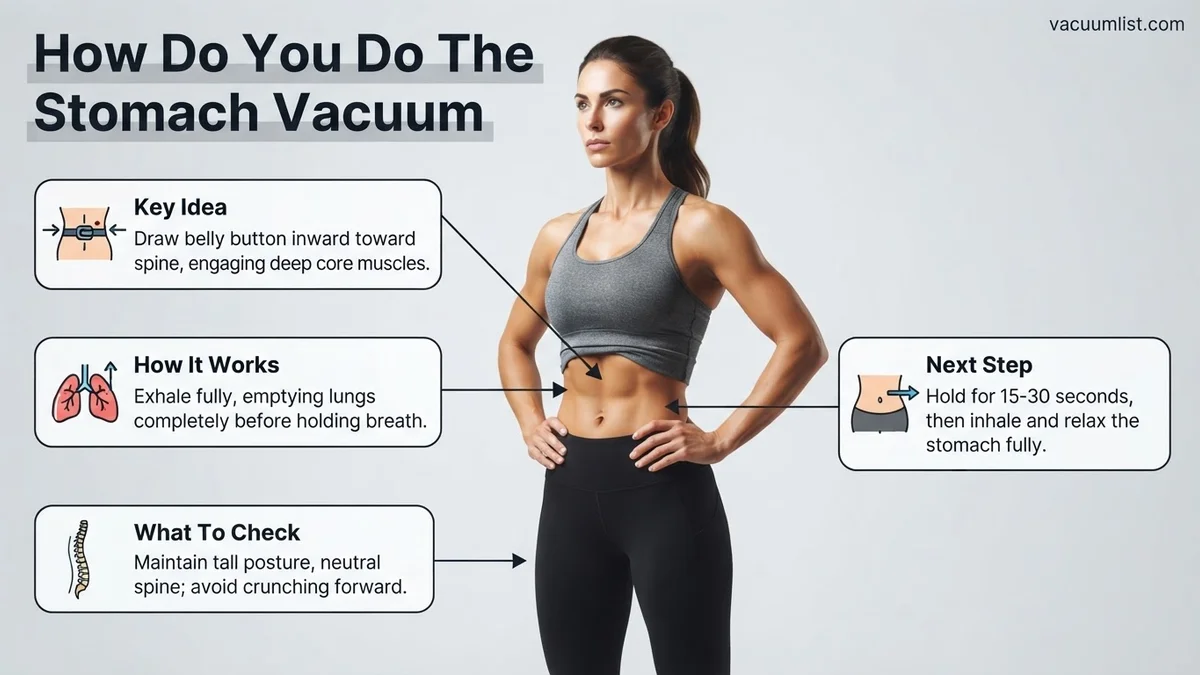
The stomach vacuum is a powerful hypopressive exercise designed to target the transverse abdominis. Proper execution requires completely exhaling all air, drawing the belly button toward the spine, and holding the breath safely. Consistency and correct posture are essential for seeing real improvements in core stability.
The stomach vacuum is a powerful isometric exercise designed to target the deepest layer of your abdominal wall: the transverse abdominis. By mastering the precise exhalation and breath-holding technique required to pull your navel toward your spine, you can dramatically improve your core stability and shrink your waistline.
As fitness trends shift in 2026, more people are prioritizing functional core strength over endless crunches. Performing this movement correctly requires zero equipment, but it demands strict attention to your breathing mechanics and body positioning to yield real results.
Key Takeaways
- Perform the stomach vacuum on an empty stomach, ideally first thing in the morning.
- Exhale all air completely from the lungs before attempting to draw the abdomen in.
- Pull your navel up and under your ribcage as far as comfortably possible.
- Beginners should start with holds of 10 to 15 seconds, gradually increasing duration.
- Avoid this exercise if you are pregnant, have high blood pressure, or experience abdominal pain.
What Causes Transverse Abdominis Weakness and Midsection Laxity
The Impact of Sedentary Posture
When you spend hours sitting at a desk, your deep core muscles essentially go to sleep. Slouching forces your pelvis into a posterior tilt, which weakens the transverse abdominis and allows your internal organs to push outward against a relaxed abdominal wall. This postural habit creates a protruding lower belly, even if you carry a low overall body fat percentage. Activating these deep stabilizers is the only way to reverse this structural laxity.
Shallow Breathing Habits
Most modern adults rely exclusively on chest breathing rather than diaphragmatic expansion. This shallow breathing pattern bypasses the internal pressure regulation system that naturally engages your core. Without proper engagement, the muscles wrap around your torso atrophy from disuse. By retraining your body to coordinate breath with muscular contraction, you restore the natural girdle effect of your deep abdominal sheath.
- Chronic slouching deactivates deep stabilizing tissue.
- Chest-only breathing prevents natural core activation.
- Organ displacement occurs when muscular tension drops.
Master the Stomach Vacuum in 6 Simple Steps
Welcome to your definitive walkthrough for performing the stomach vacuum, an isometric abdominal exercise designed to target the transverse abdominis—the deep inner core muscle acting as your body’s natural corset. Whether you want to improve your posture, enhance core stability, or achieve a tighter waistline, mastering this technique is essential. This guide will walk you through the precise mechanics of breathing, positioning, and execution to ensure you get maximum results safely and effectively.
Step 1: Choose the Right Starting Position
What you need: A comfortable, quiet space with a flat floor, and ideally a mirror so you can monitor your body alignment and abdominal movement.
Instructions: For beginners, the most effective position is on your hands and knees in a tabletop stance. Place your wrists directly under your shoulders and your knees hip-width apart under your hips. Keep your spine in a neutral position, meaning you should not be excessively arching or rounding your back. Relax your neck by looking down at the floor slightly ahead of your hands. This position utilizes gravity to help your internal organs drop forward away from the spine, making it significantly easier to pull your abdominal wall inward during the vacuum phase.
Pro Tip: Avoid practicing this exercise while standing until you have fully mastered the movement on the floor, as gravity makes the standing variation much harder to coordinate initially.
Step 2: Master the Complete Exhalation
What you need: Control of your diaphragm and lungs, requiring no special equipment other than your own focus.
Instructions: Begin by taking a slow, deep breath in through your nose, filling your lungs with air while allowing your belly to expand naturally. Next, open your mouth and push every single drop of air out of your lungs forcefully. You want your lungs to feel completely empty. To ensure you have expelled all residual air, actively contract your chest and ribcage downward at the very end of the exhale. An empty lung cavity is the absolute prerequisite for creating the negative intra-abdominal pressure necessary to perform a successful stomach vacuum.
Pro Tip: Do not attempt to suck in your stomach while you still have air in your lungs; the vacuum relies entirely on a vacuum-sealed, airless chest cavity.
Step 3: Draw the Navel In and Up
What you need: Mind-muscle connection to your deep transverse abdominis muscles rather than your superficial rectus abdominis (“six-pack” muscles).
Instructions: With your lungs completely empty and your breath held, imagine you are trying to pull your belly button backward toward your spine and simultaneously upward underneath your ribcage. Think of cinching a tight belt or trying to squeeze into a pair of pants that are two sizes too small. Your stomach should hollow out dramatically, creating a distinct cavity underneath your ribs. Keep your outer abdominal muscles as relaxed as possible—the movement should feel deep inside your core, not like you are simply flexing your abs.
Pro Tip: If your ribs do not flare slightly or if your chest feels restricted, you are likely using the wrong muscles; focus strictly on the vacuum sensation.
Step 4: Hold the Vacuum Position
What you need: A digital timer or a clock with a second hand to accurately track your holds without guessing.
Instructions: Once you have successfully drawn your stomach inward, hold this isometric contraction. For your first few attempts, aim for a modest hold of 10 to 15 seconds. As your core strength and neuromuscular control improve over the coming weeks, gradually increase your hold duration to 20, 30, or even 50 seconds. During the hold, continue to avoid taking any breaths, but do not panic; if you feel lightheaded, release the contraction immediately. Keep your body completely still and maintain your tabletop posture throughout the duration of the hold.
Pro Tip: Never hold your breath to the point of extreme dizziness. Quality of contraction is much more important than the length of time you can endure.
Step 5: Release and Recover Properly
What you need: Controlled breathing rhythm and a brief recovery period between repetitions.
Instructions: When your hold time is complete, release the stomach vacuum smoothly. Allow your abdominal wall to push back out to its normal resting position as you take a controlled, gentle inhalation through your nose. Do not gasp for air; instead, transition smoothly back to normal breathing. Take at least 30 to 60 seconds of normal, relaxed breathing to fully recover your oxygen levels before attempting your next repetition. Doing these too close together without proper oxygen recovery will lead to early fatigue and dizziness.
Pro Tip: Take deep, calming breaths between sets to normalize your heart rate and ensure your nervous system is fully prepared for the next round.
Step 6: Complete Your Repetition Protocol
What you need: Consistency and a commitment to performing the routine 3 to 4 times per week for optimal physical results.
Instructions: Perform a total of 3 to 5 successful holds (repetitions) per session. As you progress past the beginner stage, you can explore advanced variations such as performing the vacuum while seated in a chair, kneeling upright, or standing completely upright against a wall. Consistency is far more crucial than frequency or duration; doing this a few times a week yields much better results than doing a massive session once a month. Track your progress weekly by noting how many seconds you can comfortably hold the vacuum without breaking form.
Pro Tip: Always perform this exercise on an empty stomach—first thing in the morning before breakfast is the absolute best time to practice.
✅ Final Checklist
- Practiced on an empty stomach to ensure maximum core contraction and comfort
- Exhaled 100% of the air from the lungs before initiating the inward pull
- Engaged the deep transverse abdominis rather than flexing superficial abs
- Maintained proper postural alignment in the tabletop or chosen starting position
- Allowed adequate rest time between each of the 3 to 5 holds
Important Notes:
- Do not practice stomach vacuums if you are pregnant, have untreated high blood pressure, or suffer from any cardiovascular or gastrointestinal disorders without consulting a medical professional.
- Stop immediately if you experience sharp pain, severe lightheadedness, or shortness of breath.
- Estimated cost: $0 (requires no equipment), and time commitment is approximately 5 minutes per session.
How to Fix It with Proper Posture and Breathing Mechanics
Mastering the All-Fours Setup
If you are a beginner in 2026, starting on your hands and knees is the most effective way to fight gravity. Begin by placing your hands directly under your shoulders and your knees under your hips with a neutral spine. Inhale deeply through your nose, letting your belly expand naturally. Then, exhale every last drop of air from your lungs through your mouth while drawing your stomach up and in toward your spine.
Transitioning to Standing and Seated Positions
Once you master the movement on all fours, you can progress to upright postures. Stand tall with your feet shoulder-width apart and place your hands slightly above your knees, or sit upright on the edge of a sturdy chair. Hinge your torso forward slightly to reduce pressure on your internal organs. Exhale completely, flatten your ribcage, and imagine trying to touch your navel to your lower back without taking another breath.
- Keep your spine neutral to avoid lower back strain.
- Exhale 100 percent of your lung capacity before pulling in.
- Hold the vacuum position for 10 to 15 seconds initially.
Step-by-Step Instructions to Perform the Stomach Vacuum
Mastering the vacuum exercise requires precise coordination of breath and core engagement. Fitness experts and physical therapists recommend practicing this movement on an empty stomach to achieve maximum diaphragmatic excursion. Follow these step-by-step instructions to execute the standard standing variation safely in 2026.
The Four-Step Execution Process
- Assume the starting position: Stand tall with your feet shoulder-width apart. Alternatively, place your hands and knees on a mat if you are a beginner. Bend your torso slightly forward and place your hands firmly on your thighs.
- Perform a complete exhale: Take a deep breath in through your nose, expanding your ribcage. Then, exhale all the air forcefully through your mouth until your lungs feel entirely empty.
- Draw the abdomen inward: Without inhaling any air, pull your stomach in as deeply as possible. Imagine trying to touch your belly button to your spine, then draw your abdominal wall upward underneath your ribcage.
- Hold and release: Maintain this hollowed-out position for 15 to 20 seconds while taking shallow breaths if necessary. Release the contraction slowly, take a normal breath, and rest for 30 seconds before repeating for a total of 3 to 5 sets.
What If It Still Doesn’t Work and Troubleshooting Common Form Errors
If you cannot achieve the hollowed-out look or feel a cramping sensation in your abdomen, minor form adjustments are usually required. Common mistakes prevent the transverse abdominis from activating correctly during the maneuver.
- Switch to a supine position: Lie flat on your back with your knees bent and feet flat on the floor. Gravity assists the abdominal organs in falling backward, making it easier to isolate the transverse abdominis when starting out.
- Check for residual air: Ensure you are expelling 100 percent of your lung capacity. Even a small amount of trapped air in the diaphragm prevents the stomach from drawing upward under the ribs.
- Consult a pelvic floor physical therapist: If persistent abdominal pain or pelvic discomfort occurs, stop the exercise immediately. A specialized physical therapy consultation typically costs between $150 and $250 per session and ensures no underlying diastasis recti or hernia issues are present.
Conclusion
The stomach vacuum remains a powerful technique for strengthening the transverse abdominis and improving core stability when executed with precise breathing control. Consistency and proper form correction solve most initial execution hurdles. According to verified research and expert sources, integrating this movement into your weekly routine 2 to 3 times yields optimal postural and structural benefits by 2026. Your next step is to practice the four-step sequence for three sets on an empty stomach tomorrow morning.
❓ Frequently Asked Questions
How do you do the stomach vacuum while standing up?
Stand upright with hands on your hips or a table, take a deep breath in, exhale all air forcefully, and pull your stomach in and up. Hold the position without breathing for 15 seconds before releasing.
Can I do stomach vacuums every day?
Yes, you can practice this exercise daily since it primarily engages slow-twitch muscle fibers responsible for core posture. Start with 3 sets of 3 to 5 reps and increase as your endurance improves.
Why is my stomach pushing out instead of pulling in during the vacuum?
This usually happens when you fail to exhale all the air from your lungs or if you mistakenly engage the rectus abdominis. Ensure your lungs are completely empty before drawing the navel inward.
What is the difference between crunches and stomach vacuums?
Crunches target the outer superficial abdominal muscles (rectus abdominis) and involve spinal flexion. Stomach vacuums target the deep transverse abdominis without moving the spine.
Do stomach vacuums help with back pain?
By strengthening the deep core stabilizers that support the lumbar spine, regular practice can improve overall core support and reduce certain types of lower back discomfort.
What starting position is best for absolute beginners?
The all-fours (tabletop) position on your hands and knees is ideal for beginners because gravity helps pull the abdominal contents away from the spine, making the contraction easier to feel.