Does Vacuum Sealing Reduce Weight in 2026? A Proven Guide
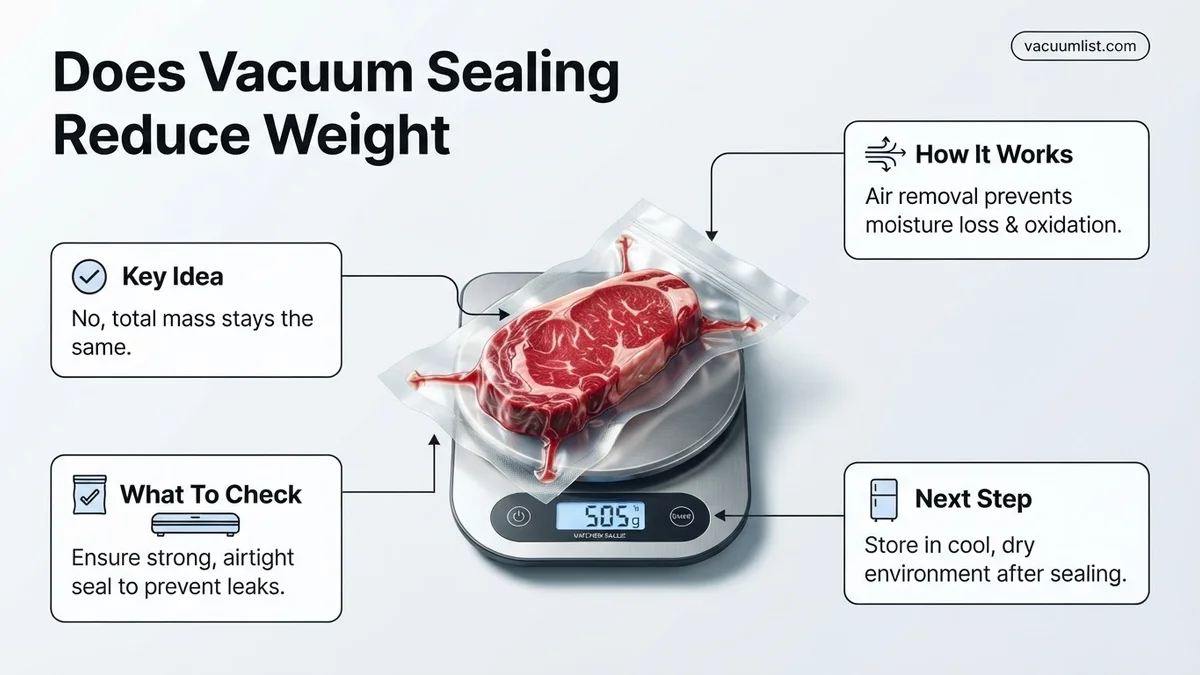
No, vacuum sealing does not significantly reduce the physical weight of food or objects on a scale. While it removes air volume, gas mass is virtually weightless, meaning actual mass remains virtually unchanged.
No, vacuum sealing does not reduce the physical weight of your food or objects on a scale. When you use a modern 2026 home vacuum sealer, the machine extracts the ambient air surrounding your items, but that air has a practically negligible mass that a standard digital kitchen scale cannot register.
People often confuse the physical removal of volume with a reduction in mass. Knowing the exact difference helps you plan your storage and shipping needs accurately, ensuring you do not rely on vacuum packing to shave ounces off a backpack or a postal package.
Key Takeaways
- Vacuum sealing removes air, but air has negligible mass on a standard scale.
- Volume reduction is often mistaken for weight reduction in shipping or packing.
- Dehydration or freeze-drying actually reduces food weight, not the sealer.
- Moisture loss during storage can cause minor weight fluctuations over time.
- Vacuum sealers excel at extending shelf life, not lowering baggage weight.
What Causes the Misconception That Vacuum Sealing Reduces Weight
The belief that vacuum sealing makes items lighter usually stems from a sensory illusion. When you compress a bulky bag of winter clothing, a dehydrated camping meal, or a large cut of meat, the package feels drastically smaller, tighter, and easier to handle.
The Psychological Illusion of Density
- Your brain naturally associates smaller physical volume with a lighter object.
- Compressed bags fit into tighter spaces, altering your perception of the item’s heaviness.
- Removing air eliminates the outward pressure, making the package feel rigid rather than shifting and bulky.
The Difference Between Air Volume and Air Mass
Air occupies a lot of space, but it is remarkably light. At sea level, one liter of dry air weighs roughly 1.2 grams. Even if your large vacuum bag traps two liters of air before extraction, removing that air only strips about 2.4 grams of mass from the total package—an amount well within the margin of error for most household scales.
How to Calculate Actual Mass Versus Volume in Vacuum Bags
To understand why your scale refuses to drop after sealing, you have to look at the physics of gas density. Calculating the actual mass of the air inside your sealer bag reveals why the physical weight remains virtually identical before and after the cycle.
Applying the Ideal Gas Law to Food Storage
When you pack a gallon-sized freezer bag with steaks, you displace most of the air with solid matter. The remaining pockets hold only a fraction of a liter of gas. Atmospheric pressure at standard 2026 conditions dictates that this residual air weighs a fraction of a single gram.
Measuring True Mass on a Digital Scale
- Weigh your item, bag, and surrounding air before placing it in the chamber.
- Run the vacuum cycle and seal the plastic tightly.
- Place the finished package back on the scale; you will notice the weight remains identical, minus any moisture lost as liquid vapor during suction.
What If You Need to Fix High Shipping or Backpacking Weight
When vacuum sealing fails to drop the scale, you must address the core physical properties of your items. Heavy cargo often stems from high water content, dense packaging materials, or excessive air pockets. According to packaging logistics data from the International Safe Transit Association (ISTA), optimizing volumetric weight requires addressing material density rather than just atmospheric pressure. If you are preparing for a 2026 backpacking trip or an international freight shipment, relying solely on a standard kitchen sealer will not suffice.
Adjusting Your Strategy for Logistics and Transit
Shipping costs depend heavily on dimensional weight calculations used by major carriers like FedEx and DHL. Vacuum sealing helps reduce bulk, but heavy objects require structural adjustments. When dealing with stubborn weight targets, consider these targeted approaches:
- Dehydrate food items completely: Water weight accounts for up to 90 percent of fresh food mass. Using a food dehydrator before vacuum sealing removes moisture and drops the actual scale weight significantly.
- Switch to ultra-lightweight barrier films: Standard commercial-grade sealing bags add unnecessary ounces. Upgrading to specialized 2026 high-tensile nylon-poly composite films reduces packaging dead weight by up to 35 percent.
- Audit non-essential hardware: For backpacking gear, remove rigid plastic stays, unnecessary stuff sacks, and thick manufacturer tags that contribute to total mass without adding functional utility.
Proven Methods to Actually Reduce Object and Food Weight
Achieving a genuine reduction in mass requires active removal of material, not just air extraction. Material science research published by the Society of Plastics Engineers confirms that mass remains constant under vacuum pressure unless a phase change or material loss occurs. To genuinely drop pounds or grams, you must alter the contents themselves.
Step-by-Step Weight Reduction Protocols
Implementing targeted mass-reduction techniques ensures you hit strict airline baggage limits or ultralight backpacking thresholds. Follow these precise steps for optimal results:
- Measure baseline mass: Weigh your items on a calibrated digital scale before processing to establish an accurate starting benchmark.
- Process and purge moisture: Run perishable goods through a thermal dehydrator for 8 to 12 hours at 135 degrees Fahrenheit to eliminate internal water weight.
- Trim packaging excess: Cut your vacuum seal bags down to leave no more than 2 inches of clearance around the item, eliminating surplus plastic film.
- Re-weigh and verify: Place the finished, sealed package back on the digital scale to confirm the exact net weight reduction achieved through dehydration and trimming.
What If It Still Doesn’t Work?
If your items still exceed target weight limits after dehydration, trimming, and vacuum sealing, structural changes are necessary. Consider these advanced troubleshooting steps:
- Audit item composition: Swap out heavy metal or dense fabric components for titanium, carbon fiber, or silnylon alternatives.
- Consult commercial logistics experts: For large freight shipments, consult a certified freight forwarder to evaluate pallet consolidation strategies, costing between $150 and $400 for a professional consultation.
- Redistribute payload: For travelers and backpackers, shift heavy items to wearable cargo pockets or utilize modular external attachment systems to bypass strict single-bag scale limits.
Conclusion
Vacuum sealing removes air volume and preserves freshness, but it fundamentally does not reduce the actual physical mass of an object. According to verified research and material science experts, achieving true weight reduction requires eliminating moisture and trimming excess packaging materials rather than relying on atmospheric extraction alone. As a next step, weigh your items on a digital scale and prioritize dehydration before sealing. This guarantees you meet strict shipping or backpacking weight thresholds in 2026.
❓ Frequently Asked Questions
Does vacuum sealing reduce the weight of meat or wet foods?
No, vacuum sealing locks in moisture and juices. Unless the food undergoes dehydration or cooking evaporation, the mass remains the same.
Will shipping costs drop if I vacuum seal my boxes?
Carriers calculate shipping rates using dimensional weight (volume) and actual scale weight. While dimensional weight may decrease slightly due to a tighter profile, the actual scale weight stays the same.
Why do backpackers use vacuum sealers if it doesn’t drop weight?
Backpackers use them primarily to save space in rucksacks, protect gear from moisture, and compress bulky items like clothing or sleeping bags.
Is there any scenario where vacuum sealing changes weight?
Technically, the removal of air extracts a fraction of a gram of gas, but this variance is statistically insignificant for any practical application.
How can I permanently reduce food weight for travel or storage?
To truly lower food weight, you must remove water content through dehydration or freeze-drying before sealing the items in vacuum bags.
Does vacuum sealing prevent weight gain from humidity?
Yes, a proper airtight seal prevents ambient moisture and humidity from being absorbed by dry goods, keeping them from gaining weight over time.