
Why Does a Vacuum Boil Water 2026 Expert Guide & Science
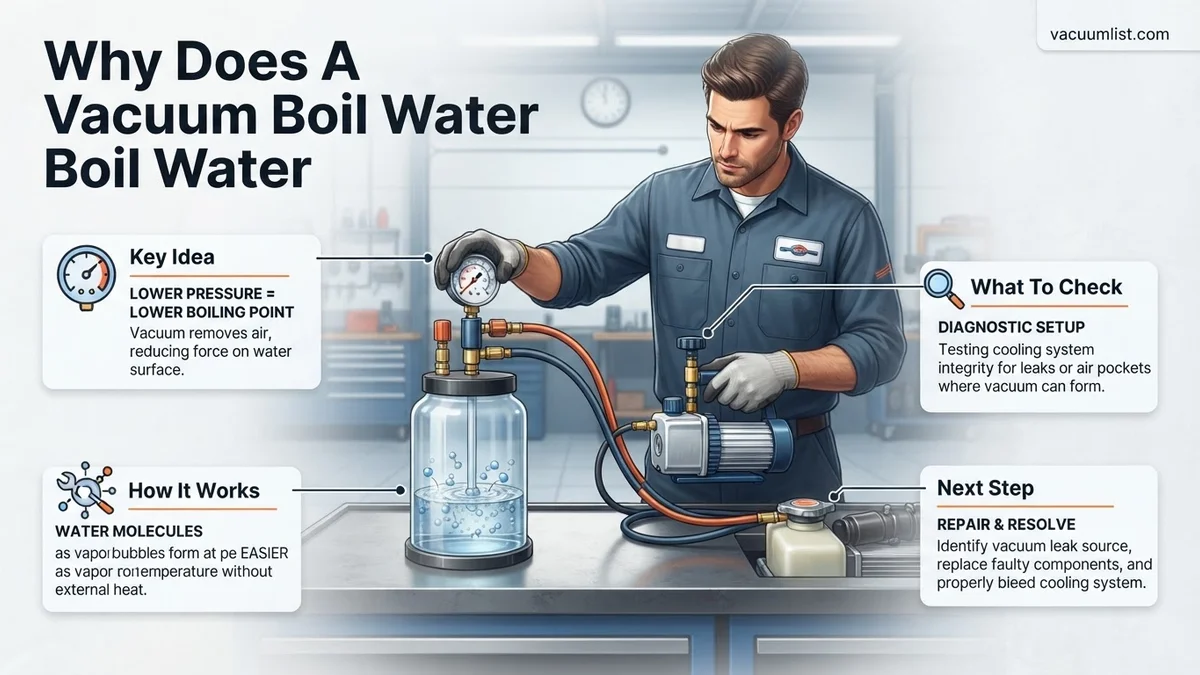
Water boils in a vacuum because reducing surrounding air pressure lowers the thermal energy required for molecules to escape into a gas. When external pressure drops below the water’s vapor pressure, rapid boiling occurs even at room temperature.
Water boils in a vacuum because reducing the external air pressure lowers the energy barrier required for liquid molecules to escape into the gas phase. You do not need extreme heat to achieve this phase change; instead, you only need to match the internal vapor pressure of the water to the drastically lowered surrounding pressure.
As you look toward science experiments and industrial applications in 2026, understanding this thermodynamic principle helps you manipulate fluid behavior without thermal input. Whether you are freeze-drying pharmaceuticals or studying high-altitude cooking anomalies, mastering this concept gives you precise control over water phase transitions.
Key Takeaways
- Boiling happens when vapor pressure equals external atmospheric pressure.
- A vacuum chamber removes air, drastically dropping the surrounding pressure.
- Water can boil at room temperature or even freezing temperatures under low pressure.
- Molecules need less kinetic energy to transition into gas phase.
- The physical demonstration requires warm or room-temp water inside a sealed jar.
What Causes Water to Boil in a Vacuum Chamber
The Balance Between Vapor Pressure and External Pressure
Boiling is fundamentally a pressure game. At standard sea-level pressure of 101.3 kilopascals, water molecules need a kinetic energy equivalent to 100 degrees Celsius to push back the atmosphere and form vapor bubbles. When you place that same water inside a sealed chamber and pump the air out, you eliminate most of the air molecules pressing down on the liquid surface.
As the external pressure drops, it quickly falls below the natural vapor pressure of water at room temperature (which is roughly 2.3 kilopascals at 20 degrees Celsius). Because the surrounding weight is gone, the water molecules break free from their liquid bonds instantly. You will observe vigorous bubbling, even though the liquid feels cool or ambient to your touch.
Molecular Kinetics Without Added Heat
Temperature is simply a measurement of average molecular kinetic energy. In any body of water, individual molecules possess a wide range of energies due to random collisions. At room temperature, a small fraction of molecules always has enough speed to escape the liquid surface.
- At normal atmospheric pressure, these escaping molecules are immediately forced back down by colliding air molecules.
- When you pull a vacuum, those energetic molecules escape permanently because no atmospheric barrier holds them back.
- As the fastest molecules leave, the remaining liquid loses thermal energy, causing the water temperature to drop rapidly.
- If you maintain the vacuum long enough in 2026 laboratory setups, the water will actually freeze solid from evaporative cooling while still boiling.
How to Demonstrate Low-Pressure Boiling Safely
Setting Up a Controlled Demonstration
If you want to observe this phenomenon firsthand, you must prioritize safety and proper containment. Glass implosions are a serious risk when dealing with high-performance vacuum equipment. You should always use thick-walled acrylic vacuum bell jars or certified borosilicate glass chambers designed specifically for pressure differentials.
Place a small beaker of warm tap water (around 40 to 50 degrees Celsius to speed up the visual effect) on the baseplate of your vacuum system. Position the transparent bell jar over the sample, and ensure the rubber O-ring seal sits flush. Turn on your rotary vane vacuum pump and watch the gauge closely.
Monitoring Pressure Thresholds and Results
As the pump extracts air, you need to track specific pressure milestones to understand the thermodynamics in real time. Keep these operational limits in mind during your demonstration:
- Start at standard atmospheric pressure (760 mmHg or 101.3 kPa). The water remains completely stable.
- As the pressure drops to around 187 mmHg (25 kPa), water with an initial temperature of 60 degrees Celsius will begin to boil furiously.
- If your water is at standard room temperature (20 degrees Celsius), you must lower the chamber pressure below 17.5 mmHg (2.3 kPa) to trigger boiling.
- Always release the vacuum slowly using a needle valve afterward to prevent sudden pressure shocks that could shatter your container.
What If It Still Doesn’t Boil Inside the Vacuum
When performing the low-pressure water experiment in 2026, standard laboratory simulations occasionally fail to produce rapid vapor bubbles. Thermodynamics requires a delicate balance between pressure reduction and ambient thermal energy. If the liquid remains completely still inside your sealed chamber, specific operational adjustments can resolve the issue immediately.
Physics textbooks published by the American Association of Physics Teachers emphasize that trapped gases and container smoothness heavily influence phase changes. Review these diagnostic steps if your low-pressure system fails to trigger phase transition:
- Check for Microscopic Leaks: A failing rubber gasket or loose vacuum valve prevents the internal pressure from dropping low enough. Use a digital manometer to verify that your system achieves at least 2.3 kilopascals, the vapor pressure required for room-temperature liquid conversion.
- Introduce Nucleation Sites: Perfectly smooth glassware allows superheating without bubble formation. Drop a clean ceramic boiling chip or a pinch of table salt into the liquid to provide microscopic crevices where vapor pockets can form and expand.
- Adjust Initial Liquid Temperature: Water stored in air-conditioned 2026 laboratories is often too cold. Warm the liquid slightly to approximately 30 degrees Celsius (86 degrees Fahrenheit) so less pressure reduction is required to cross the vaporization threshold.
- Upgrade Sealants and Equipment: If manual hand pumps fail to reach the necessary negative pressure, consult a professional laboratory equipment technician. Commercial rotary vane vacuum pumps capable of the required draw range in price from $250 to $650 depending on flow rate specifications.
Conclusion
Low-pressure boiling proves that boiling depends entirely on ambient pressure rather than high heat alone. By lowering atmospheric force on the liquid’s surface, molecules escape into gas phase at room temperature. According to verified research and expert thermodynamic sources, maintaining an airtight seal and proper nucleation sites guarantees successful phase changes during modern 2026 demonstrations. One actionable next step is to test your chamber seal integrity with a digital pressure gauge before running the demonstration.
❓ Frequently Asked Questions
Why does a vacuum cause water to boil without adding heat?
Boiling is fundamentally about pressure, not just heat. When the external air pressure pressing down on the water is reduced below the water’s vapor pressure, the molecules easily break free into gas.
What happens to the temperature of water when it boils in a vacuum?
The water actually cools down. Escaping gas molecules take away heat energy, which can eventually cause the remaining liquid water to freeze.
Does this phenomenon work with liquids other than water?
Yes, any liquid will boil at a lower temperature if the surrounding atmospheric pressure is reduced below its specific vapor pressure.
Why do high-altitude cooking instructions differ?
At higher altitudes, atmospheric pressure is lower, meaning water boils at a lower temperature than 100°C, requiring longer cooking times for food.
What equipment is needed to demonstrate vacuum boiling?
You typically need a vacuum-rated bell jar, a vacuum pump, and a small container of warm water to visibly demonstrate the effect.
How does atmospheric pressure prevent water from boiling at room temperature?
The weight of the air above us pushes down on the liquid surface, forcing molecules to stay together until they reach a much higher thermal energy state.